
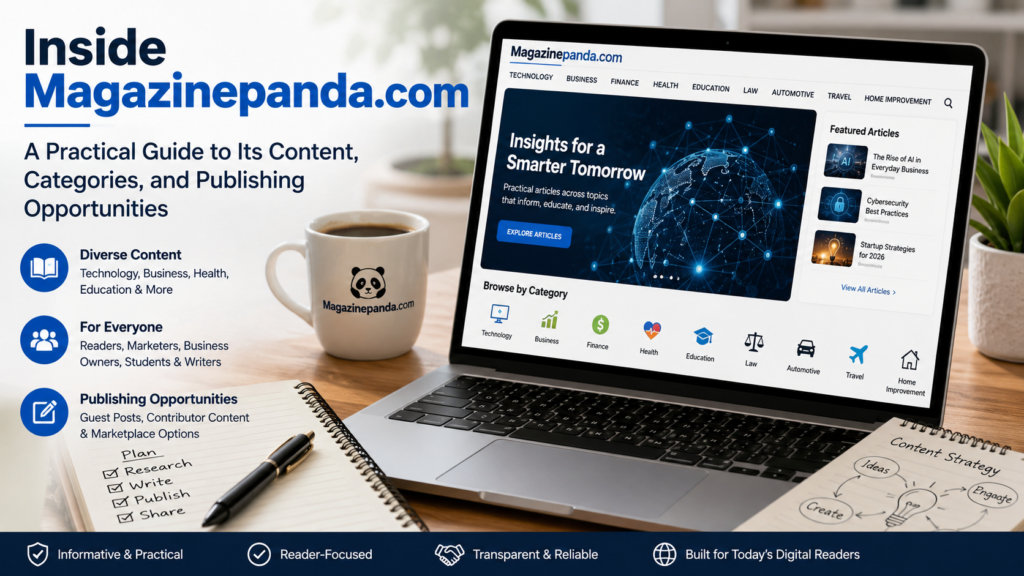
Online readers rarely follow a single path when researching a subject. A business owner may begin with search engine optimization, move to cybersecurity, and later read about personal finance or workplace wellness. Magazinepanda.com apears to serve this type of varied browsing behavior by publishing magazine-style articles across professional, technical, and everyday-interest categories.
According to the platform’s website, its coverage includes Technology, Business, Finance, Health, Education, Law, Automotive, Travel, and Home Improvement. Individual articles may also address artificial intelligence, cloud computing, cybersecurity, startup development, digital marketing, lifestyle, wellness, and entertainment.
This broad editorial approach reflects the continuing importance of digital publishing. Pew Research Center reports that roughly 93% of U.S. adults get at least some news online through mobile or desktop devices. Although Magazinepanda.com is better described as a general content platform than a traditional newsroom, the statistic illustrates the large audience that now discovers information through websites and other digital channels.
Magazinepanda.com may therefore interest general readers, marketers, business owners, students, and prospective contributors. Its value, however, depends on the purpose of each visit. Readers should evaluate individual articles for accuracy and relevance, while writers considering publication should examine the site’s current submission terms, editorial policies, and commercial arrangements before proceeding.
Understand What Magazinepanda.com Is
Magazinepanda.com presents itself as an online magazine and multi-category publishing platform. Rather than concentrating on a single industry, it appears to organize articles around several areas of professional knowledge, consumer interest, and practical decision-making.
The platform’s structure resembles that of a general digital magazine. Readers can explore subjects by category, discover individual articles through search engines, and move between related topics using internal links and site navigation. This format may suit visitors who prefer broad topic discovery instead of relying exclusively on highly specialized publications.
Its coverage appears to include both evergreen and trend-led material. Evergreen articles may remain relevant for longer periods because they address recurring questions, such as improving a home, planning a marketing strategy, or understanding a common technology. Trend-focused articles may examine newer developments involving AI tools, cybersecurity risks, cloud services, social platforms, or changing business practices.
Magazinepanda.com also includes standard informational and policy pages. According to the website description provided, these include About, Disclaimer, DMCA Policy, Privacy Policy, and Terms and Conditions pages. Such documents may help visitors understand how the platform describes its operations, copyright process, data practices, and limits of responsibility.
Their presence should not be treated as automatic evidence that every article has been independently verified or professionally reviewed. Readers still need to examine the wording of the policies and assess each article on its own merits.
Identify the Platform’s Likely Readers
The range of topics suggests that Magazinepanda.com may serve several overlapping audiences. Technology readers may arrive through content about AI, software, cloud computing, or digital security. Entrepreneurs may be interested in startup planning, business development, customer acquisition, and marketing.
Students and educators may browse articles connected with learning, career development, academic skills, or educational technology. Consumers may visit for information about health, travel, vehicles, household projects, and lifestyle decisions.
Digital marketers and content creators represent another likely audience. Because the website appears to publish material about SEO, content marketing, social media, and online promotion, it may offer introductory explanations and practical ideas for people building an online presence.
The site may also attract writers, agencies, brands, and publishers because it features a page titled “Guest Post Marketplace 2026.” That page suggests that contributed content or arranged publishing opportunities are part of the platform’s current offering. Prospective contributors should confirm the exact process directly, since requirements, fees, and editorial terms can change.
Assess the Publishing Style
Articles on a general-interest platform can differ substantially in purpose and depth. Some may explain a subject for beginners, while others may focus on a product, trend, strategy, or commercial service. Readers should therefore look beyond the headline before deciding whether an article meets their needs.
A useful assessment begins with the publication date, author information, supporting sources, and scope of the discussion. An article explaining a broad concept may not need the same level of technical detail as professional documentation, but it should still distinguish evidence from opinion.
Readers should also consider whether a page appears educational, promotional, sponsored, or contributor-written. These formats are not necessarily incompatible with useful information, but transparency helps readers understand the motivation behind the content.
Explore the Content Categories and Topics Covered
Magazinepanda.com appears to use a broad category model rather than a narrowly defined editorial niche. Its stated coverage connects technology and business with personal interests such as health, education, travel, automotive topics, and home improvement.
This variety may make the site useful for discovery. A reader who enters through a digital marketing article may encounter related material about startups, business software, cybersecurity, or content production. Someone researching a household project may move from home improvement to smart technology or personal finance.
The breadth also creates an important limitation. Expertise in one field does not automatically establish authority in another. A well-supported article about social media strategy does not confirm that every health or legal article follows the same editorial process.
Readers should judge the strength of each page according to its subject, evidence, author background, and potential consequences.
Review Technology, AI, and Cybersecurity Content
Technology appears to be one of the platform’s prominent subject areas. Relevant articles may cover artificial intelligence, software applications, computing devices, cloud systems, automation, cybersecurity, and digital workplace tools.
AI content may examine how automated systems affect business operations, marketing, customer service, education, automotive sales, or content creation. Because artificial intelligence changes rapidly, readers should check when an article was published and whether the tools, features, and policies it describes remain current.
Cybersecurity articles may address device protection, endpoint security, remote work, account access, phishing, malware, data privacy, or organizational risk. These topics can provide a useful introduction, but implementing security controls usually requires current vendor documentation and advice suited to the organization’s systems.
Cloud computing material may discuss online storage, hosted applications, remote collaboration, scalability, and business continuity. Readers comparing services should confirm pricing, technical limits, regional availability, and security features through the provider’s official documentation.
Technical accuracy matters because outdated instructions can create more than a minor inconvenience. A software interface may change, a security feature may be renamed, or a previously recommended configuration may no longer follow current practice.
Examine Business and Startup Coverage
Business content may appeal to entrepreneurs, managers, freelancers, and people exploring new commercial ideas. Topics could include startup development, branding, operations, funding, productivity, customer acquisition, and market positioning.
For early-stage founders, general articles may help organize questions before developing a business plan. A guide could introduce subjects such as target audiences, value propositions, pricing, digital operations, or customer communication. It should not, however, replace financial modeling, legal review, or direct market research.
Established businesses may find articles related to workflow improvement, technology adoption, online visibility, or team management. The usefulness of such content will depend on whether the advice matches the size, industry, location, and resources of the business.
Financial claims require particular care. Revenue expectations, investment returns, funding availability, and operating costs differ widely. Readers should avoid treating broad business guidance as a forecast for a specific company.
Evaluate Finance Articles Carefully
Magazinepanda.com’s stated Finance category may cover personal money management, business finance, borrowing, insurance, investments, taxation, or economic topics. These subjects can help readers identify relevant terms and questions, but they also carry significant personal and commercial consequences.
A finance article should be read as general information unless it clearly states otherwise and comes from an appropriately qualified source. Individual circumstances may change the suitability of a loan, investment, tax strategy, or insurance product.
Readers should check whether financial figures have dates, whether regulations apply to their country or state, and whether claims link to official sources. Interest rates, tax thresholds, fees, and product conditions can change quickly.
When a decision involves substantial money or long-term obligations, confirmation from a regulated adviser, accountant, lender, insurer, or government authority may be necessary.
Explore Digital Marketing Coverage
Digital marketing appears to connect several of Magazinepanda.com’s subject areas. Relevant content may address SEO, content marketing, social media, branding, lead generation, online advertising, analytics, and audience development.
SEO articles may introduce search intent, keyword selection, page structure, internal linking, technical performance, and content usefulness. These concepts can help website owners understand how pages are discovered, but no article or publishing placement can guarantee a search ranking.
Content marketing coverage may focus on editorial planning, brand voice, topic selection, distribution, and measuring audience response. Social media articles may discuss platform selection, posting formats, engagement, community management, and campaign planning.
Industry observers note that digital marketing guidance is most useful when it connects tactics with a defined audience and a measurable business objective. Publishing more content is not automatically an effective strategy if the material lacks relevance, evidence, or a clear purpose.
Readers should also check publication dates because search systems, advertising tools, analytics platforms, and social networks regularly change their features and policies.
Consider Health, Wellness, and Lifestyle Material
Health and wellness content may include fitness, nutrition, self-care, mental well-being, personal habits, or general lifestyle improvement. Such articles may offer accessible background information, but the level of caution should match the seriousness of the subject.
Advice concerning symptoms, diagnoses, medication, treatment, supplements, or disease prevention should be checked against qualified medical sources. Personal health decisions depend on factors that a general article cannot evaluate, including medical history, age, allergies, existing conditions, and other treatments.
Lifestyle articles generally involve lower-risk subjects, such as routines, entertainment, organization, hobbies, or personal development. Even so, readers should distinguish personal opinions from evidence-based recommendations.
Product-centered wellness content deserves additional scrutiny. Visitors may wish to determine whether the article contains affiliate links, sponsorship, or promotional language before acting on a recommendation.
Read Education and Law Articles With the Right Expectations
Education content may address study methods, online learning, classroom technology, career development, training, admissions, or professional qualifications. These articles may help readers understand a process or prepare questions for an institution.
Official requirements should always be confirmed through the relevant school, university, examination body, accrediting organization, or government agency. Admission dates, fees, eligibility criteria, and course rules can change.
Legal content requires even greater attention to jurisdiction. A rule that applies in one country or state may not apply elsewhere. Laws, court procedures, filing deadlines, and contractual rights also change over time.
Readers should check whether a legal article identifies the applicable location, cites current law, and separates general information from advice about an individual case. Anyone facing a dispute, deadline, investigation, or legal obligation should consider consulting a licensed professional.
Browse Automotive, Travel, and Home Improvement Topics
Automotive content may include vehicle technology, ownership, maintenance, buying decisions, dealership operations, safety, and industry developments. Articles discussing AI in automotive sales, for example, may connect the category with business technology and customer management.
Vehicle specifications, repair procedures, recall information, and safety advice should be verified through manufacturers, qualified mechanics, or official transportation authorities. A general article may help frame the issue but cannot inspect a particular vehicle.
Travel content may cover destinations, accommodation, transportation, itineraries, activities, and planning advice. Because entry requirements, prices, safety conditions, and schedules can change, readers should confirm time-sensitive details through official sources before booking.
Home improvement articles may address renovation, storage, decorating, smart-home products, soundproofing, painting, or outdoor spaces. These topics can provide ideas and planning guidance, but structural, electrical, gas, plumbing, and permit-related work may require trained contractors and local approval.
Evaluate the Guest Posting and Digital Marketing Angle
The “Guest Post Marketplace 2026” page suggests that Magazinepanda.com appears to support some form of outside publishing or content-placement service. This feature may attract independent writers, agencies, consultants, brands, and companies seeking visibility on a third-party website.
Guest posting can have several purposes. A professional may contribute an educational article to explain a subject within their field. A company may use contributed content to present an informed perspective. A writer may seek publication experience or a portfolio example.
Commercial guest posting may also be connected with brand awareness, referral traffic, or SEO. These outcomes should not be assumed. Results depend on the relevance of the publication, the usefulness of the article, audience interest, link treatment, search indexing, competition, and the contributor’s broader marketing strategy.
A single placement cannot guarantee rankings, leads, sales, credibility, or sustained website traffic.
Confirm the Current Submission Process
Prospective contributors should examine the latest marketplace page before preparing an article or making a payment. The page may explain accepted categories, content standards, pricing, turnaround expectations, and link rules.
Important details include whether submissions must be original, how many revisions are permitted, and whether the platform reserves the right to edit titles, links, formatting, or body text. Writers may also want to confirm whether articles receive a named byline or are published under a general account.
The publication timeline should be clear. Contributors should understand whether a quoted date represents review, acceptance, or live publication. They should also ask what happens when an article does not meet editorial requirements.
Where fees apply, terms should identify the total cost, payment method, refund policy, and conditions under which a page may later be removed or updated.
Review Authorship, Links, and Disclosures
Authorship affects how readers interpret contributed content. A visible name and biography may help establish the writer’s background, while anonymous or brand-written articles may provide less information about the source.
Contributors should ask what links are permitted, where those links may appear, and whether their technical attributes can change. Search engines distinguish between editorial references and links created through paid or promotional arrangements.
Commercial relationships may also require disclosure. A paid placement should not be presented in a way that misleads readers into believing it is fully independent editorial coverage.
Writers should ensure that claims are accurate, images are licensed, and quotations are properly sourced. Publishing through a marketplace does not transfer responsibility for copyright compliance or truthful advertising.
Match the Article to the Audience
A relevant contribution should connect the writer’s knowledge with a subject that Magazinepanda.com’s readers are likely to find useful. A cybersecurity professional might explain remote-access risks. A marketer could discuss content planning. A contractor might cover renovation preparation or seasonal maintenance.
The article should offer more than brand promotion. Excessive links, repetitive company references, unsupported claims, and sales-heavy language can weaken reader trust.
Reviewing recent content may help contributors understand the site’s preferred headline style, article length, paragraph structure, and level of detail. It may also reveal topics that have already been covered extensively.
A strong pitch identifies a specific reader problem and explains how the proposed article will address it without exaggerating results.
Review Things to Consider Before Using It
Readers and contributors should approach Magazinepanda.com as they would any broad online content platform. The website may be useful for discovering ideas and learning basic concepts, but the reliability and depth of individual pages may vary.
Start with the author, publication date, and evidence. A recent article with clear sources may be more useful for a changing subject than an undated page with broad claims. An author biography can provide background, although it should not replace an assessment of the actual content.
Look for links to primary materials, especially when an article discusses research, regulations, technical specifications, or market data. Statements that sound precise should be traceable to a credible source.
The language also matters. Articles that promise guaranteed income, instant rankings, effortless health improvements, or universally successful strategies deserve careful scrutiny.
Verify High-Stakes Guidance Independently
Health, finance, law, cybersecurity, and major purchasing decisions require more verification than general lifestyle reading. A magazine article can identify considerations, but it cannot account for every reader’s circumstances.
Medical guidance should be checked with qualified healthcare providers and recognized health authorities. Legal information should be confirmed through current legislation, official agencies, courts, or licensed lawyers.
Financial decisions may require an accountant, regulated adviser, lender, insurer, or tax authority. Technical security decisions should be checked against current vendor documentation and professional guidance.
Independent verification does not mean that general articles have no value. It places them in the appropriate role: a starting point for research rather than the final authority.
Read the Privacy and Legal Pages
Before creating an account, submitting personal information, contacting the publisher, or purchasing a service, users should review Magazinepanda.com’s Privacy Policy and Terms and Conditions.
The privacy page may explain the use of cookies, analytics tools, contact forms, advertising systems, or third-party services. Users should read the actual policy rather than assuming how their data is handled.
The Disclaimer may describe limits on responsibility for informational content. The DMCA Policy may outline a process for reporting material believed to infringe copyright.
Contributors should pay particular attention to ownership terms. They may need to determine whether they retain copyright, grant the platform a publishing license, or permit future edits and redistribution.
Separate Editorial Content From Promotion
Multi-category websites may publish staff-written articles, contributed posts, sponsored pages, and commercially arranged content. Readers benefit when those formats are labeled clearly.
A positive review or recommendation should be considered alongside any disclosed financial relationship. Visitors may also examine whether an article links repeatedly to a particular brand or service.
Prospective contributors should not assume that payment guarantees permanent publication or business results. They should request written terms and retain records of the agreed service.
Transparency protects both sides. Readers can judge the content with fuller information, while publishers and contributors reduce the risk of misleading presentation.
Compare Magazinepanda.com With Other Publishing Formats
The following table summarizes broad differences between Magazinepanda.com and several common online publishing formats. The descriptions are general and should not be interpreted as guarantees about every website within a category.
| Consideration | Magazinepanda.com | Specialist Industry Blog | Traditional News Website | Guest-Post Marketplace |
|---|---|---|---|---|
| Main format | Multi-category online magazine | Publication focused on one field | Reporting-led digital newsroom | Service connecting contributors with publishing options |
| Topic coverage | Appears to span technology, business, finance, health, education, law, automotive, travel, and home topics | Usually limited to a defined profession or industry | Broad news sections or a specific geographic market | Depends on the available publications |
| Typical purpose | Topic discovery, practical reading, and general information | Detailed analysis or specialist education | Current events, reporting, and public-interest information | Content placement, outreach, or brand publishing |
| Contributor access | Appears to include a Guest Post Marketplace 2026 page | May accept selected expert submissions | Usually managed by professional editors | Often designed for contributed or paid placements |
| Likely depth | May vary significantly by category and author | Often deeper within its core subject | Varies by newsroom, desk, and story | Depends on the publisher and submission |
| Content lifespan | Mix of evergreen and trend-related articles | Often evergreen, technical, or analytical | Frequently time-sensitive | Determined by the submitted article |
| Potential strength | Broad range of subjects in one location | Concentrated subject knowledge | Reporting processes and timely coverage | Access to multiple publishing opportunities |
| Main consideration | Each page requires an individual credibility check | Narrow focus may omit wider perspectives | Rapid publication can limit explanatory depth | Quality, disclosure, and link policies may vary |
Magazinepanda.com appears to sit between a general online magazine and a contributor-friendly publishing platform. Its range is broader than that of a specialist blog, while its stated guest-post marketplace adds a commercial publishing element that is not always present on conventional editorial sites.
The most suitable format depends on the reader’s goal. A specialist publication may be preferable for technical depth, while a newsroom may be better for breaking developments. Magazinepanda.com may be useful when broad exploration or cross-category browsing is the priority.
Answer Common Questions About Magazinepanda.com
Is Magazinepanda.com an online magazine?
Magazinepanda.com appears to operate as a multi-category online magazine or content platform. According to its website, it publishes articles across technology, business, finance, health, education, law, automotive, travel, home improvement, and related subjects.
What topics does Magazinepanda.com cover?
The platform states that its content includes topics such as artificial intelligence, cybersecurity, cloud computing, startup development, SEO, content marketing, social media, health and wellness, lifestyle, entertainment, travel, and household projects. Coverage may change as new articles are added.
Does Magazinepanda.com accept guest posts?
The site appears to offer publishing opportunities through a page titled “Guest Post Marketplace 2026.” Writers and businesses should review the current page for submission rules, costs, link policies, editorial requirements, and publication terms.
Can readers rely on Magazinepanda.com for professional advice?
The platform may provide general information and useful starting points, but readers should independently verify medical, legal, financial, and technical guidance. The appropriate source may include a licensed professional, government agency, academic institution, or current official documentation.
Will a guest post on Magazinepanda.com improve SEO?
Publication does not guarantee higher rankings, traffic, leads, or sales. Any potential SEO benefit depends on content relevance, quality, audience alignment, link treatment, indexing, competition, and compliance with search-engine policies.
Decide Whether Magazinepanda.com Fits Your Purpose
Magazinepanda.com appears to provide a broad mix of professional, technical, and lifestyle content within one digital platform. Its category range may suit readers who want to explore technology, business, finance, health, education, law, automotive subjects, travel, home improvement, and digital marketing without limiting themselves to a single niche.
Its Guest Post Marketplace 2026 page may also be relevant to writers, agencies, and companies looking for an external publishing option. Before committing, prospective contributors should confirm current pricing, editorial review practices, authorship rules, link treatment, disclosures, content ownership, and removal policies.
For readers, the strongest approach is selective rather than automatic trust. An article may provide a useful overview, practical ideas, or terminology for further research, but its date, author, sources, and purpose still matter. High-stakes guidance should be confirmed through qualified or primary sources.
Visit magazinepanda.com to review its current categories, recent articles, policy pages, and guest-post information. Comparing those details with your research, reading, or publishing goals can help you decide whether the platform is an appropriate starting point.