
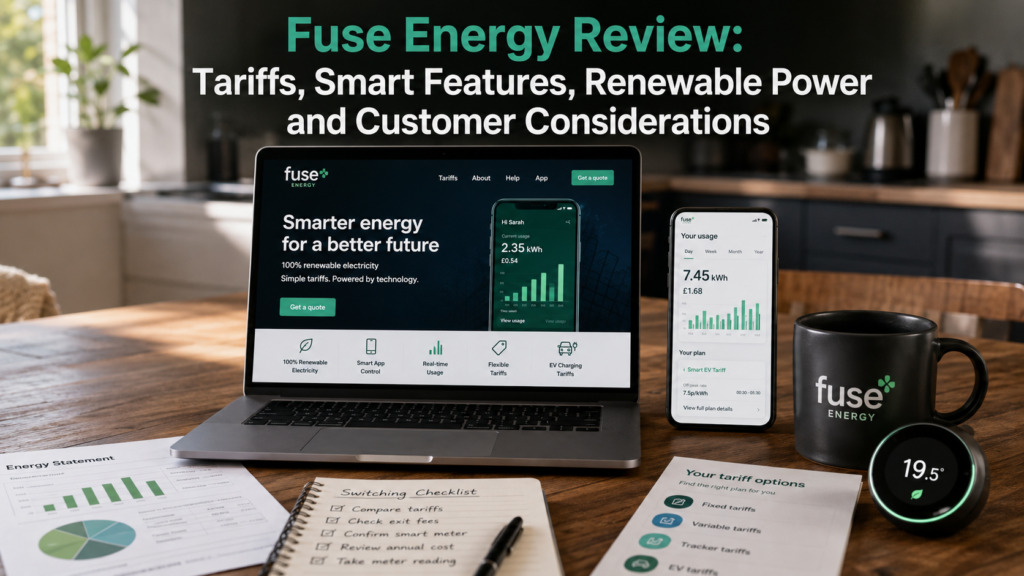
Fuse Energy is a UK energy supplier offering electricity and gas tariffs through a technology-led platform. The company promotes app-based account management, smart-meter insights, renewable electricity and specialist pricing options for households that want greater control over their energy use.
Consumers researching Fuse Energy are usually trying to determine whether the supplier is legitimate, competitively priced and suitable for their home. The answer depends on more than a headline unit rate. Standing charges, annual consumption, meter compatibility, payment terms, exit fees and customer-service preferences can all affect the value of a tariff.
This independent guide examines the company’s regulatory position, tariff structure, digital tools and switching process. It also explains how to verify Fuse Energy’s claims before entering a contract.
Editorial disclosure: This article provides general consumer information and does not represent Fuse Energy. Tariffs, prices and product availability can change. Consumers should review a personalised quote and the supplier’s current contractual terms before switching.
Confirm Fuse Energy’s Regulatory Status
Fuse Energy supplies customers through Fuse Energy Supply Limited. Companies House records show that the business is an active private limited company registered under company number 08469701. Its current registered office is listed at One Bank Street in Canary Wharf, London.
Ofgem granted Fuse Energy Supply Limited a gas supply licence on November 22, 2024. The licence authorises the company to supply gas to domestic and non-domestic premises in Great Britain. Ofgem also maintains a current list of electricity licensees that includes companies authorised to participate in the electricity market.
This regulatory information confirms that Fuse Energy operates through a registered company with relevant energy-market permissions. Ofgem explains that licensed companies must meet the conditions associated with their activities. However, a licence does not mean that a supplier offers the lowest prices or the best service for every household.
Consumers should distinguish Fuse Energy Supply Limited from similarly named businesses. Checking the company number is the safest way to verify that documents, payment requests and contractual information relate to the correct legal entity.
Compare Fuse Energy Tariff Options
Fuse Energy publishes information about fixed, variable, tracker and specialist electricity tariffs. The exact plans available to a customer can depend on location, meter type, payment method and current market conditions.
A fixed tariff generally keeps the unit rate and specified charges unchanged for a defined period. Fuse Energy explains that fixed plans can offer greater price certainty, although customers may have to pay an exit fee when leaving before the contract ends.
A variable tariff can change during the customer’s contract. Standard variable tariffs are affected by the Ofgem energy price cap, which limits the rates suppliers can charge rather than limiting a household’s total bill. A customer who uses more energy will still pay more, even when the tariff falls under the price cap.
Fuse Energy also publishes information about tracker tariffs. These products link rates more directly to wholesale energy prices, allowing charges to move as market conditions change. Tracker tariffs may become cheaper when wholesale prices fall, but customers also face greater exposure when prices rise.
| Tariff type | Main feature | Potential advantage | Primary risk |
|---|---|---|---|
| Fixed tariff | Rates remain fixed for a specified term | Predictable unit prices | Exit fees and missed market reductions |
| Variable tariff | Rates can change periodically | Greater contractual flexibility | Less certainty over future costs |
| Tracker tariff | Rates follow wholesale market movements | Potential savings when wholesale prices fall | Bills can rise quickly |
| Time-of-use tariff | Prices vary by time of day | Lower costs during off-peak periods | Higher peak-time charges |
| EV tariff | Reduced rates may apply to scheduled charging | Lower electric-vehicle charging costs | Requires compatible equipment and usage habits |
A tariff should be judged by its estimated annual cost rather than one attractive rate. Consumers must compare both the price per kilowatt-hour and the daily standing charge.
Calculate the Full Annual Cost
An energy bill normally contains two major charges: the unit rate and the standing charge. The unit rate applies to each kilowatt-hour of energy used, while the standing charge is a daily amount that applies regardless of consumption. Fuse Energy states that its quoted rates include 5% VAT.
A low unit rate can be offset by a higher standing charge. This distinction matters for low-usage households, second homes and properties that remain empty for part of the year. A household with high consumption may place greater importance on the unit rate because usage charges represent a larger share of the annual bill.
Consumers should use actual annual consumption figures from a recent statement when requesting a quote. Estimates based only on property size or occupant numbers may not reflect electric heating, home working, electric-vehicle charging or other unusual consumption patterns.
Before accepting a Fuse Energy tariff, review:
- Electricity and gas unit rates
- Daily standing charges
- Estimated annual cost
- Contract start and end dates
- Exit fees
- Payment requirements
- Discount conditions
- Smart-meter requirements
- Peak and off-peak periods
- Rules for promotional credits
The Tariff Information Label should provide a standardised summary of the key plan details. Fuse Energy describes the label as a tool for comparing tariff terms, prices and contractual conditions.
Review the Fuse Energy App
Fuse Energy positions its app as a central part of the customer experience. The company says its digital tools allow customers to view billing and consumption information, manage their account and monitor energy use.
Smart-meter data can help customers identify periods of high consumption. A household may discover that heating, electric-vehicle charging, cooking or laundry accounts for a disproportionate amount of electricity use.
This information is particularly useful for customers on time-of-use tariffs. Moving flexible activities into cheaper periods may reduce costs, provided the savings are not outweighed by higher prices at peak times.
The app does not guarantee lower bills by itself. Savings depend on whether customers understand the data and change their consumption accordingly. Some users may also prefer telephone-based service rather than an app-led relationship.
Billing information can be based on smart-meter readings, customer-submitted readings or estimated consumption. Fuse Energy’s terms explain that customers may need to supply an actual reading when they believe an estimate is incorrect.
Verify Smart-Meter Compatibility
Smart meters can send readings automatically when they operate in smart mode. Citizens Advice notes that consumers can switch suppliers with a smart meter, but they should check whether the meter will continue working in smart mode after the change.
A meter that does not communicate correctly may require manual readings. The customer could also lose access to detailed consumption information or tariffs that depend on half-hourly data.
Fuse Energy states that its app can integrate with smart-meter information to provide insights into household consumption. The actual experience may vary according to the meter generation, communications network and account settings.
Customers should confirm the following before switching:
- Whether the current meter is supported
- Whether automated readings will continue
- Whether half-hourly data is required
- Whether the chosen tariff needs a smart meter
- Whether a meter installation or upgrade is necessary
Citizens Advice provides a smart-meter checking tool that helps consumers identify whether a meter should be capable of operating in smart mode.
Assess Electric-Vehicle Tariff Suitability
Fuse Energy publishes guidance on combining smart chargers with tariffs that offer cheaper off-peak electricity. Scheduling charging overnight or during lower-priced periods can reduce vehicle charging costs.
An EV tariff is not automatically cheaper for the entire household. Some plans offer a very low charging rate but apply a higher rate during the day. Households with substantial daytime consumption should compare the combined cost rather than focusing solely on the advertised overnight price.
Compatibility is another important issue. Consumers should confirm that their vehicle, charger and smart meter work with the tariff’s control system. They should also establish whether charging must be managed through the supplier’s app.
The most useful comparison should include:
- Off-peak unit rate
- Peak unit rate
- Number of discounted hours
- Charger compatibility
- Vehicle compatibility
- Smart-meter requirements
- Exit fees
- Estimated whole-home annual cost
A specialist tariff offers the greatest value when a large share of consumption can be shifted into discounted periods.
Examine Renewable-Energy Claims Carefully
Fuse Energy presents itself as a company focused on cleaner electricity and modern energy infrastructure. Consumers interested in environmental performance should review the specific evidence supporting those claims rather than relying only on broad language.
Renewable supply claims can be supported through different arrangements, including company-owned generation, direct power-purchase agreements and renewable energy certificates. These approaches do not always have the same environmental effect.
A transparent supplier should explain how much renewable power it generates, purchases or matches against customer consumption. It should also disclose whether environmental certificates are used and how its gas supply fits within its climate strategy.
Consumers can evaluate environmental claims by checking:
- The source of supplied electricity
- The role of renewable certificates
- Ownership of generation assets
- Published carbon-reduction targets
- Progress against dated commitments
- Treatment of gas-related emissions
Environmental performance is only one part of choosing a supplier. Price, service, billing accuracy and contractual flexibility remain important practical considerations.
Follow a Safe Switching Process
Citizens Advice recommends comparing tariffs and payment methods before switching. Direct-debit customers may have access to a wider range of deals, while prepayment customers may encounter a smaller selection of tariffs.
Switching supplier does not normally require replacing the physical cables, pipes or energy supply connection. The administrative responsibility for billing and purchasing energy changes, while the local network remains responsible for delivering it.
Customers should take a dated meter reading when the switch takes place. Keeping a photograph can help resolve disagreements between the old and new suppliers.
Before completing a switch:
- Check the current tariff for exit fees.
- Download recent bills and annual statements.
- Confirm the new tariff’s unit rates and standing charges.
- Verify meter and EV-charger compatibility.
- Save the quote and contractual terms.
- Record meter readings on the switching date.
- Check the final bill from the previous supplier.
- Review the first Fuse Energy bill for errors.
Tenants who pay the energy supplier directly are generally able to switch supplier, even when they rent their home. Citizens Advice recommends checking the tenancy agreement and informing the landlord when appropriate.
Decide Whether Fuse Energy Fits Your Household
Fuse Energy may suit customers who prefer app-based account management, smart-meter monitoring and tariffs designed around flexible consumption. It may also appeal to electric-vehicle owners who can move charging into off-peak periods.
The supplier may be less suitable for customers who require extensive telephone support, lack compatible technology or cannot shift their consumption away from expensive periods.
A household should not choose Fuse Energy solely because it is described as modern, green or affordable. The decision should be based on a personalised comparison using actual annual consumption.
Fuse Energy is worth considering when its full annual estimate, contract conditions and service model compare favourably with other licensed suppliers. Consumers should compare at least several alternatives using the same usage data.
Conclusion
Fuse Energy is a registered UK energy supplier offering gas and electricity tariffs through an app-focused platform. Its regulatory status can be verified through Companies House and Ofgem, while its product information includes fixed, variable, tracker and specialist tariff options.
Its digital tools may help smart-meter customers understand consumption and move energy use into cheaper periods. However, app features and attractive off-peak rates do not guarantee a lower overall bill.
Consumers should compare unit rates, standing charges, annual estimates, exit fees and technical requirements before switching. Fuse Energy may provide good value for some households, but the best supplier is the one that matches the customer’s usage, equipment and service expectations.
Frequently Asked Questions
Is Fuse Energy a legitimate supplier?
Yes. Fuse Energy Supply Limited is listed as an active UK company, and Ofgem granted it a gas supply licence in November 2024.
Does Fuse Energy supply gas and electricity?
Fuse Energy Supply Limited holds a gas supply licence and appears within Ofgem’s electricity licensing information. Product availability should be checked using the customer’s postcode.
Does Fuse Energy offer fixed tariffs?
Fuse Energy publishes information about fixed tariffs that maintain specified rates for a contractual period. Customers should check the term and any exit fee before signing up.
Can customers use Fuse Energy with a smart meter?
Smart-meter customers may be able to use Fuse Energy’s digital consumption tools. Compatibility and continued smart-mode operation should be confirmed before switching.
Is Fuse Energy suitable for electric vehicles?
It may suit EV owners who have compatible chargers and can schedule charging during cheaper periods. The complete household cost should be compared, including both peak and off-peak rates.
Is Fuse Energy the cheapest UK supplier?
No supplier is cheapest for every household. The result depends on postcode, annual consumption, tariff type, standing charges, payment method and available offers.