For a small business, an event booth has to do more than look polished. It has to help people recognize the brand, understand the offer, start a conversation, and take a measurable next step. Custom event canopies can support that process by creating a visible, consistent space at farmers markets, trade shows, festivals, pop-up shops, product launches, and community events.
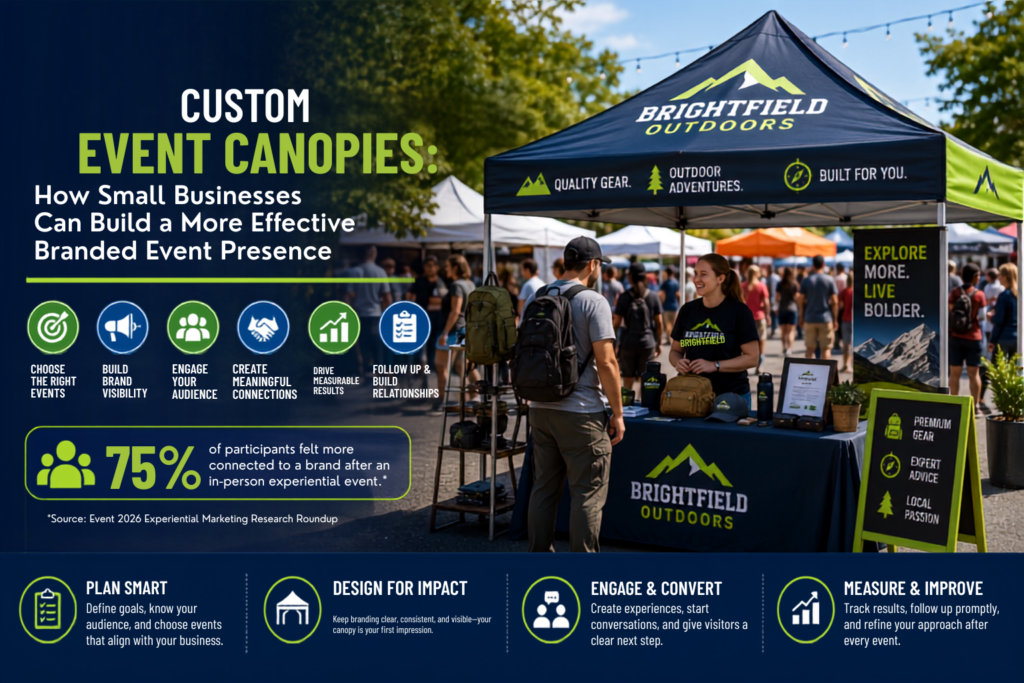
That visibility matters because in-person events continue to play a meaningful role in customer acquisition. Cvent’s 2026 roundup of experiential marketing research reports that 75% of participants felt more connected to a brand after an in-person experiential event. The same source reports that 84% of marketers believe events give them a competitive advantage in crowded markets. These figures suggest that physical experiences can strengthen relationships in ways that complement digital advertising, email, search, and social media.
A canopy alone will not make an event profitable. Results depend on choosing the right event, reaching the right audience, creating an easy-to-understand booth, preparing staff, and tracking what happens afterward. For small businesses with limited marketing budgets, those operational details are often more important than attending the biggest event available.
Choose Event Formats That Match the Business Goal
Before paying a vendor fee or ordering display materials, define what the event should accomplish.
A retailer may want same-day sales. A professional service firm may value qualified leads more than immediate revenue. A new consumer brand may be trying to generate product trials, while an established local business may want repeat customers and community visibility.
The event format should match that objective. Attendance figures can be useful, but a smaller event filled with relevant prospects can outperform a larger gathering where few attendees fit the target customer profile.
Use Pop-Up Shops for Direct Customer Sales
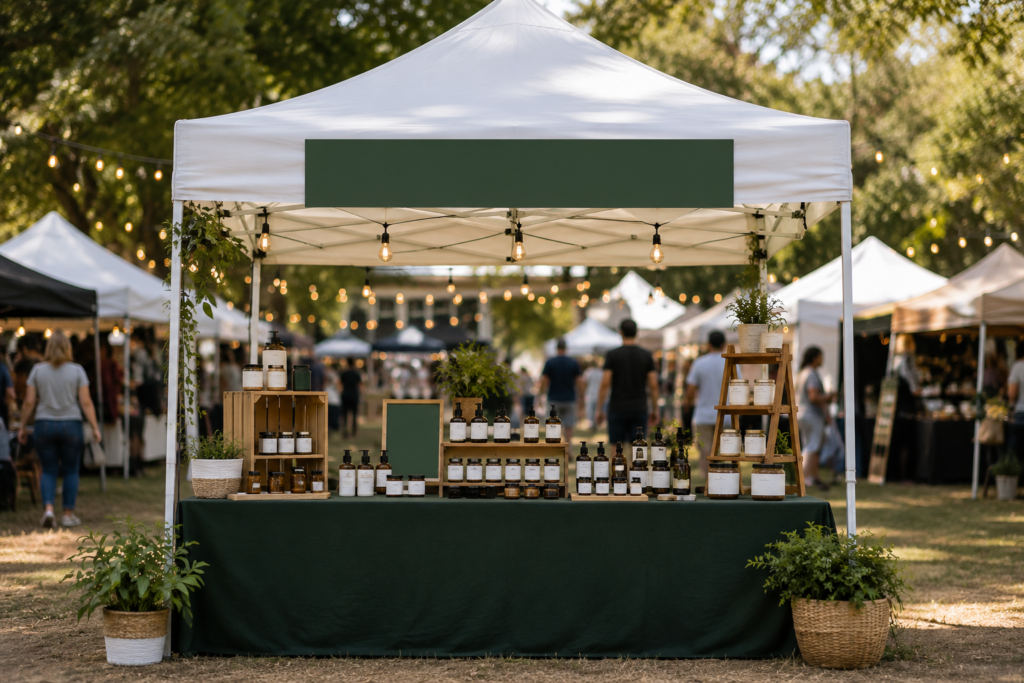
Pop-up shops allow ecommerce brands, makers, specialty retailers, food companies, beauty businesses, and other product sellers to create a temporary physical storefront.
The format is particularly useful when customers benefit from seeing, touching, tasting, trying, or comparing products before buying. It also gives an online-first business an opportunity to observe customer questions and objections directly.
At outdoor pop-ups, a custom canopy can define the selling space while making the brand identifiable from farther away. The most effective setup keeps the shopping experience simple: visitors should immediately see what is being sold, where prices are displayed, and how to make a purchase.
Host Workshops to Demonstrate Practical Expertise
Workshops are well suited to businesses that sell knowledge, services, specialty products, or experiences.
A garden center might demonstrate container planting. A bakery could teach decorating techniques. A photography business could run a short portrait workshop. A technology consultant might offer a practical session for local business owners.
The value comes from showing expertise rather than simply claiming it. Attendees experience the company’s knowledge firsthand, which can make a later sales conversation more natural.
The workshop should remain closely connected to the business. An educational session that attracts people with no realistic interest in the company’s services can create activity without creating useful leads.
Build Product Launches Around Demonstration
An event can make a product launch more tangible.
Instead of asking customers to respond to an advertisement alone, businesses can give them an opportunity to see a new product, ask questions, compare features, test it, or sample it.
The booth should place the new product at the center of the experience. Avoid surrounding it with too many unrelated messages. A visitor who approaches the space should be able to identify the launch item and understand its main benefit quickly.
For products that require explanation, assign a staff member who can demonstrate them repeatedly without turning every interaction into a lengthy presentation.
Partner With Complementary Local Businesses
Collaborative events can expand reach while distributing some of the promotional effort.
A wedding photographer might collaborate with a florist. A coffee shop could partner with a bakery. A fitness studio might work with a sportswear retailer. A home-improvement contractor could participate in an event with complementary home-service providers.
The strongest partnerships serve similar customers without creating unnecessary competition between the participating businesses.
Agree on responsibilities before promotion begins. Determine who controls the venue, marketing, expenses, customer data, setup, signage, staffing, and follow-up. Clear responsibilities reduce last-minute confusion.
Use Seasonal Markets to Capture Existing Demand
Seasonal markets and community festivals give small businesses access to customer demand that already exists around a particular occasion.
Holiday markets, summer fairs, fall festivals, spring markets, and back-to-school events can work especially well for retailers, food businesses, makers, and lifestyle brands.
A reusable booth system has an advantage in this environment. The primary canopy, logo, colors, table covers, and structural displays can remain consistent while smaller signs and featured products change by season.
This approach reduces the need to redesign the entire event space for every appearance.
Attend Networking Mixers for B2B Lead Generation
Networking events require a different approach from retail markets.
Consultancies, agencies, suppliers, professional services companies, and other B2B firms are unlikely to judge success mainly by transactions completed during the event. Their value may come from conversations that later become meetings, proposals, partnerships, or referrals.
The booth or event presence should communicate specialization clearly. A visitor should not need a five-minute conversation just to understand what the business does.
A concise statement explaining who the company helps and what problem it solves is often more useful than a broad slogan.
Use Giveaways to Attract Relevant Prospects
Giveaways can increase booth traffic, but more traffic is not automatically better.
A generic high-value prize may attract people who have no interest in becoming customers. A prize linked directly to the business can produce a smaller but more relevant participant pool.
Examples include a product bundle, service credit, free consultation, trial package, or event-specific offer.
If contact information is collected, participants should understand what they are signing up to receive. Businesses should also follow applicable privacy and marketing-consent requirements when adding people to email or SMS campaigns.
Compare Small Business Event Options Before Investing
The best event mix depends on the company’s sales model, audience, staff capacity, and available budget.
| Event type | Effort level | Best business fit |
|---|---|---|
| Pop-up shop | Medium | Ecommerce brands, retailers, makers, food and beauty businesses |
| Educational workshop | Medium | Service firms, specialists, educators, fitness and creative businesses |
| Product launch | Medium to high | Consumer brands, retailers, technology companies, food businesses |
| Local collaboration | Medium | Businesses serving complementary customer groups |
| Seasonal market or festival | Medium | Retailers, food brands, crafts businesses, local service providers |
| Networking mixer | Low to medium | Consultants, agencies, B2B services, professional firms |
| Trade show or expo | High | B2B suppliers, manufacturers, established service companies |
| Giveaway activation | Low to medium | Brands focused on lead generation, awareness, or product trials |
Effort includes more than the exhibitor fee. Businesses should calculate staff time, transportation, display equipment, inventory, samples, printed materials, payment-processing costs, travel, accommodation where necessary, setup labor, and post-event follow-up.
An event should therefore be evaluated against expected business outcomes, not attendance alone.
Use Custom Event Canopies as a Visibility Tool
At a busy outdoor event, attendees may be looking at dozens of vendors within a few minutes. The upper portion of a booth is often one of the easiest areas to see from a distance, which makes the canopy useful for basic brand identification.
Its job is not to communicate every product feature.
A canopy works best when it answers the first questions a passerby has: Which business is this? What kind of product or service does it offer? Is there a reason for me to stop?
That usually means prioritizing a recognizable logo, appropriate brand colors, and a short message over dense copy.
Businesses comparing booth systems can use ExpoPrint as one source for custom event canopies, trade show booths, display stands, table covers, and related branded event materials. ExpoPrint currently offers multiple canopy sizes and booth formats, along with an online 3D design studio for previewing custom displays.
Keep Branding Legible From Outside the Booth
Design decisions should reflect viewing distance.
A detailed paragraph that looks acceptable on a computer screen may be unreadable when printed on a canopy and viewed from across an event aisle.
Give the business name or logo visual priority. If the brand name does not explain the business, add a short descriptor.
For example, a company name may be paired with a phrase such as “Handmade Skincare,” “Commercial IT Support,” or “Specialty Coffee Roasters.”
Long URLs, phone numbers, extensive product lists, QR codes, and detailed promotional information generally work better on surfaces intended for closer viewing.
Keep the Booth Consistent With Existing Branding
Customers should recognize the same company across the booth, website, packaging, social profiles, and storefront.
Use established brand colors and logo treatments rather than creating a separate event identity for each appearance.
Consistency does not mean printing a logo on every available surface. Too much visual repetition can make a small booth difficult to scan.
Instead, create hierarchy. Use the canopy for identification, a back wall or banner for the primary message, product displays for merchandise, and smaller signage for prices or calls to action.
Confirm Booth Dimensions Before Ordering
Event organizers frequently assign exhibitors a specific footprint.
ExpoPrint, for example, currently lists custom canopy formats ranging from 5-by-5 feet through 20-by-10 feet, including the widely used 10-by-10-foot format.
However, the correct size is determined by the event organizer, not by what is most common.
Check the exhibitor agreement before ordering a canopy. Venue rules may address maximum dimensions, height, sidewalls, anchoring, fire requirements, placement, and aisle clearance.
For outdoor events, organizers may also specify how canopies must be weighted or secured. Follow both venue requirements and the equipment manufacturer’s safety instructions.
Arrange the Booth Around Visitor Behavior
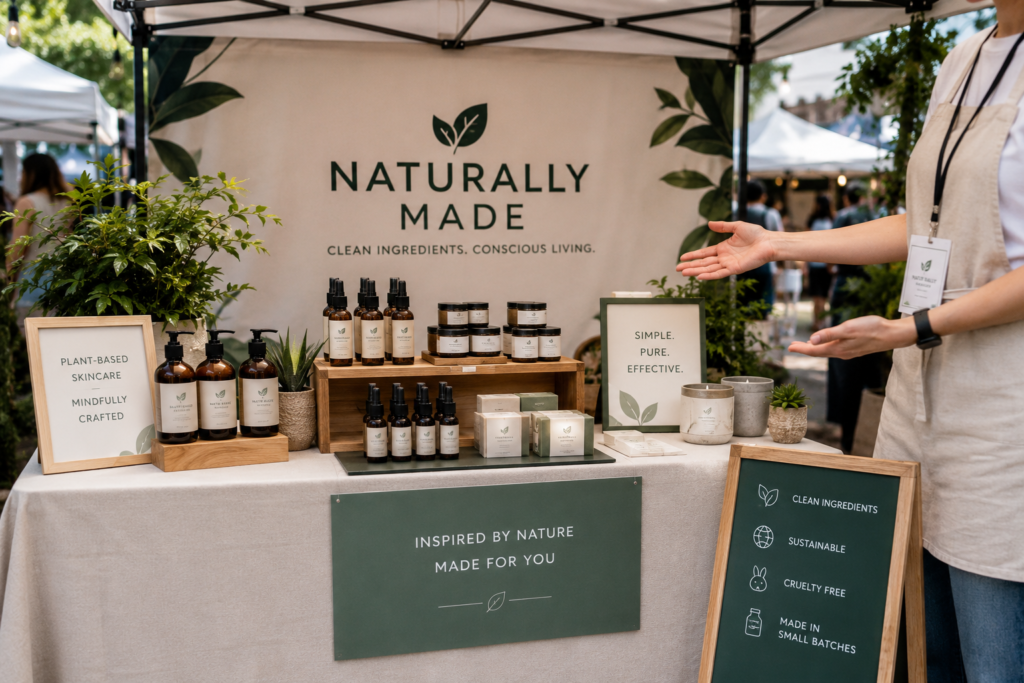
A professional-looking display can still underperform when customers do not know how to enter or where to look.
Imagine the booth from the perspective of someone walking past for the first time.
Can the visitor see the main product? Is there a clear entrance? Can prices be found? Is a staff member accessible? Is it obvious where to pay or ask a question?
The physical layout should make those decisions easy.
Create One Dominant Focal Point
Every booth needs a visual priority.
For a retailer, it may be a new product or bestseller. For a service company, it may be a concise statement describing the problem it solves. For a food brand, it could be a sample station.
Avoid giving six messages identical visual weight.
When everything competes for attention, visitors have to work harder to determine what matters. A clear hierarchy lets supporting materials reinforce the primary offer rather than compete with it.
Display Products at Useful Viewing Heights
Products placed low to the ground can disappear in a crowded space. Small items spread across an oversized table can also be difficult to scan.
Use shelves, risers, racks, boxes, or display stands where appropriate to create multiple viewing levels.
Group related items together and provide enough negative space for individual products to remain distinguishable.
Price information deserves equal attention. Customers who cannot determine the approximate cost of a product may hesitate to begin a conversation.
Plan for Actual Outdoor Conditions
Outdoor events introduce practical risks that are easy to underestimate during design.
Wind can move signs, table coverings, and lightweight merchandise. Rain can change traffic patterns. Direct sunlight can affect products, displays, electronic screens, and staff comfort.
Any canopy should be installed and secured according to manufacturer instructions and event requirements.
Businesses should also plan where inventory will be protected, how water-sensitive materials will be stored, and how the booth can be closed quickly if conditions deteriorate.
For indoor trade shows, the constraints change. Power access, lighting, maximum booth height, aisle traffic, neighboring exhibits, setup rules, and venue restrictions become more important.
Give Customers a Specific Reason to Stop
Brand recognition gets attention. An experience creates engagement.
Product sampling, live demonstrations, mini consultations, customization, interactive displays, event-only products, workshops, and demonstrations can all encourage people to spend more time at the booth.
The activity should connect naturally to what the company sells.
A cookware company can demonstrate a product. A printer can show material samples. A beauty company can offer appropriate product testing. A software provider can walk prospects through a short use case.
Activities that have little connection to the actual business may generate crowds without improving customer acquisition.
Make the Next Step Clear
Once someone is interested, the booth needs a clear conversion path.
For a retailer, that may be purchasing.
For a service company, it may be scheduling an appointment.
For a B2B exhibitor, the next step could be booking a demonstration or follow-up meeting.
For a newer consumer brand, it might be joining an email list, requesting a sample, or scanning a QR code to shop later.
Choose the action that best supports the event goal and make that action easy to complete.
Plan Event Marketing From the Event Date Backward
Event preparation becomes easier when deadlines are calculated backward from the day the booth opens.
Start with the event date, then assign deadlines for final testing, equipment delivery, production, artwork approval, ordering, promotion, staff scheduling, inventory preparation, and registration.
A local market may require a relatively short preparation period. A large trade show with custom booth components, shipping, staff travel, and lead-generation systems may require significantly more.
The correct schedule depends on the event rather than an arbitrary rule.
Review Organizer Requirements First
Before purchasing equipment, request the exhibitor manual, vendor agreement, or official event instructions.
Confirm details including:
- Booth footprint and height
- Indoor or outdoor placement
- Canopy and sidewall rules
- Required weights or anchoring
- Setup and teardown windows
- Electricity availability
- Parking and loading access
- Insurance requirements
- Signage restrictions
- Venue-specific safety requirements
- Furniture or fixtures provided by the organizer
These rules directly affect equipment decisions.
A booth component that works at one venue may not be permitted at another.
Leave Time for Design, Proofing, and Production
Custom displays need time for artwork preparation and review.
Businesses should verify logo quality, dimensions, colors, text placement, and print areas before approving a final design.
ExpoPrint states that its current online design tool allows users to add logos, text, and graphics and preview a custom canopy through an interactive 3D mockup before production. Its site also describes a proof-approval stage as part of its ordering process.
Regardless of supplier, proofing is valuable because errors that are easy to fix before printing can become expensive after production.
Build additional time between expected delivery and the event. That creates an opportunity to inspect the equipment, test assembly, and address missing or damaged components.
Conduct a Full Setup Test
A rehearsal exposes problems that a floor plan may not reveal.
Set up the canopy, tables, banners, product displays, signs, payment equipment, storage, and other major components as they will appear at the event.
Check sightlines from several directions.
Make sure the company name is visible. Confirm that important products are not blocked. Test whether staff can move through the space without interfering with visitors.
A practice setup also tells the team how many people are realistically needed for installation and how long the process takes.
Promote the Event Before Opening Day
An event should not depend entirely on organizer traffic.
Businesses can promote their participation through email, social media, websites, customer communications, partners, and relevant local channels.
Give customers a specific reason to attend.
Instead of simply announcing that the company will have a booth, promote a new product, demonstration, tasting, limited offer, consultation, workshop, or other experience available at the event.
If the organizer provides an exhibitor directory, social templates, event hashtags, or partner marketing resources, use them where they fit the business’s audience.
GrowBusinessMag regularly examines small-business growth through the relationship between marketing activity and measurable commercial outcomes. Event marketing deserves the same discipline: identify the audience, define the intended result, calculate the investment, and measure whether the event produced meaningful business.
Measure Business Results After Every Event
Foot traffic is not a sufficient measure of success.
A booth may receive hundreds of visitors but produce few qualified customers. Another business may have fewer conversations but generate several high-value opportunities.
Measurement should reflect the original goal.
A retail business can track event revenue, number of transactions, average order value, new customers, and event-specific discount codes.
A service business can record qualified leads, appointments booked, proposals requested, and eventual sales.
A brand-awareness campaign might measure product samples distributed, email sign-ups, QR-code scans, social interactions, or increases in branded search and direct website traffic after the event.
Event costs should be tracked as carefully as outcomes. Include vendor fees, labor, transportation, printing, equipment, inventory used for samples, payment fees, accommodation, and other direct expenses.
Reusable displays require a slightly different calculation. A custom canopy used at 20 events should not be judged solely against the revenue generated at the first appearance.
Follow Up While Conversations Are Still Recent
For businesses collecting leads, the event is not finished when the booth is packed away.
Send requested information promptly. Contact qualified prospects. Process any promised quotes. Thank customers where appropriate. Give attendees a clear way to continue the conversation.
Whenever practical, use information from the actual interaction.
A prospect who discussed a specific business problem should receive a more relevant follow-up than a person who simply entered a giveaway.
This is one of the practical advantages of in-person customer acquisition: the business can carry information from a real conversation into the next stage of the sales process.
Build a Repeatable Event System
Companies that attend events regularly can improve results by treating event marketing as an operating system rather than a collection of isolated appearances.
Create a central inventory of reusable equipment such as the canopy, printed walls, banners, table covers, display stands, storage containers, approved extension equipment, point-of-sale hardware, lead-capture tools, cleaning supplies, and replacement parts.
Maintain an event checklist for packing, transportation, setup, opening procedures, lead capture, inventory control, teardown, and follow-up.
After each event, record what happened.
Which products attracted attention?
Which message prompted questions?
Where did congestion occur?
Which event generated qualified leads?
What equipment was unnecessary?
What did customers repeatedly ask?
These observations create first-party evidence that can make the next event more effective.
Treat Custom Event Canopies as Part of the Customer Experience
Custom event canopies are most useful when they perform a defined role within a larger event strategy.
They can make a small business easier to identify, create visual continuity across repeated appearances, provide an organized footprint for outdoor selling, and support a more professional customer experience. But a canopy cannot compensate for a poorly chosen event, confusing offer, weak booth layout, or absent follow-up.
Start with the customer and the commercial objective.
Choose events where relevant prospects are likely to be present. Confirm the organizer’s specifications before buying equipment. Design the booth for readability at real viewing distances. Give visitors a reason to engage. Create one clear next step. Then measure the results.
Current event-marketing research supports the continued importance of face-to-face experiences. Cvent’s 2026 research roundup reports that 75% of participants felt more connected to a brand following an in-person experiential event. The opportunity for a small business is to turn that human connection into something measurable: a purchase, qualified lead, appointment, repeat customer, or stronger local brand relationship.
When that process is repeated and improved over time, the canopy becomes more than signage. It becomes one part of a reusable customer-acquisition system.
Frequently Asked Questions About Custom Event Canopies
How much should a small business spend on an event?
There is no universal event budget. The appropriate amount depends on vendor fees, expected customer value, staffing, transportation, inventory, promotional materials, and display requirements. Start by calculating the full cost of participation and determine what level of sales or qualified leads would make the investment worthwhile. For reusable equipment such as custom canopies, evaluate the cost across the number of events where the equipment is realistically expected to be used.
How far in advance should an event be planned?
The planning period should match the complexity of the event. A local market may need several weeks of preparation, while a major trade show can involve registration, travel, shipping, custom production, staff scheduling, and months of advance coordination. Work backward from the event date and leave a buffer for custom-display production, delivery, proof corrections, and a full setup test.
What size event is best for a business attending its first event?
A smaller, highly relevant local event is often a practical starting point. It allows the business to test booth setup, staffing, inventory levels, payment processing, messaging, and lead capture without assuming the cost and complexity of a major trade show. Audience fit matters more than attendance. An event with a few hundred appropriate prospects can be more useful than one with thousands of people who are unlikely to become customers.
Where can businesses source canopy and booth materials?
Specialist display printers, commercial event-display providers, trade show suppliers, and local sign companies offer different combinations of canopies, backdrops, flags, table covers, booth structures, printed walls, stands, and replacement graphics. Compare suppliers based on available dimensions, print specifications, hardware, production schedules, proofing process, replacement options, design support, and compatibility with the events you plan to attend. ExpoPrint’s current catalog, for example, includes custom canopy tents, multiple expo-booth systems, table covers, flags, backdrops, and display stands.