
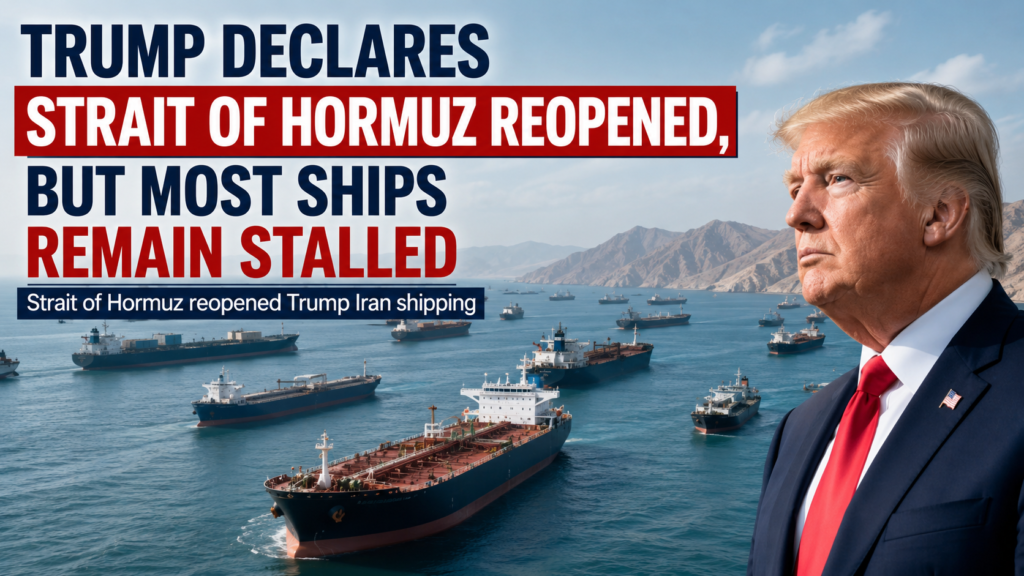
President Donald Trump says the Strait of Hormuz is reopening and oil tankers are beginning to move again. Yet vessel-tracking data and shipping industry assessments tell a different story, with hundreds of ships still waiting for clearer security assurances before resuming normal operations through one of the world’s most critical energy chokepoints. According to the U.S. Energy Information Administration, roughly 20 million barrels of oil pass through the Strait of Hormuz each day, accounting for about one-fifth of global petroleum liquids consumption. GrowBusinessMag previously covered the early stages of this standoff in its Strait of Hormuz oil crisis report, which detailed how the blockade began affecting global oil supply chains.
Trump Signals Shipping Traffic Is Resuming
In social media comments and remarks at the G7 summit, Trump said ships loaded with oil were starting to leave the strait following an agreement reached with Iran. He also indicated that efforts were underway to address remaining maritime hazards and predicted the waterway would be fully open by Friday.
Tracking Data Shows Most Vessels Remain Trapped
However, tanker-tracking firm Kpler reported no significant movement among the roughly 220 tankers and nearly 500 total vessels currently trapped inside the Persian Gulf. Analysts say the lack of activity is not surprising given that the agreement is not scheduled to be signed until later in the week, leaving many shipping companies reluctant to move ahead without greater operational clarity.
Industry groups point to several unresolved issues. Shipping operators still lack detailed guidance on safe transit corridors, timing, naval escort arrangements, and procedures designed to prevent congestion in narrow shipping lanes. Maritime officials also want confirmation that any mine threats have been identified and cleared before encouraging a broader resumption of traffic.
Insurance and Security Concerns Continue to Weigh on Traffic
Those uncertainties continue to weigh on risk assessments across the sector. Maritime insurers have not broadly signaled a return to standard coverage for vessels transiting the strait. One insurer, Skuld, confirmed that its coverage limitations remain unchanged, emphasizing that underwriting decisions depend on confidence that voyages can be completed safely.
That has created what analysts describe as a classic chicken-and-egg dilemma. Shipowners want proof that insurers will provide coverage, while insurers want evidence that routes are secure and vessels are moving safely. Matt Smith, lead oil analyst at Kpler, has noted that operators are likely to wait for other ships to complete successful transits before committing their own vessels. As a result, commercial traffic remains well below normal levels.
Markets Look Ahead to a Gradual Reopening
Despite the operational standoff, financial markets reacted positively to the prospect of reopening. Expectations that oil exports could soon normalize helped push oil futures to a three-month low. As GrowBusinessMag has observed across previous energy disruptions, markets often price in anticipated improvements before physical supply chains fully recover.
Analysts believe a complete return to normal traffic could take three to four months. If that timeline holds, a full reopening would ease pressure on global shipping networks, strengthen confidence among insurers and vessel operators, and improve energy flows through a route that remains essential to global oil markets.