The global mining sector depends on advanced machinery to maintain productivity, efficiency, and operational safety. From open-pit excavation to underground mineral processing, every stage of extraction requires specialized systems engineered for durability and precision. In gold mining, the importance of reliable machinery becomes even greater because operators must manage high volumes of ore while maintaining cost control and recovery efficiency.
According to the World Gold Council, global gold demand reached a record high of 4,974 tonnes in 2024, driven by strong central bank purchases and rising investment demand — pushing the total value of gold demand to an all-time high of $382 billion. This sustained pressure on supply is pushing mining companies to invest more heavily in advanced equipment and operational efficiency than ever before.
Modern gold mining equipment has evolved far beyond traditional prospecting tools. Today’s operations rely on intelligent hauling systems, automated drilling platforms, crushing technology, material separation equipment, and environmentally conscious processing systems. These machines support large-scale mineral recovery while helping mining companies improve throughput, reduce downtime, and maintain regulatory compliance.
As gold demand continues to rise across investment, electronics, jewelry, and industrial sectors, mining companies are under pressure to maximize operational output without compromising worker safety or environmental performance. This has accelerated investment in heavy machinery, predictive maintenance technologies, fuel-efficient equipment, and digital fleet management systems.
Mining operations involve multiple stages that require different forms of heavy equipment. Excavation, hauling, drilling, crushing, grinding, and mineral recovery each depend on machinery designed for specific geological and operational conditions. The effectiveness of gold mining equipment directly influences production capacity, ore recovery rates, operational costs, and long-term profitability.
Operate Large-Scale Excavation Systems For Efficient Gold Extraction
Excavation forms the foundation of every mining operation. Before gold-bearing ore can be processed, operators must remove overburden, loosen rock formations, and transport massive quantities of material. Excavators are among the most critical pieces of gold mining equipment because they handle continuous earthmoving activities across the site.
Hydraulic excavators dominate modern mining environments due to their lifting power, mobility, and operational flexibility. These machines use hydraulic systems to control booms, buckets, and arms capable of moving enormous amounts of rock and soil. Open-pit mines rely heavily on hydraulic excavators to maintain steady production flow.
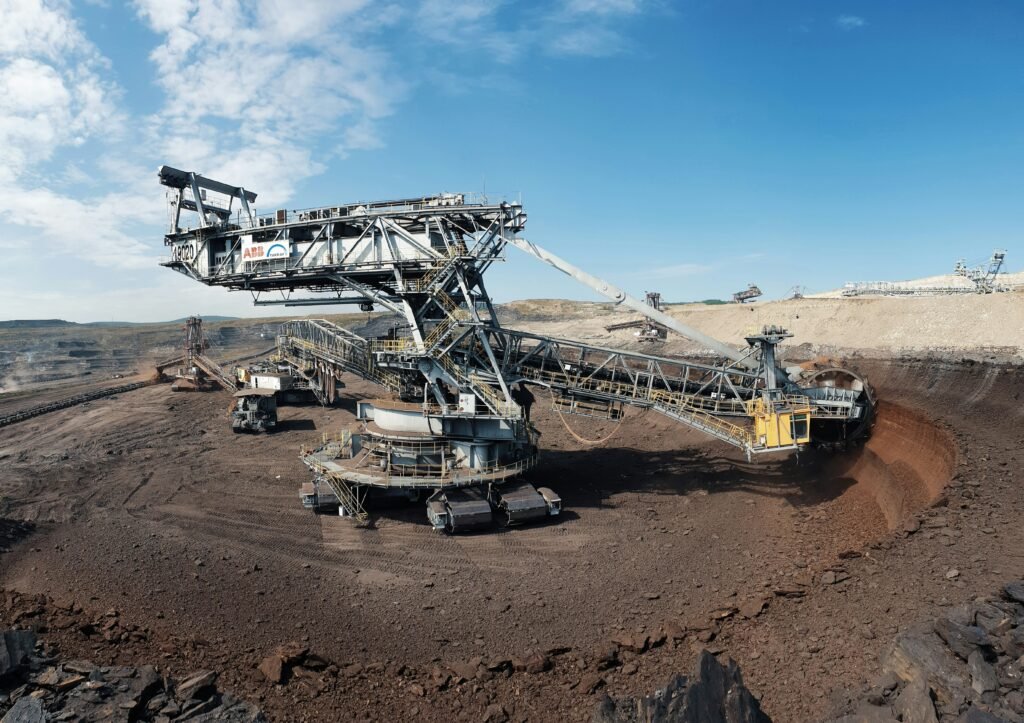
Dragline excavators are commonly used in large-scale surface mining projects where extensive overburden removal is required. Their massive boom structures and suspended buckets allow operators to move material across long distances without repositioning the machine frequently. This capability improves efficiency in high-volume operations.
Underground gold mining projects often require compact excavation machinery designed for confined environments. Low-profile loaders and underground excavators support tunnel development while maintaining maneuverability in restricted spaces.
Common Excavation Machinery Used In Gold Mining
| Equipment Type | Primary Function | Best Application |
|---|---|---|
| Hydraulic Excavators | Digging and material movement | Open-pit mining |
| Dragline Excavators | Overburden removal | Large surface mines |
| Underground Loaders | Tunnel material transport | Underground operations |
| Track Excavators | Uneven terrain excavation | Rugged mining sites |
| Backhoe Excavators | Secondary excavation tasks | Smaller operations |
Efficient excavation systems improve ore accessibility while reducing fuel consumption and operational delays.
Deploy Heavy Haul Trucks To Transport High Ore Volumes
Material transportation is one of the most demanding aspects of mining operations. Once ore is excavated, it must be transported quickly and safely to crushing facilities, stockpiles, or processing plants. Haul trucks are essential gold mining equipment because they maintain the continuous movement of extracted material throughout the mining cycle.
Rigid dump trucks are widely used in large-scale mining operations because they can carry extremely heavy payloads across structured haul roads. Their reinforced frames and high-capacity dump bodies allow operators to move substantial ore volumes efficiently.
Articulated dump trucks provide better maneuverability in difficult terrain. Their hinged design allows them to navigate steep inclines, muddy surfaces, and uneven haul routes more effectively than rigid-frame alternatives. Although they carry smaller payloads, they offer superior adaptability in challenging conditions.
Mining companies increasingly integrate autonomous haulage systems into modern fleets. Self-driving haul trucks improve route efficiency, reduce fuel waste, and minimize accident risks associated with human fatigue.
Fleet management software also plays a critical role in optimizing transport operations. GPS tracking, predictive analytics, and real-time diagnostics help managers reduce idle time and improve logistical coordination across large mining sites.
Utilize Precision Drilling Equipment For Controlled Blasting Operations
Before excavation can begin in hard rock environments, operators must loosen mineral-bearing formations through controlled blasting. Drilling equipment enables mining companies to create accurate blast patterns that maximize ore recovery while minimizing unnecessary rock fragmentation.
Rotary drills are widely used in surface mining operations because they can penetrate soft to medium-hard rock formations efficiently. These machines apply rotational force and downward pressure to create deep blast holes suitable for large-scale production environments.
Percussion drills operate differently by repeatedly striking the rock surface with high-impact force. This method is particularly effective in hard rock mining where rotary systems may struggle to maintain penetration speed.
Hammer drills combine rotary action with impact energy, making them highly effective for challenging geological formations. Underground gold mining projects often depend on these machines for tunnel advancement and ore body access.
Advanced drilling systems now incorporate automation, onboard monitoring, and digital mapping capabilities. Operators can analyze geological data in real time and adjust drilling parameters for improved blasting accuracy and reduced operational waste.
Install Crushing And Grinding Systems To Improve Ore Processing
Extracted ore cannot be processed effectively until it is reduced into smaller particles. Crushing and grinding machinery plays a central role in mineral liberation by separating gold-bearing material from surrounding rock.
Jaw crushers are commonly used during primary crushing stages. These machines apply compressive force to break large rocks into manageable fragments suitable for further processing.
Cone crushers handle secondary crushing operations by producing finer material with more consistent particle sizes. Their high-speed rotational systems improve throughput while maintaining efficient energy usage.
Grinding mills continue the reduction process by transforming crushed ore into fine material suitable for mineral recovery systems. Ball mills and rod mills are frequently used in gold processing plants because they provide consistent grinding performance across different ore types.
Processing Equipment Used In Gold Mining
| Processing Machine | Main Purpose | Operational Benefit |
|---|---|---|
| Jaw Crushers | Primary rock reduction | Handles large ore volumes |
| Cone Crushers | Secondary crushing | Produces finer output |
| Ball Mills | Fine ore grinding | Improves mineral liberation |
| Rod Mills | Coarse grinding control | Reduces overgrinding |
| Vibrating Screens | Material separation | Enhances processing efficiency |
Efficient processing systems increase gold recovery rates while lowering operational costs associated with waste material handling.
Operate Specialized Gold Mining Equipment For Mineral Separation
Gold extraction requires highly specialized recovery systems capable of separating dense gold particles from surrounding sediment and waste material. Different mining environments require different recovery methods depending on ore composition, water availability, and production scale.
Sluice boxes remain widely used in placer mining operations because they use flowing water to separate heavier gold particles from lighter sediment. Although traditionally associated with small-scale mining, industrial sluice systems are also used in larger recovery operations.
Trommels are rotating screening systems designed to wash and separate gravel, sand, and ore particles according to size. These machines improve material classification before further processing stages.
Gold dredges extract sediment directly from riverbeds or underwater deposits. These systems combine excavation and processing functions, making them valuable in alluvial mining environments.
Shaker tables use vibration and gravity to separate gold particles based on density differences. They are frequently used in final concentration stages to improve recovery efficiency.
Centrifugal concentrators represent one of the most advanced forms of modern gold mining equipment. These machines use high-speed rotational force to capture fine gold particles that traditional gravity systems may miss.
Improve Operational Safety Through Equipment Monitoring And Training
Mining environments present significant operational risks due to heavy machinery movement, blasting activities, confined workspaces, and challenging terrain conditions. Safety management has become a major priority for modern mining companies investing in gold mining equipment.
Operator training remains one of the most important safety measures. Workers must understand machine limitations, blind spots, load capacities, emergency procedures, and site communication protocols before operating heavy machinery.
Preventive maintenance programs also support workplace safety by reducing the likelihood of mechanical failures. Daily inspections help identify hydraulic leaks, structural wear, damaged tires, and faulty braking systems before accidents occur.
Advanced monitoring systems now provide real-time equipment diagnostics through onboard sensors and digital dashboards. Managers can track engine performance, component wear, fuel efficiency, and operational stress remotely.
Collision avoidance systems have become increasingly common in large mining fleets. Radar sensors, proximity detection technology, and automated braking systems reduce accident risks in busy operational zones.
Remote-controlled and autonomous machinery further improves safety by removing operators from hazardous areas. Mining companies can now manage drilling rigs, loaders, and haul trucks from centralized control rooms located far from active extraction zones.
Reduce Environmental Impact With Sustainable Mining Technology
Environmental sustainability has become a central focus across the mining industry. Traditional mining operations consume significant amounts of fuel, generate emissions, and disturb large land areas. Modern mining companies are investing heavily in cleaner technologies and environmentally responsible operating practices.
Electric and hybrid-powered machinery is becoming increasingly common in mining operations. Battery-powered haul trucks and electric excavators reduce greenhouse gas emissions while lowering fuel costs over time.
Energy-efficient crushing and grinding systems also contribute to sustainability goals by reducing electricity consumption during ore processing stages.
Water management systems play a major role in responsible gold extraction. Recycling technologies allow operators to reuse processing water, reducing freshwater demand and minimizing environmental discharge.
Dust suppression systems improve air quality around mining sites while protecting nearby communities and ecosystems. Sprinkler systems, enclosed conveyors, and advanced filtration technology help reduce airborne particulate matter.
Mining companies also invest in land reclamation initiatives once extraction projects conclude. Heavy machinery is frequently repurposed to reshape terrain, stabilize soil, and support revegetation efforts aimed at restoring natural landscapes.
Integrate Automation And Smart Technology Into Mining Operations
Digital transformation continues to reshape the mining sector. Automation, artificial intelligence and data analytics are improving productivity while reducing operational inefficiencies across large-scale extraction projects.
Autonomous drilling systems can follow programmed blast patterns with remarkable accuracy, improving consistency and reducing human error. Automated haulage fleets optimize transportation routes while lowering fuel consumption and maintenance requirements.
Smart sensors installed across gold mining equipment continuously monitor temperature, vibration, hydraulic pressure, and component performance. Predictive maintenance software analyzes this data to identify potential failures before breakdowns occur.
Mining companies also use drone technology for surveying, mapping, stockpile measurement, and infrastructure inspections. These systems improve operational visibility while reducing manual inspection risks.
Centralized control centers allow operators to manage multiple machines remotely through integrated digital platforms. Real-time performance dashboards help managers make faster operational decisions while improving overall site coordination.
The adoption of automation technology is expected to accelerate further as mining companies pursue greater efficiency, lower emissions, and safer working conditions.
Strengthen Mining Productivity Through Strategic Equipment Investment
Mining profitability depends heavily on equipment reliability and operational efficiency. Downtime caused by machinery failures can disrupt production schedules, increase maintenance costs, and reduce overall output. For mining companies serious about long-term profitability, cutting corners on equipment quality is rarely a viable strategy — the cost of a single unplanned breakdown often exceeds the savings made on cheaper machinery.
Mining companies increasingly evaluate equipment investments based on long-term operational performance rather than initial purchase price alone. Fuel efficiency, durability, maintenance accessibility, and automation compatibility all influence purchasing decisions.
High-performance gold mining equipment allows operators to process more ore with greater consistency while reducing labor intensity. Integrated fleet management systems also improve asset utilization and scheduling accuracy.
Strategic partnerships with equipment manufacturers have become common across the industry. Many mining companies now rely on long-term service agreements that include maintenance support, software updates, operator training, and replacement component management.
Scalability is another major consideration. Mining projects often expand over time, requiring equipment fleets capable of adapting to increased production demands without major operational disruptions.
Conclusion
The modern mining industry depends on advanced machinery to maintain productivity, operational safety, and competitive performance. From excavation and hauling to drilling, crushing, and mineral recovery, every stage of extraction relies on specialized systems engineered for demanding environments.
Gold mining equipment plays a particularly important role because gold extraction requires precision, high processing efficiency, and reliable material handling across complex geological conditions. Hydraulic excavators, haul trucks, drilling systems, crushers, grinding mills, trommels, dredges, and centrifugal concentrators all contribute to successful mining operations.
Technological innovation continues to transform the sector through automation, predictive maintenance, electric-powered machinery, and intelligent fleet management systems. Mining companies investing in modern equipment gain advantages in efficiency, sustainability, worker safety, and long-term operational resilience.
As global demand for gold remains strong across investment and industrial markets, the importance of reliable gold mining equipment will continue to grow. Companies that prioritize advanced machinery, skilled operators, and sustainable mining practices will remain better positioned to achieve consistent production performance in an increasingly competitive industry.
Frequently Asked Questions
What is the most important gold mining equipment used in large operations?
Excavators, haul trucks, crushers, grinding mills, and drilling systems are among the most important machines used in large-scale gold mining operations.
How do crushers help in gold mining?
Crushers reduce large rocks into smaller fragments, making it easier to process ore and separate gold-bearing material during later recovery stages.
Why are haul trucks essential in mining operations?
Haul trucks transport massive quantities of ore, waste rock, and processed material across mining sites efficiently and continuously.
What role do grinding mills play in gold extraction?
Grinding mills reduce crushed ore into fine particles, allowing gold to separate more effectively from surrounding rock during processing.
How is automation changing gold mining equipment?
Automation improves safety, productivity, and fuel efficiency through autonomous haulage systems, smart sensors, predictive maintenance, and remote-controlled machinery.
Are electric mining machines becoming more common?
Yes. Many mining companies are adopting electric and hybrid-powered machinery to reduce emissions, lower fuel costs, and improve environmental sustainability.