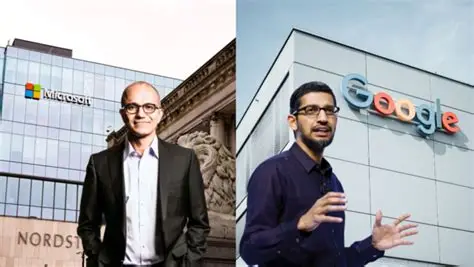
The technology industry has produced countless innovators, visionaries, and entrepreneurs, but only a handful of leaders have transformed some of the world’s most influential companies while simultaneously shaping the future of digital innovation. Among those rare figures stand Sundar Pichai and Satya Nadella, two executives whose leadership has influenced how billions of people search for information, collaborate at work, and interact with artificial intelligence.
Leading Google and Microsoft, respectively, Sundar Pichai and Satya Nadella have become defining figures in an era shaped by AI, cloud computing, enterprise software, and digital transformation. Their journeys from India to the executive offices of two technology giants have become powerful examples of global leadership in the modern economy.
As organizations increasingly depend on technology to remain competitive, the strategic decisions made by these leaders continue to affect industries ranging from healthcare and education to finance and cybersecurity. Their approaches to innovation, culture, and long-term growth provide valuable insight into the future direction of the technology sector.
Explore the Remarkable Journeys of Two Global Technology Leaders
The stories of Sundar Pichai and Satya Nadella share several striking similarities.
Both were born and educated in India before pursuing opportunities in the United States. Both built reputations through technical expertise and strategic thinking. Most importantly, both rose to the top of highly competitive organizations by consistently delivering results and adapting to changing market conditions.
Despite these similarities, each executive followed a distinct path that shaped his leadership philosophy and vision for the future.
Sundar Pichai’s Rise at Google
Sundar Pichai joined Google in 2004 and quickly became associated with products that would eventually become central to the company’s global ecosystem.
His leadership contributed to the growth of:
- Google Chrome
- Google Drive
- Gmail
- Google Maps
- Android
As Chrome grew into the world’s most widely used browser, Pichai established a reputation for managing complex products at global scale. His ability to align engineering, product, and business teams ultimately led to his appointment as CEO of Google and later Alphabet.
Satya Nadella’s Rise at Microsoft
Satya Nadella joined Microsoft in 1992 and spent more than two decades working across multiple business units.
Before becoming CEO, he led initiatives involving:
- Enterprise software
- Cloud infrastructure
- Microsoft Azure
- Server technologies
- Business platforms
When Nadella became CEO in 2014, Microsoft was navigating major industry shifts. Mobile computing had altered consumer behavior, and cloud services were reshaping enterprise technology spending.
Under his leadership, Microsoft successfully repositioned itself around cloud computing, AI, and productivity platforms.
Understand Their Leadership Styles
One reason Sundar Pichai and Satya Nadella attract attention beyond the technology sector is their leadership approach.
Both leaders are known for encouraging collaboration, continuous learning, and innovation rather than relying on highly centralized decision-making structures.
Pichai’s Product-Centric Leadership
Pichai’s leadership style is closely connected to product development and user experience.
His priorities often include:
- User accessibility
- Product scalability
- Technical innovation
- Global reach
- Long-term growth
This approach has helped Google maintain leadership positions across search, mobile operating systems, digital advertising, and AI-powered services.
Nadella’s Culture-First Strategy
Nadella is widely recognized for reshaping Microsoft’s corporate culture.
After becoming CEO, he emphasized:
- Continuous learning
- Employee empowerment
- Cross-functional collaboration
- Innovation
- Customer success
Many business analysts view Microsoft’s cultural transformation as one of the key reasons for the company’s sustained growth over the past decade.
Looking for the latest technology news? Read our TechTVHub.com review and find out why it’s a platform worth exploring.
Examine Their Impact on Artificial Intelligence
Artificial intelligence has become one of the most significant technological developments of the modern era.
Both companies have committed substantial resources to AI innovation, placing Sundar Pichai and Satya Nadella at the center of one of the most important competitive races in technology.
According to a 2024 McKinsey Global Survey, 65% of organizations report regularly using generative AI in at least one business function, nearly double the percentage reported just ten months earlier. This rapid adoption highlights why AI has become a strategic priority for nearly every major technology company.
Google’s AI Vision Under Pichai
Google has integrated AI capabilities throughout its ecosystem.
Examples include:
- Google Search
- Gemini
- Google Assistant
- Google Photos
- YouTube recommendations
Pichai has repeatedly described AI as a foundational technology capable of transforming how people access and use information.
Under his leadership, Google continues investing heavily in machine learning research, AI infrastructure, and next-generation computing technologies.
Microsoft’s AI Expansion Under Nadella
Microsoft accelerated its AI strategy through major investments and partnerships.
Key initiatives include:
- Microsoft Copilot
- Azure AI services
- Enterprise AI solutions
- AI-powered productivity tools
- OpenAI collaboration
Nadella has focused on embedding AI directly into workplace software, helping organizations incorporate advanced capabilities into everyday operations.
Analyze Their Influence on Cloud Computing
Cloud computing represents another area where Sundar Pichai and Satya Nadella have significantly influenced the global technology landscape.
Organizations increasingly rely on cloud platforms to support digital transformation, data management, and AI deployment.
Google Cloud’s Growth
Google Cloud has expanded substantially under Pichai’s leadership.
The platform supports:
- Data analytics
- AI development
- Enterprise applications
- Cybersecurity solutions
- Infrastructure services
While Google entered the cloud market later than some competitors, it has established itself as a major provider for enterprises seeking advanced analytics and AI capabilities.
Microsoft’s Azure Success
Azure has become one of Microsoft’s most important growth engines.
The platform powers:
- Enterprise software
- Hybrid cloud environments
- AI workloads
- Data services
- Government technology systems
Azure’s growth has played a central role in Microsoft’s transformation into one of the world’s most valuable companies.
Compare Their Contributions to Innovation
Innovation remains a defining characteristic of both leaders.
Although they operate within different business models, their priorities reveal notable differences in how they approach growth and technological advancement.
| Category | Sundar Pichai | Satya Nadella |
|---|---|---|
| Company | Google / Alphabet | Microsoft |
| Primary Focus | Consumer Technology | Enterprise Technology |
| Key Growth Area | AI and Search | Cloud and AI |
| Leadership Style | Product-Oriented | Culture-Oriented |
| Major Platform | Android | Azure |
| Innovation Strength | Global Consumer Reach | Enterprise Transformation |
| Strategic Vision | AI-Powered Information Access | AI-Powered Productivity |
Both executives have demonstrated an ability to guide large organizations through periods of profound technological change.
Assess Their Global Business Influence
The influence of Sundar Pichai and Satya Nadella extends well beyond Silicon Valley.
Their companies affect:
- Education
- Healthcare
- Financial services
- Government operations
- Small businesses
- Consumer technology
Products developed under their leadership are used by billions of people worldwide every day.
Digital Transformation Across Industries
Organizations increasingly depend on technology platforms from Google and Microsoft to modernize operations.
These solutions support:
- Remote work
- Cloud collaboration
- Data-driven decision making
- AI-powered automation
- Cybersecurity protection
As businesses continue modernizing their technology infrastructure, the impact of these leaders becomes even more significant.
Learn How Their Backgrounds Shape Their Leadership
One of the most compelling aspects of Sundar Pichai and Satya Nadella is how their personal experiences influence their leadership philosophies.
Both leaders frequently emphasize:
- Lifelong learning
- Curiosity
- Humility
- Adaptability
- Inclusion
Their journeys from India to leadership roles at global technology companies have shaped perspectives that prioritize opportunity, education, and continuous growth.
The Importance of Empathy
Empathy remains a recurring theme in both leaders’ public discussions.
Business experts increasingly view empathy as a competitive advantage because it helps organizations:
- Understand customer needs
- Support employees
- Encourage creativity
- Build stronger cultures
This leadership philosophy has become a defining characteristic of both executives.
A Technology Expert’s Perspective
From a technology leadership perspective, one of the most notable qualities shared by Pichai and Nadella is their ability to balance innovation with operational discipline. Many executives can drive growth or manage scale, but relatively few consistently achieve both while navigating disruptive shifts such as AI and cloud computing.
Evaluate Their Role in the Future of Technology
Several transformative technologies are expected to shape the coming decade.
These include:
- Artificial intelligence
- Quantum computing
- Cloud infrastructure
- Cybersecurity
- Digital productivity
- Automation
As leaders of two of the world’s most influential technology companies, Sundar Pichai and Satya Nadella remain central figures in these developments.
The AI-Driven Future
Many industry observers believe AI could become as transformative as the internet itself.
Google and Microsoft continue competing aggressively to develop:
- Advanced AI models
- Enterprise AI platforms
- Consumer AI assistants
- Intelligent productivity solutions
The strategic choices they make today will influence how businesses and consumers use technology for years to come.
Expanding Global Access to Technology
Both leaders have consistently emphasized broader access to technology.
Their initiatives include:
- Expanding connectivity
- Supporting digital education
- Improving accessibility tools
- Broadening access to AI technologies
These efforts have the potential to create new opportunities for individuals and organizations worldwide.
Frequently Asked Questions
1. Who are Sundar Pichai and Satya Nadella?
Sundar Pichai is the CEO of Google and Alphabet, while Satya Nadella serves as the CEO of Microsoft.
2. Why are Sundar Pichai and Satya Nadella so influential?
They lead two of the world’s most important technology companies and play major roles in shaping AI, cloud computing, software development, and digital transformation.
3. Which company focuses more on cloud computing?
Both companies invest heavily in cloud services, although Microsoft Azure currently plays a particularly central role in Microsoft’s overall strategy.
4. How have they contributed to artificial intelligence?
Both executives have overseen significant AI investments, including Google’s Gemini initiatives and Microsoft’s Copilot ecosystem.
5. What leadership qualities do they share?
They are known for strategic thinking, adaptability, humility, collaboration, and a commitment to innovation.
6. Are Sundar Pichai and Satya Nadella from India?
Yes. Both leaders were born and educated in India before pursuing advanced education and professional careers in the United States.
7. How are they shaping the future of technology?
They continue driving innovation in AI, cloud computing, cybersecurity, digital productivity, and technology accessibility.
Final Thoughts
The influence of Sundar Pichai and Satya Nadella extends far beyond the companies they lead. Their leadership has strengthened Google and Microsoft while accelerating innovation across artificial intelligence, cloud computing, and enterprise technology.
As digital transformation continues reshaping industries worldwide, their decisions will remain closely watched by investors, business leaders, policymakers, and consumers alike. If you want to stay ahead of the trends shaping the next generation of technology, follow the initiatives, innovations, and strategies emerging from the organizations led by Sundar Pichai and Satya Nadella. The future of technology is being built today, and both leaders are playing a major role in defining it.