
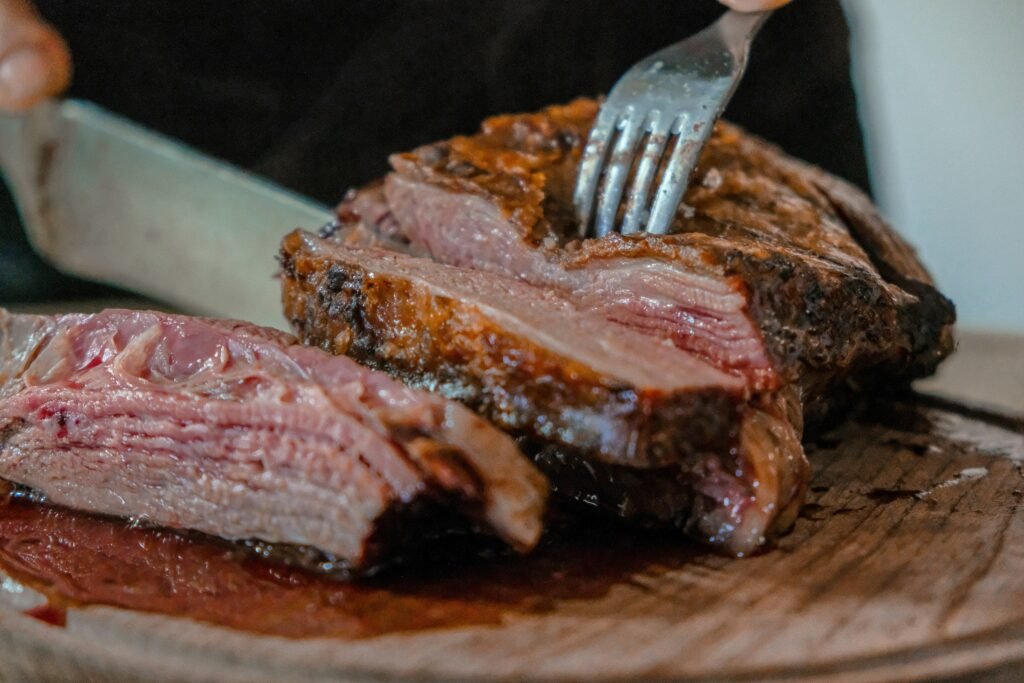
Few beef comparisons create as much interest among steak lovers, home cooks, restaurant diners, and holiday hosts as prime rib vs ribeye. Both cuts come from the same general section of the cow, both are known for rich marbling, and both can deliver an impressive eating experience. Yet they are not the same cut, and the differences matter when choosing a meal, planning a dinner, ordering at a steakhouse, or shopping at a butcher counter.
The main difference in prime rib vs ribeye comes down to cut size, preparation method, cooking style, and serving experience. Prime rib is usually cooked as a larger roast, often bone-in, then sliced into portions after cooking. Ribeye is usually cut into individual steaks before cooking and prepared quickly over high heat.
Both options are prized for tenderness and beefy flavor, but they appeal to slightly different dining occasions. Prime rib is often associated with holiday meals, buffets, carving stations, and formal dinners. Ribeye is more commonly linked to steakhouses, grilling, pan-searing, and individual plated meals.
According to the USDA, beef graded Prime has “abundant marbling” and is generally produced from young, well-fed cattle, which explains why high-grade rib cuts are so valued for tenderness, juiciness, and flavor. (USDA Agricultural Marketing Service)
Understanding prime rib vs ribeye helps buyers choose the right cut based on budget, cooking skill, flavor preference, timing, and presentation.
Understand Where Prime Rib and Ribeye Come From
The first step in comparing prime rib vs ribeye is understanding that both cuts come from the rib primal section of beef. This area is located along the upper ribcage and is known for tenderness because the muscles do less heavy work than tougher cuts from the shoulder or round.
Prime rib usually refers to a standing rib roast, which includes multiple ribs and may be cooked with the bone attached. Ribeye is cut from the same rib section but portioned into individual steaks.
Looking for an interesting restaurant story? Read our article on 801 Chophouse and discover what is chapter 11
Prime Rib vs Ribeye Cut Location
| Feature | Prime Rib | Ribeye |
|---|---|---|
| Beef section | Rib primal | Rib primal |
| Typical format | Large roast | Individual steak |
| Bone option | Often bone-in | Bone-in or boneless |
| Cooking style | Slow roasting | Grilling, broiling, searing |
| Serving style | Sliced after cooking | Served as a steak |
Because both cuts come from the same region, they share a rich flavor profile and generous marbling. The major difference is how the meat is cut and prepared before it reaches the plate.
In my experience, people often prefer prime rib for the occasion and ribeye for the crust. Prime rib feels ceremonial, while ribeye delivers the concentrated sear many steak lovers crave.
Compare Flavor Differences Between Prime Rib and Ribeye
Flavor is one of the biggest reasons people search for prime rib vs ribeye before ordering or cooking.
Prime rib tends to have a deep, roasted beef flavor because it cooks slowly as a larger piece of meat. The fat melts gradually, basting the roast from the inside and creating a juicy, tender result.
Ribeye delivers a more intense surface flavor because it is exposed directly to high heat. Grilling or pan-searing creates browning through the Maillard reaction, producing a crusty, savory exterior.
Flavor Comparison
| Flavor Factor | Prime Rib | Ribeye |
|---|---|---|
| Overall taste | Rich, roasted, juicy | Bold, beefy, seared |
| Crust development | Limited unless finished hot | Strong crust potential |
| Fat rendering | Slow and gentle | Fast and intense |
| Seasoning style | Herbs, garlic, salt, pepper | Salt, pepper, butter, steak rubs |
| Best flavor feature | Tender roast flavor | Charred steakhouse flavor |
Prime rib is often more delicate and evenly tender throughout. Ribeye usually offers stronger contrast between crisp exterior and juicy interior.
For diners who value roasted richness, prime rib may be the better choice. For those who love a charred steak crust, ribeye usually wins.
Evaluate Texture and Tenderness
Texture plays a major role in the prime rib vs ribeye debate.
Prime rib is slow-cooked, which helps preserve moisture and create a soft, tender texture. Because it is sliced after roasting, it often has a more uniform doneness from edge to center when cooked carefully.
Ribeye has a firmer steak texture because it is cooked as a smaller individual portion. The exterior develops more chew and crust, while the center remains tender.
Texture Comparison
| Texture Feature | Prime Rib | Ribeye |
|---|---|---|
| Tenderness | Very tender | Very tender |
| Exterior texture | Soft roasted edge | Crisp seared crust |
| Interior texture | Juicy and uniform | Juicy with firmer bite |
| Fat experience | Slowly rendered | Rich pockets of melted fat |
| Mouthfeel | Smooth and luxurious | Bold and steak-like |
Both cuts can be exceptionally tender when properly cooked. Poor technique can still ruin either one, especially through overcooking.
Prime rib is usually more forgiving for large gatherings because slow roasting allows better moisture retention. Ribeye requires closer attention because a few extra minutes can change the doneness quickly.
Compare Cooking Methods for Prime Rib vs Ribeye
Cooking method is one of the clearest differences in prime rib vs ribeye.
Prime rib is usually roasted at low or moderate heat, sometimes finished with high heat for browning. Ribeye is usually cooked with direct high heat through grilling, broiling, cast iron searing, or reverse searing.
Cooking Method Comparison
| Cooking Method | Prime Rib | Ribeye |
|---|---|---|
| Oven roasting | Excellent | Possible but less common |
| Grilling | Possible for roast, less common | Excellent |
| Cast iron searing | Not typical for full roast | Excellent |
| Reverse sear | Excellent | Excellent |
| Sous vide | Useful for precision | Useful for precision |
| Broiling | Used for finishing | Strong option |
Prime rib cooking often focuses on internal temperature and resting time. Ribeye cooking focuses on sear quality, heat control, and fast timing.
Typical Cooking Temperatures
| Doneness | Internal Temperature |
|---|---|
| Rare | 120–125°F |
| Medium rare | 130–135°F |
| Medium | 140–145°F |
| Medium well | 150–155°F |
| Well done | 160°F+ |
Many chefs recommend medium rare for both prime rib and ribeye because the fat renders well while the meat stays juicy.
Understand Cost Differences and Value
Cost is another major consideration in prime rib vs ribeye.
Prime rib is usually purchased as a larger roast, making the total price higher even if the per-pound price is sometimes comparable or slightly lower than ribeye steaks. Ribeye steaks are portioned individually, which can make them easier to buy for smaller meals.
Cost Comparison
| Cost Factor | Prime Rib | Ribeye |
|---|---|---|
| Purchase size | Large roast | Individual steak |
| Total cost | Higher | Flexible |
| Per-pound cost | Often high | Often high |
| Best value use | Group meals | Individual servings |
| Waste potential | Higher if overbought | Easier portion control |
Prime rib can be a better value for feeding a group because one roast serves multiple people. Ribeye is better for single meals, couples, or smaller households.
Premium beef grades, dry aging, bone-in cuts, and specialty butchers can significantly increase the price of either option.
Compare Prime Rib and Ribeye for Special Occasions
Many people compare prime rib vs ribeye when planning holidays, birthdays, anniversaries, or formal dinners.
Prime rib often works better for special occasions because it creates a centerpiece presentation. A whole roast on the table or carving station feels impressive and traditional.
Ribeye works better when each guest wants a personalized steak cooked to individual preference.
Occasion-Based Comparison
| Occasion | Better Choice | Reason |
|---|---|---|
| Holiday dinner | Prime rib | Elegant roast presentation |
| Backyard grilling | Ribeye | Fast high-heat cooking |
| Steakhouse dinner | Ribeye | Classic premium steak |
| Buffet or carving station | Prime rib | Easy slicing and serving |
| Romantic dinner | Ribeye | Individual plating |
| Large family gathering | Prime rib | Efficient serving |
Prime rib can be more efficient for hosting because the cook manages one large roast rather than several steaks.
Ribeye gives more control over individual doneness but requires more attention if cooking for a crowd.
Examine Bone-In vs Boneless Options
Both prime rib and ribeye can be sold bone-in or boneless.
Bone-in cuts often appeal to cooks who want stronger presentation and slightly more insulation during cooking. Boneless cuts are easier to slice, season, and serve.
Bone-In vs Boneless Comparison
| Feature | Bone-In | Boneless |
|---|---|---|
| Presentation | More impressive | Cleaner and simpler |
| Cooking behavior | Bone insulates meat | More even access |
| Carving | More difficult | Easier |
| Flavor perception | Often considered richer | Still flavorful |
| Price | May cost more | Usually easier to portion |
Bone-in prime rib is often called standing rib roast because the bones can support the roast during cooking.
Bone-in ribeye is sometimes called a cowboy steak when thick-cut, while an extra-long bone version may be called a tomahawk steak.
Understand the Difference Between Prime Grade and Prime Rib
A common confusion in prime rib vs ribeye involves the word “prime.”
Prime rib does not always mean USDA Prime beef. “Prime rib” refers to the cut, while USDA Prime refers to a beef quality grade based largely on marbling and maturity.
Prime Rib vs USDA Prime
| Term | Meaning |
|---|---|
| Prime rib | A beef rib roast cut |
| USDA Prime | A high beef quality grade |
| USDA Choice | Common quality grade with good marbling |
| USDA Select | Leaner grade with less marbling |
A prime rib roast can be USDA Prime, Choice, or Select. A ribeye steak can also be USDA Prime, Choice, or Select.
This distinction matters because a USDA Prime ribeye may be more heavily marbled than a USDA Choice prime rib roast.
Compare Nutrition Profiles
When comparing prime rib vs ribeye, nutrition can vary depending on portion size, trimming, grade, and cooking method.
Both cuts are rich in protein, iron, zinc, vitamin B12, and saturated fat. Ribeye is often one of the fattier steak cuts due to heavy marbling.
General Nutrition Comparison
| Nutrition Factor | Prime Rib | Ribeye |
|---|---|---|
| Protein | High | High |
| Fat | High | High |
| Calories | High | High |
| Iron | Good source | Good source |
| Vitamin B12 | Good source | Good source |
| Saturated fat | Significant | Significant |
Portion size matters. A thick ribeye steak may contain more calories than a moderate slice of prime rib, while a large prime rib serving with au jus and sides can also be calorie-dense.
For lighter meals, smaller portions and leaner side dishes can help balance the richness.
Choose the Best Cut for Home Cooking
Home cooks often ask prime rib vs ribeye because they want the best result without wasting an expensive cut.
Prime rib requires more planning but less active cooking once it is in the oven. Ribeye requires less total time but more hands-on attention.
Home Cooking Difficulty
| Factor | Prime Rib | Ribeye |
|---|---|---|
| Prep time | Moderate | Low |
| Cook time | Long | Short |
| Active attention | Moderate | High during searing |
| Thermometer importance | Very high | High |
| Resting time | Essential | Important |
| Beginner friendliness | Good with thermometer | Good with practice |
A reliable meat thermometer is one of the most important tools for both cuts.
Prime rib should rest after roasting so juices redistribute before slicing. Ribeye should rest briefly after searing for better texture and moisture.
Select the Right Cut at the Butcher Counter
Buying well is half the battle in prime rib vs ribeye.
Look for good marbling, bright color, and clean trimming. Avoid meat that looks gray, overly wet, or poorly packaged.
Buying Checklist
| Quality Sign | What to Look For |
|---|---|
| Marbling | Fine white fat throughout meat |
| Color | Bright cherry-red beef |
| Fat cap | Even but not excessive |
| Thickness | Consistent cut size |
| Smell | Clean, fresh aroma |
| Packaging | Tight and cold |
For prime rib, ask the butcher how many ribs you need based on guest count. A common rule is one rib for every two people, depending on appetite and side dishes.
For ribeye, choose steaks at least 1 to 1.5 inches thick for better searing and doneness control.
Pair Prime Rib and Ribeye With the Right Sides
The richness of both cuts benefits from balanced side dishes.
Side Dish Pairings
| Side Category | Prime Rib Pairings | Ribeye Pairings |
|---|---|---|
| Potatoes | Mashed potatoes, gratin | Baked potato, fries |
| Vegetables | Green beans, asparagus | Grilled vegetables |
| Sauces | Horseradish, au jus | Compound butter, steak sauce |
| Salads | Caesar, wedge salad | Arugula, chopped salad |
| Wine style | Cabernet, Bordeaux | Malbec, Syrah |
Prime rib often pairs beautifully with horseradish cream and au jus. Ribeye pairs well with garlic butter, chimichurri, or peppercorn sauce.
The goal is balance. Acidic, herbal, or crisp sides can cut through the richness of the beef.
Decide Between Prime Rib vs Ribeye Based on Preference
The best choice in prime rib vs ribeye depends on what kind of eating experience you want.
Choose prime rib if you want:
- A roast for a group
- Tender slices
- Elegant presentation
- Holiday-style dining
- Mild roasted flavor
Choose ribeye if you want:
- A steakhouse crust
- Individual portions
- Fast cooking
- Bold charred flavor
- Strong sear contrast
Quick Decision Table
| Preference | Best Choice |
|---|---|
| Feeding a crowd | Prime rib |
| Wanting strong crust | Ribeye |
| Hosting a holiday | Prime rib |
| Grilling outdoors | Ribeye |
| Wanting dramatic presentation | Prime rib roast or tomahawk ribeye |
| Cooking quickly | Ribeye |
There is no universal winner. Prime rib and ribeye are premium cuts designed for different cooking experiences.
Avoid Common Mistakes With Both Cuts
Because both cuts are expensive, avoiding mistakes is essential.
Common Mistakes
| Mistake | Why It Matters |
|---|---|
| Skipping thermometer | Increases overcooking risk |
| Cooking cold meat straight from fridge | Uneven doneness |
| Under-seasoning | Reduces flavor impact |
| Cutting too soon | Loses juices |
| Using too low heat for ribeye sear | Weak crust |
| Overcooking prime rib | Reduces tenderness |
Simple technique improvements can dramatically improve results.
Salt generously, monitor temperature carefully, rest the meat properly, and slice against the grain when possible.
Conclusion
The prime rib vs ribeye debate is not about which cut is objectively better. It is about choosing the right beef experience for the occasion.
Prime rib is a large roast that delivers tender slices, elegant presentation, and classic holiday appeal. Ribeye is an individual steak that delivers intense seared flavor, rich marbling, and steakhouse-style satisfaction.
Both come from the rib primal, both offer excellent tenderness, and both can be outstanding when cooked correctly.
For group dinners, prime rib often provides the better centerpiece. For quick, bold, high-heat steak cooking, ribeye is usually the stronger choice.
Understanding prime rib vs ribeye helps shoppers, cooks, and diners make smarter decisions based on flavor, texture, budget, cooking method, and occasion.
Frequently Asked Questions About Prime Rib vs Ribeye
What is the main difference between prime rib vs ribeye?
Prime rib is usually cooked as a large roast and sliced after cooking, while ribeye is cut into individual steaks before cooking.
Is prime rib more tender than ribeye?
Both are tender cuts from the rib section. Prime rib often feels softer because it is slow-roasted, while ribeye has a firmer steak texture with a seared crust.
Does prime rib taste like ribeye?
They share a similar beefy flavor because they come from the same area, but prime rib tastes more roasted and ribeye tastes more seared.
Which is more expensive, prime rib or ribeye?
Both can be expensive. Prime rib usually costs more overall because it is bought as a large roast, while ribeye costs more per individual serving in many cases.
Can you cut ribeye steaks from prime rib?
Yes. Ribeye steaks are cut from the same rib section used for prime rib roasts.
Which is better for grilling?
Ribeye is usually better for grilling because it is portioned as a steak and develops a strong crust over high heat.