
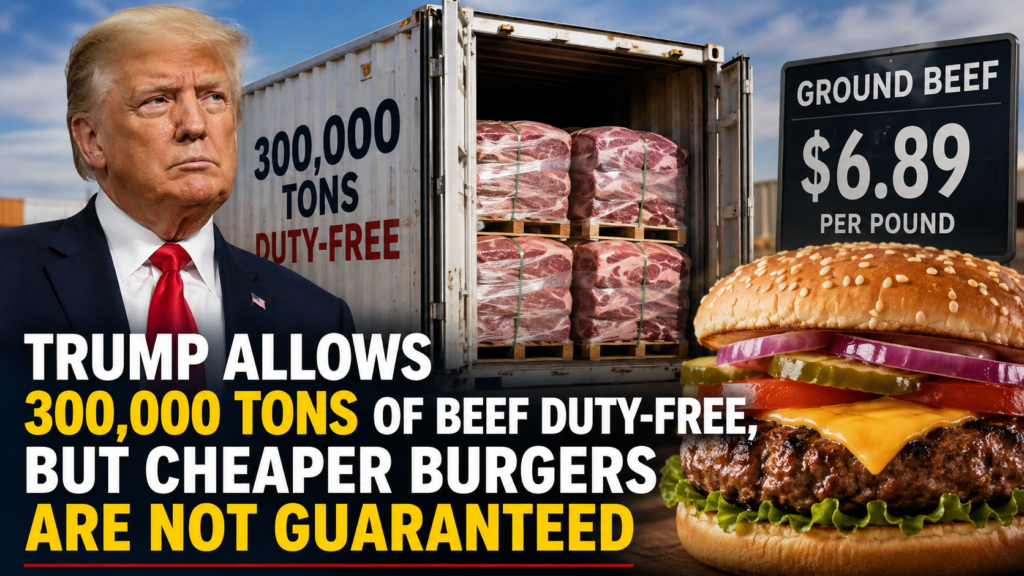
President Donald Trump has authorized 300,000 metric tons of beef to enter the United States duty-free for 90 days beginning September 1, 2026, as part of an effort to increase supply and ease record-high beef prices.
The policy could provide some relief, but agricultural economists caution that its effect on grocery store and restaurant prices may be modest. According to Bureau of Labor Statistics data cited by CNN, the average price of ground beef is currently about $6.89 per pound.
Increase Beef Supply Through Temporary Tariff Relief
Trump’s proclamation removes higher tariffs on qualifying imported beef for a limited period. The imported product must reportedly be offered at prices about 25% below prevailing market levels.
However, the exemption primarily applies to beef trimmings, which processors blend with other cuts when producing ground beef. That distinction matters because cheaper trimmings represent only one component of the final retail product.
Glynn Tonsor, an agricultural economist at Kansas State University who specializes in meat pricing, told CNN that the additional supply could help consumers but warned that the potential impact can be overstated.
Compare Imported Beef With Total US Consumption
The 300,000 metric tons covered by the policy represent only about 2% of domestic beef consumption, based on US Department of Agriculture data cited in the report.
| Market Factor | Expected Effect |
|---|---|
| 300,000 metric tons of imports | Adds limited supply |
| Duty-free beef trimmings | May lower some processing costs |
| Small share of US consumption | Limits retail price reductions |
| Strong consumer demand | Supports higher beef prices |
Another uncertainty is whether imported beef actually increases total available supply or simply replaces beef that processors would otherwise purchase from US producers.
Monitor the Factors Keeping Beef Prices High
American consumers are paying roughly 27% more for ground beef, beef and veal than three years ago, while prices have increased about 9% over the past year, according to Consumer Price Index data referenced by CNN.
The White House has linked elevated prices to insufficient supply and a US cattle herd that remains near a multi-decade low. Supply disruptions have also played a role, including restrictions on live cattle imports from Mexico following concerns involving New World screwworm.
Demand remains equally important. Tonsor’s Meat Demand Monitor found that consumers were recently willing to pay $10.09 per pound for ground beef and $24.62 for a restaurant hamburger, both higher than three years earlier.
Expect Only Modest Relief for Burger Prices
The temporary tariff exemption may add lower-cost beef to the US market, but several forces continue to support high prices. Limited cattle inventories, strong consumer demand and the relatively small size of the import program reduce the likelihood of a major price decline.
For shoppers, the most realistic outcome is modest price relief rather than dramatically cheaper burgers. The final impact will depend on how much additional supply reaches processors, retailers and consumers during the 90-day program.