Construction procurement often slows down at the exact point where project teams need certainty. A custom bracket, mounting plate, architectural panel, equipment guard, enclosure, template, or replacement component may be simple to manufacture, yet pricing it can still involve emails, drawing attachments, follow-ups, supplier calls, revisions, and several rounds of clarification.
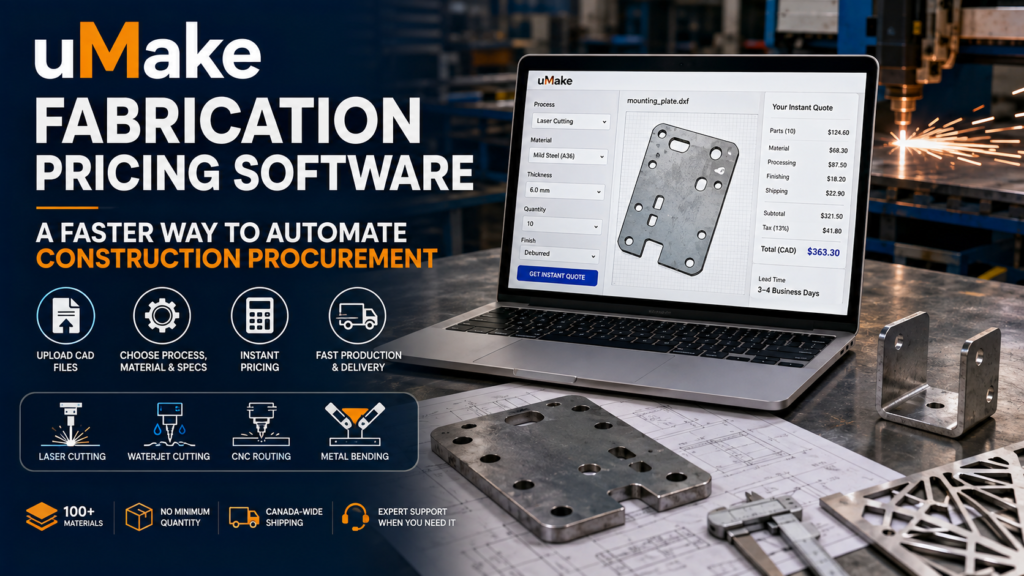
uMake fabrication pricing software is designed to shorten that process by turning digital fabrication files into online pricing for supported manufacturing work. Buyers can upload CAD files, configure materials and fabrication requirements, review pricing, and move suitable parts toward production without starting every request as a conventional RFQ. uMake currently offers instant online quoting for fabrication processes including laser cutting, waterjet cutting, CNC routing, and metal bending.
For construction estimators, project managers, subcontractors, engineers, maintenance departments, and manufacturers, the value is broader than getting a number faster. Earlier fabrication pricing can improve budgeting, value engineering, change-order review, quantity planning, and purchasing decisions. At the same time, automated quoting should not be treated as a substitute for engineering judgment. Material suitability, tolerances, structural requirements, drawing quality, finishing, and installation conditions still need appropriate technical review.
This guide evaluates uMake from a practical procurement perspective, including how the quoting workflow works, where it can save time, where human review remains necessary, and which factors buyers should verify before placing a fabrication order.
Upload a Production-Ready CAD File Before Requesting Pricing
Begin with the drawing because the quality of an automated fabrication quote depends heavily on the information supplied by the buyer. A clean digital file allows the quoting platform to evaluate geometry and calculate the manufacturing work required to produce the component.
uMake currently accepts several commonly used fabrication file formats across its services. Its website lists DXF, AI, SVG, PDF, STEP, and other CAD-compatible formats depending on the production process. For CO2 laser cutting and engraving specifically, uMake lists AI, DXF, SVG, PDF, and suitable raster images, while other fabrication pages reference STEP and native CAD files.
Before uploading a file, the buyer should verify:
- Drawing scale and dimensions
- Current revision number
- Closed and clean geometry
- Hole locations and diameters
- Material specification
- Material thickness
- Quantity
- Required bends
- Surface finish
- Tolerances
- Delivery requirements
These checks matter because pricing software can analyze the information it receives, but it cannot automatically correct every design-intent problem. If a drawing contains the wrong revision or an incorrect hole diameter, receiving an instant price does not make that file production-ready.
This distinction is important for E-E-A-T and for practical purchasing. Automated quoting improves transaction speed, but buyer-controlled design verification remains part of responsible fabrication procurement.
Select the Manufacturing Process Based on the Component
Choose the process that matches the physical and functional requirements of the part rather than simply selecting the least expensive manufacturing option.
uMake’s current online fabrication capabilities include laser cutting, waterjet cutting, CNC routing, CNC metal bending, and additional finishing services. The company states that it works with metals, plastics, wood, composites, and other materials depending on the process.
Laser cutting is commonly appropriate for precise profiles made from sheet metal. Typical construction-related examples include mounting plates, structural tabs, equipment brackets, architectural screens, enclosure panels, guards, signage plates, and connection components.
Waterjet cutting can be valuable when the material is thick, heat-sensitive, or difficult to process with a thermal cutting method. It can also handle materials beyond conventional sheet metal, depending on thickness and equipment capabilities.
CNC routing is frequently used for plastics, wood, composites, panels, and other machinable sheet materials. This makes it useful beyond structural metalwork, particularly for millwork, signage, displays, templates, architectural panels, and product components.
CNC bending becomes relevant when a flat part needs to become a three-dimensional component. uMake currently markets press-brake bending for materials including stainless steel, mild steel, aluminum, brass, copper, and specialty alloys, subject to thickness, grade, bend length, and design requirements.
Choosing the process correctly helps ensure the quote reflects the actual manufacturing requirement instead of an incomplete version of the part.
Confirm Material and Thickness Before Evaluating the Price
Treat material specification as a technical decision first and a pricing variable second.
Construction components may be produced from mild steel, stainless steel, aluminum, plastics, acrylic, wood products, rubber, composites, and specialty materials. uMake currently advertises more than 100 material choices across its fabrication platform, although availability depends on the selected manufacturing method.
Material choice influences several characteristics simultaneously:
| Factor | Material can affect |
|---|---|
| Strength | Load-bearing capability |
| Corrosion resistance | Outdoor and wet-environment durability |
| Weight | Handling, installation, and shipping |
| Appearance | Exposed architectural finish |
| Fabrication method | Cutting and bending suitability |
| Cost | Raw material and processing expense |
| Finish requirements | Painting, brushing, coating, or polishing |
| Service life | Maintenance and replacement frequency |
For example, a mild-steel bracket may be economical for an interior protected environment, but that does not automatically make it an equivalent substitute for stainless steel used in a corrosive application.
Similarly, increasing thickness may alter more than raw material cost. A thicker part can weigh more, require additional cutting time, affect bending capability, and increase shipping expense.
Procurement teams should therefore compare fabrication quotes only when the underlying specifications are technically equivalent.
Generate a Fabrication Quote While the Design Is Still Flexible
Use instant pricing before the purchase order stage when design choices can still be evaluated.
Traditional procurement often postpones accurate fabrication pricing until drawings are nearly complete. That sequence can make value engineering harder because changing a design late may affect approvals, coordination, installation details, and project schedules.
Digital quoting makes earlier pricing more practical.
uMake states that its in-house quoting engine analyzes uploaded files and calculates manufacturing factors including laser cutting, waterjet cutting, CNC routing time, material costs, selected finishing operations, and shipping information.
For supported jobs, uMake also markets quote generation in seconds or under a minute on several current pages.
The practical benefit is that an estimator can obtain manufacturing cost information while actively reviewing the component rather than opening a separate supplier communication cycle.
That capability can be useful during:
- Concept estimating
- Preconstruction
- Design development
- Value engineering
- Change-order pricing
- Prototype development
- Budget reconciliation
- Maintenance planning
- Replacement-part procurement
Speed is valuable because it keeps pricing close to the decision that created the need for the quote.
Compare Materials and Quantities Before Committing to Production
Use the digital workflow to test commercially realistic alternatives before placing an order.
Fabrication prices can change materially when quantity changes. Raw material utilization, machine time, setup efficiency, nesting, handling, packaging, and production sequencing can all influence unit economics.
uMake describes automatic pricing based on manufacturing inputs, and some of its current location pages state that the platform analyzes geometry and uses automated nesting to improve material utilization.
That capability can help buyers answer practical questions such as:
- Should we order one component or five?
- Is it economical to include installation spares?
- Does increasing quantity materially lower unit cost?
- Would another approved material reduce cost?
- Is the prototype economical enough to proceed?
- Does a simplified geometry reduce manufacturing expense?
Consider a contractor who needs four custom equipment brackets immediately but expects two additional units may be required later. A digital pricing workflow allows the buyer to compare four versus six pieces before releasing the order.
The correct decision is not always the lowest unit price. Extra inventory has a cost as well. However, seeing the relationship between quantity and total order value gives the buyer more information than simply requesting one fixed RFQ.
Reduce Manual RFQ Work for Straightforward Fabrication Parts
Automate repeatable requests rather than treating every custom component as a high-touch purchasing exercise.
A conventional fabrication RFQ can involve several manual actions. The estimator prepares drawings, writes the request, sends files, waits for acknowledgement, answers technical questions, follows up, receives a price, and may repeat the entire process when the design changes.
For complex fabrication, that interaction can be valuable and necessary.
For a straightforward CAD-defined plate, however, the administrative effort can exceed the technical complexity of the part.
uMake’s digital workflow is designed around uploading files and obtaining pricing directly through its online platform. The company also states that online quotes are checked by uMake operators before production in an effort to identify potential oversights.
That combination of automation and production review is important. It indicates that the process does not rely solely on an algorithm between upload and manufacturing.
For procurement departments, reducing repetitive RFQ administration can free time for higher-value activities including supplier qualification, contract review, scope analysis, schedule coordination, risk management, and cost forecasting.
Calculate ROI Using Your Own Procurement Workload
Measure automated quoting against actual internal labor rather than relying on generalized savings claims.
Suppose an estimating team handles 30 small fabrication pricing requests per week. If preparing, issuing, tracking, and following up on each traditional request requires an average of 25 minutes of active employee time, the team uses approximately:
30 requests × 25 minutes = 750 minutes
That equals 12.5 hours of active administrative time per week.
If a structured online workflow reduced active processing time to an average of eight minutes for suitable requests, the same workload would require:
30 requests × 8 minutes = 240 minutes
That equals 4 hours per week.
The illustrative difference is 8.5 hours per week.
This is not a claimed or guaranteed uMake saving. Actual results depend on the user’s current RFQ process, drawing quality, order complexity, approval requirements, software familiarity, and the number of parts that qualify for automated pricing.
A useful internal ROI assessment should measure:
| Metric | How to measure it |
|---|---|
| RFQs per month | Count fabrication quote requests |
| Admin time per RFQ | Track estimator or buyer time |
| Average supplier response | Measure request-to-quote time |
| Quote revisions | Count repeated pricing cycles |
| Labor rate | Use actual loaded employee cost |
| Design alternatives | Track options priced per project |
| Order value | Compare quote and purchase totals |
| Procurement lead time | Measure file-to-approved-order duration |
This creates an E-E-A-T stronger business case because the ROI comes from documented operational data rather than unsupported percentage claims.
Price Change Orders Before Fabrication Delays Reach the Field
Use digital fabrication pricing to establish component cost earlier when drawings change.
Construction change orders can create a difficult timing problem. A site condition may require a new bracket, cover plate, access panel, guard, or architectural component immediately, yet the project team may need several days to obtain conventional supplier pricing.
Automated fabrication quoting can reduce the time required to establish the manufacturing portion of that change.
A project manager might upload the revised component, select the specified material and thickness, define quantity, and obtain pricing for supported work. That amount can then become one input in the larger change-order calculation.
The final change-order value may still require:
- Installation labor
- Site supervision
- Equipment
- Freight
- Taxes
- Subcontractor markup
- General conditions
- Engineering
- Access costs
- Schedule impact
This limitation should be explicit. An instant fabrication quote is not automatically a complete installed construction price.
It provides a manufacturing cost input that can help estimators make the broader commercial decision faster.
Support Value Engineering With Actual Fabrication Cost Feedback
Use pricing data to compare technically approved alternatives instead of estimating whether a fabrication change will save money.
Value engineering is most useful when cost feedback arrives before design changes become expensive to implement.
A design team may be considering two approved panel patterns, alternative metal thicknesses, a different bend configuration, or a revised quantity. Without quick pricing, evaluating each variation may require another RFQ.
With automated fabrication software, selected alternatives can be quoted independently and compared.
For example, a project team could test:
Option A: More complex geometry with less overall material.
Option B: Simpler geometry with slightly greater material usage.
Without manufacturing data, it may not be obvious which design costs less. More complex cut paths may increase machine time even when material usage decreases.
The same principle applies to architectural screens, mounting plates, brackets, equipment panels, templates, and production parts.
Engineering controls must remain in place. Procurement staff should not change thickness, alloys, structural details, fire-rated components, or other performance-critical requirements solely because software displays a lower price.
Fabrication pricing informs the design decision. It does not replace the qualified professional responsible for approving that decision.
Order Prototypes and Low-Volume Components Without Assuming a Large Minimum
Use small-volume digital fabrication when validating a design or replacing a limited number of parts.
Traditional fabrication procurement can become inefficient when only one or two components are needed. Some suppliers may apply minimum charges because preparing the machine, material, paperwork, and production schedule takes time regardless of quantity.
uMake currently advertises no minimum quantities on its main site and across several material pages. The company describes its service as suitable for one-off prototypes through larger production quantities.
This can make the platform relevant for:
- Prototype brackets
- Replacement machine guards
- Signage plates
- Equipment covers
- Architectural samples
- Installation templates
- Jigs
- Repair components
- Test panels
- Product-development parts
A prototype-first workflow also reduces production risk. Instead of manufacturing 100 parts before confirming the design, a buyer can consider producing a small validation batch and testing fit, dimensions, assembly, finish, and performance.
Once the design is approved, larger quantities can be priced separately.
Combine Cutting and Bending When the Finished Part Requires Forming
Include downstream fabrication operations in the pricing review rather than evaluating the flat blank alone.
A common purchasing mistake is to compare the cost of a flat-cut component when the actual project requires a bent or finished part.
uMake currently offers CNC metal bending alongside its cutting capabilities. The company states that its bending service works with metals including mild steel, stainless steel, aluminum, brass, copper, and other alloys, depending on material grade, thickness, and bend dimensions.
This matters for construction components such as:
- Equipment brackets
- Flashing components
- Formed covers
- Enclosures
- Channels
- Guards
- Mounting assemblies
- Architectural trim
- Connection pieces
Bending cost depends on more than overall part size. Number of bends, bend length, material properties, thickness, tooling, and geometry all influence manufacturability.
A price for the flat laser-cut blank therefore should not be treated as the final component cost if forming remains necessary.
Buyers should review the complete production route from raw sheet to installable part.
Review Finishing Requirements Before Comparing Vendors
Account for secondary operations because the lowest cutting price may not produce the lowest finished cost.
A fabrication order may require deburring, edge treatment, brushing, coating, engraving, polishing, or other finishing work before the part is suitable for installation.
uMake’s current instant-quote description states that its pricing engine can include selected secondary operations such as deburring, edge rounding, and No. 4 brushed finishing. Its broader fabrication pages also reference additional finishing capabilities.
When comparing suppliers, the procurement team should confirm whether the quoted amount covers equivalent work.
For example:
Supplier A: $800 cutting only.
Supplier B: $920 cutting, deburring, and required finish.
The $800 quote is not necessarily cheaper if another vendor must subsequently perform $200 of finishing.
The same principle applies to shipping, packaging, bending, assembly, and other secondary operations.
A credible comparison uses scope-equivalent landed cost, not the lowest number appearing on an initial quotation.
Verify Fabrication Tolerances Against the Drawing
Check whether the manufacturing process can meet the specified dimensional requirements before ordering.
Fabrication accuracy depends on equipment, material, thickness, geometry, cut method, thermal effects, part size, and post-processing.
uMake publishes process-specific tolerance information on some current service pages. For example, its CO2 laser cutting page lists typical tolerances of approximately ±0.1 to ±0.2 mm depending on material thickness and geometry.
That published figure should not be applied automatically to every uMake process, material, or part.
Waterjet cutting, fiber laser cutting, routing, machining, and bending have different capability ranges. Tight-tolerance dimensions may require direct confirmation with the manufacturer, especially when the part interfaces with bearings, shafts, precision equipment, alignment systems, or machined assemblies.
Construction parts often tolerate more dimensional variation than precision mechanical components, but the design requirement remains the controlling standard.
Buyers should therefore compare:
Drawing tolerance → fabrication process capability → inspection requirement.
If those three items do not align, a fast quote does not resolve the manufacturing risk.
Confirm Shipping Cost and Delivery Conditions Before Checkout
Calculate landed cost rather than relying only on fabrication pricing.
Shipping can materially affect the final cost of heavy steel plates, large panels, oversized components, or multiple-part production orders.
uMake currently advertises Canada-wide delivery and free shipping on qualifying orders over $250, with exclusions for oversized parcels. Its instant-quote documentation also states that the system integrates real-time shipping information through multiple carriers.
These terms should be verified at the time of ordering because freight policies, qualification thresholds, and exclusions can change.
Construction buyers should review:
- Fabrication price
- Secondary operations
- Packaging
- Freight
- Oversize surcharges
- Taxes
- Delivery location
- Production lead time
- Carrier transit time
The distinction between production time and delivery time is particularly important.
A part may be manufactured quickly but still arrive too late for installation if freight was not considered in the schedule.
Escalate Complex Parts for Human Review
Use automated pricing for clearly defined work and technical consultation for fabrication that exceeds standard assumptions.
Automated quoting is strongest when the geometry is clear, materials are available, manufacturing processes are established, and the component does not require unusual engineering interpretation.
Human review becomes more important for:
- Complex assemblies
- Welding
- Unusual alloys
- Tight tolerances
- Difficult bend geometry
- Specialty finishes
- Large assemblies
- Ambiguous drawings
- Safety-critical parts
- Certification requirements
- Non-standard inspection
- Field-fit conditions
uMake currently states that customers can use either its instant online estimating process or request a personalized quote from a uMake professional. Its main website also says instant online quotes are reviewed by operators before production.
That is an important trust signal for procurement teams because responsible automation should include a mechanism for escalation.
The goal of fabrication pricing software should not be eliminating professional judgment. It should be removing unnecessary administrative work from parts that can be priced reliably through standardized data.
Evaluate uMake Against Traditional Fabrication Procurement
Compare the two sourcing models based on the nature of the project.
Traditional fabricators can offer substantial value when a scope requires detailed consultation, field measurement, welding, assembly, installation coordination, custom engineering, or extensive shop-drawing development.
Online fabrication platforms can be particularly effective when a part is already digitally defined and the main purchasing need is rapid, repeatable pricing.
| Requirement | uMake-style digital workflow | Traditional RFQ |
|---|---|---|
| CAD-defined flat part | Strong fit | Strong fit |
| Immediate budget estimate | Strong fit | Supplier-dependent |
| One-off prototype | Strong fit | Supplier-dependent |
| Rapid design comparison | Strong fit | Requires re-quoting |
| Repeat component | Strong fit | May require new RFQ |
| Complex welded assembly | Technical review likely | Often strong fit |
| Field measurement | Not the primary model | Often available |
| Installation | Separate consideration | Some shops provide |
| Custom engineering | May require consultation | Often available |
| Instant self-service purchasing | Strong fit | Less common |
The practical answer is often a hybrid procurement strategy.
A contractor might use uMake for standardized plates, brackets, panels, templates, and repeat components while maintaining relationships with full-service fabrication companies for stair assemblies, railings, welded structures, field-measured components, and other complex scopes.
That approach automates the work that benefits from automation without forcing every fabrication requirement through the same purchasing model.
Check uMake’s Experience and Operational Trust Signals
Look beyond software functionality when evaluating a company that will manufacture physical project components.
Digital procurement platforms should be assessed as manufacturers as well as software interfaces. A fast quote has limited value if production quality, communication, inspection, or delivery is unreliable.
uMake states that it has operated since 2009, giving the company approximately 17 years of operating history as of 2026. Its current website also states that it has served more than 20,000 customers and displays customer-review information. These figures are company-published claims and should be interpreted as such rather than as independently audited statistics.
For a business purchaser, useful trust checks include:
- Years in operation
- Manufacturing location
- Contact information
- Technical support availability
- Published fabrication capabilities
- Customer reviews
- Quote transparency
- Terms and conditions
- Shipping policies
- Quality-control procedures
- Rework policies
- Material traceability when required
Company history is a positive signal, but it should not replace project-specific due diligence.
Organizations buying critical components should still establish whether the supplier can meet applicable specifications, certifications, tolerances, documentation, and inspection requirements.
Protect Procurement Quality With a Pre-Order Review
Conduct a final technical and commercial check before converting an instant quotation into a production order.
Speed creates value only when the information being processed is correct.
Before approval, verify:
- Correct drawing version
- Correct material
- Correct thickness
- Correct dimensions
- Correct quantity
- Required bends
- Required finish
- Tolerance requirements
- Manufacturing notes
- Delivery address
- Lead time
- Shipping cost
- Taxes
- Installation deadline
For safety-critical, structural, regulated, or engineered components, the responsible professional should verify that the manufacturing specification matches the approved design.
This procedure may add a few minutes to procurement, but it can prevent far more expensive rework.
The strongest automated procurement process therefore combines fast pricing with disciplined approval rather than sacrificing one for the other.
Use uMake for Repeat Parts and Standardized Construction Components
Build reusable fabrication workflows around parts that an organization orders more than once.
Repeatedly requesting quotations for the same approved component creates administrative work without adding much procurement value.
Digital fabrication is particularly useful for standardized parts such as:
- Equipment brackets
- Machine guards
- Access covers
- Mounting plates
- Signage substrates
- Retail fixtures
- Templates
- Architectural panels
- Maintenance components
- Standard enclosure pieces
Once the design has been verified, procurement can work from the approved digital file instead of rebuilding the scope from email records.
This approach also improves revision control. If the component changes, the buyer can maintain a clearly identified updated file instead of relying on an old PDF attached to a historical conversation.
Standardized digital parts can therefore contribute to broader construction procurement automation by converting recurring custom fabrication into a controlled purchasing category.
Decide Whether uMake Fits Your Construction Procurement Workflow
Test the platform using representative work before changing an organization’s purchasing process.
A useful evaluation should include several different job types:
Test 1: A simple flat laser-cut plate.
Test 2: A small batch of brackets.
Test 3: A component requiring bending.
Test 4: A non-metal routed or waterjet-cut component.
Test 5: A repeat part that has previously been purchased conventionally.
Record the time required to create each quote, clarity of the pricing, available materials, shipping cost, manufacturing lead time, and final landed price.
Then compare those results with recent traditional RFQs.
The decision should consider more than whether uMake is cheaper on one component. Evaluate whether the platform improves the overall procurement process.
Useful evaluation questions include:
- Does it reduce estimator effort?
- Does it provide pricing early enough to influence decisions?
- Are the required materials available?
- Are manufacturing capabilities appropriate?
- Is delivered pricing competitive?
- Can technical questions be escalated?
- Does the workflow work for low quantities?
- Can repeat procurement be standardized?
- Are production and delivery timelines appropriate?
This evidence-based approach provides a stronger procurement decision than adopting new software solely because it promises instant quotes.
Start an Instant uMake Quote With a Real Project File
Use an actual project component to determine whether instant fabrication pricing delivers practical value for your organization.
Choose a straightforward part that already has an approved CAD file. Confirm its revision, material, thickness, quantity, and finishing requirements, then upload it into the uMake quoting workflow.
uMake’s current platform is designed to analyze supported digital files, calculate manufacturing requirements, present pricing, and provide a path toward ordering. The company’s published services currently include laser cutting, waterjet cutting, CNC routing, bending, and selected finishing options across a broad material range.
Compare the process with how the same item would normally be purchased.
Measure active staff time, quotation speed, delivered cost, and how easy it is to test a second quantity or material.
That trial provides procurement teams with real evidence about whether the platform fits their workflow.
For organizations processing many CAD-defined custom components, the potential advantage is straightforward: fewer repetitive RFQs, earlier cost information, and a shorter path between drawing and manufacturing.
Answer Frequently Asked Questions About uMake Fabrication Pricing Software
Does uMake provide instant fabrication pricing?
Yes. uMake currently offers an online quoting platform that analyzes supported design files and calculates pricing for several fabrication processes. The company markets instant quoting for laser cutting, waterjet cutting, CNC routing, and related manufacturing services.
Which CAD files can uMake accept?
uMake lists formats including DXF, AI, SVG, PDF, STEP, and other CAD file types across its current fabrication services. Exact compatibility can vary according to process, so buyers should verify the preferred format for their particular job.
Does uMake require a minimum order?
uMake currently advertises no minimum quantity on its primary website and multiple service and material pages. This makes the platform suitable for certain prototypes and one-off parts as well as larger production quantities.
Can contractors use uMake for construction procurement?
Yes, when the required component can be adequately specified through digital fabrication files and available manufacturing processes. Relevant examples include plates, brackets, panels, guards, templates, signage components, equipment pieces, and other custom parts. Complex structural assemblies or field-dependent fabrication may require a more traditional consultation process.
Can uMake quote CNC bending as well as cutting?
Yes. uMake currently markets CNC metal bending alongside laser cutting and other digital fabrication services. Material, thickness, bend length, geometry, and quantity affect whether a component can be formed using the available process.
Does automated fabrication quoting replace an estimator or engineer?
No. The software can automate manufacturing-price calculations for supported work, but qualified people still need to validate drawings, material suitability, structural requirements, tolerances, scope, installation costs, and project-specific risks.
Improve Procurement Decisions With Faster, Better-Verified Fabrication Pricing
The strongest case for uMake fabrication pricing software is not simply that an online quote can appear faster than a traditional RFQ. Its larger value is that fabrication cost can become available while estimators, project managers, engineers, and buyers are still making decisions.
uMake currently combines digital file uploads with automated pricing for laser cutting, waterjet cutting, CNC routing, metal bending, and related fabrication services. The company also advertises more than 100 materials, no minimum quantities, nationwide Canadian shipping, and both automated and human-supported quoting paths.
For straightforward CAD-defined parts, this model can reduce repetitive purchasing work and help teams evaluate quantity, material, geometry, and production decisions earlier.
For complex fabrication, human expertise remains essential.
That balance is important. Reliable construction procurement automation does not remove professional review from the process. It uses automation where standardized data can make purchasing faster while preserving technical oversight where material performance, tolerances, constructability, structural requirements, or unusual fabrication details require judgment.
Organizations evaluating uMake should therefore test it with real project files, compare landed costs against existing suppliers, measure internal labor savings, and verify that the finished manufacturing specification matches project requirements.
When those checks support the business case, instant fabrication pricing can turn a traditionally slow procurement task into a more measurable and repeatable workflow, helping construction and manufacturing teams move from CAD file to verified price to production decision with less administrative friction.