
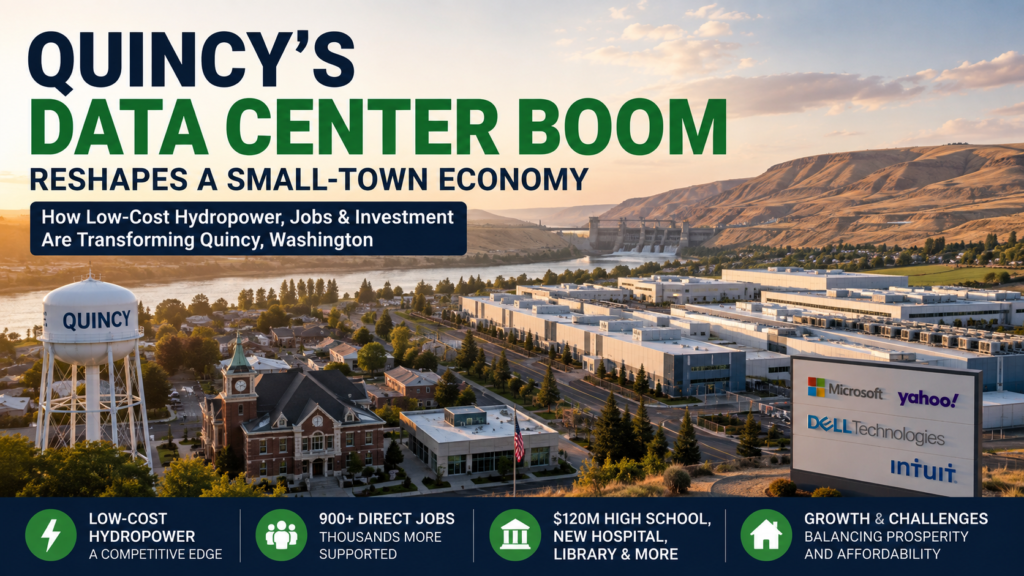
A town once known primarily for agriculture has become one of Washington state’s most striking examples of technology-driven economic growth. Quincy, a community of about 8,500 people, is now home to roughly 30 data centers operated by major companies including Microsoft, Yahoo, Dell and Intuit. Their arrival has expanded the local tax base, created hundreds of jobs and financed public projects that have changed the town’s physical and economic landscape.
Build Growth Around Low-Cost Hydroelectric Power
The shift began in 2006, when Microsoft selected Quincy for a major data center. One of the town’s biggest advantages was access to inexpensive and abundant hydroelectric power generated along the Columbia River.
That energy advantage attracted additional technology companies, creating a concentration of data-center investment unusual for a community of Quincy’s size. Today, the facilities are estimated to generate about 57% of the town’s property-tax revenue.
The additional revenue has helped finance major civic improvements, including a $120 million high school, a new hospital, a public library, upgraded police and fire stations, and a $15 million aquatic center. Former Quincy city administrator Pat Haley described the transformation as giving the town access to “brand-new everything.”
Expand Employment Across the Local Economy
The industry supports about 900 direct jobs in Quincy, ranging from engineering positions to work for electricians and pipefitters. Washington State analyses suggest every direct data-center job can generate another four to six jobs in sectors such as construction, retail and local services.
Local businesses have felt the impact directly. Quincy Hardware & Lumber, owned by Tina Stetner, expanded its inventory as construction crews and data-center operators increased demand for tools, materials and equipment.
The broader economic improvement is also reflected in poverty statistics. Quincy’s poverty rate declined from 29.4% in 2012 to 6.2% in 2024, illustrating the scale of change highlighted by business outlets such as GrowBusinessMag.
Invest in Power and Water Infrastructure
Data centers require significant infrastructure, but Quincy has structured much of that growth so industrial users bear more of the cost. Operators pay for their own power infrastructure rather than transferring those expenses directly to households.
Last year, residential electricity rates increased 3.5%, while rates for large industrial customers rose 9.1%. Data centers also account for about 8% of the city’s water use, and Microsoft contributed funding toward a $30 million water-reuse facility.
Address Housing Pressure as Prosperity Grows
The boom has not benefited every resident equally. Home prices have roughly doubled over the past decade, creating affordability pressures, while some community advocates argue that local workers have not captured the same share of economic gains as large employers and specialized contractors.
Quincy’s next challenge will be managing that imbalance. Continued data-center expansion could bring more revenue and employment, but the town’s long-term success will depend on whether it can pair technology investment with affordable housing, local workforce development and infrastructure that keeps pace with growth.