
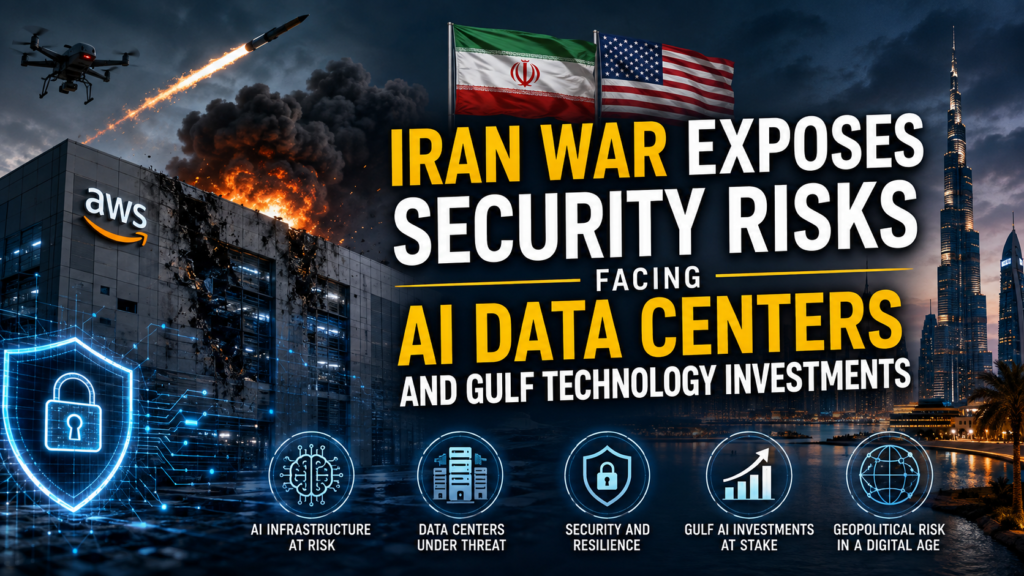
AI data centers are becoming a new source of geopolitical and economic risk as the Iran war expands beyond traditional military and energy targets. According to reporting by CNN, Iran and the United States have attacked multiple data centers in the Gulf region, highlighting how cloud infrastructure can serve both commercial customers and government defense operations.
The development matters because data centers support artificial intelligence systems, financial services, government platforms, communications networks and military intelligence. Damage to these facilities could disrupt digital services while weakening confidence in one of the world’s fastest-growing technology investment regions.
Assess Reported Attacks on Gulf Data Centers
CNN reported that Iran and the United States had targeted at least five data centers in the region. The incidents reportedly included two Iranian attacks on an Amazon Web Services facility in Bahrain. Amazon declined to comment on the attacks, although the company’s service dashboard showed a regional disruption following the first incident.
Satellite imagery cited in the report also indicated significant damage to the AWS facility. However, the full operational impact and the extent of any data loss were not publicly confirmed.
Iran’s Islamic Revolutionary Guard Corps reportedly identified 29 regional technology targets connected to companies including Amazon, Google, Microsoft, Nvidia and Palantir. Iranian authorities argued that cloud facilities supporting US military intelligence could be treated as military targets.
Amazon, Google, Microsoft and Oracle are contractors for the US Department of Defense’s Joint Warfighting Cloud Capability program. This connection illustrates the difficulty of separating civilian cloud services from defense infrastructure.
Evaluate Risks to Gulf AI Investments
The attacks could affect Gulf states that are investing heavily in artificial intelligence and advanced computing. Saudi Arabia has made AI a major part of its economic development plans, while the United Arab Emirates has pursued large-scale technology agreements with US companies.
Bahrain, Kuwait, Oman, Qatar, Saudi Arabia and the UAE have collectively announced more than $2 trillion in AI-related investments and commercial agreements with the United States, according to figures cited in the CNN report.
Helima Croft, head of global strategy at RBC Capital Markets, warned that attacks on technology infrastructure could undermine confidence in the Gulf as a center for AI innovation. Her assessment reflects a wider concern among investors: valuable digital infrastructure may become increasingly exposed when technology partnerships align closely with military or diplomatic interests.
Strengthen Resilience Against Physical Attacks
Data centers usually rely on backup power, duplicated networks and geographically distributed storage. These systems are designed to protect services from equipment failures, natural disasters and damaged communication cables.
Physical attacks create a more serious challenge. Philip Wray, an insurance specialist at MSIG USA, described data centers as warehouse-style buildings containing extremely expensive equipment. Their size, energy requirements and fixed locations make them difficult to protect completely from missiles or drones.
Insurance costs may also rise. Industry specialists quoted by CNN said some insurers were becoming less willing to cover infrastructure in high-risk regions. Technology companies may therefore have to retain more financial risk while also paying higher prices for chips, construction materials, security and labor.
Prepare AI Infrastructure for Geopolitical Conflict
The Iran war demonstrates that AI infrastructure can no longer be treated as purely commercial property. Data centers now support economic systems, public services and defense operations, making them strategically valuable during conflicts.
Companies and governments will need stronger geographic diversification, reliable backup capacity, improved physical security and transparent risk planning. The long-term growth of Gulf AI investment may depend not only on access to capital and technology, but also on whether critical computing infrastructure can remain secure during regional instability.