
Christian Stracke has built his reputation in a corner of finance where influence rarely produces celebrity. He does not run a consumer bank, promote a retail investing app, or cultivate a highly visible personal brand. His work takes place largely inside institutional credit markets, where investors assess corporate debt, private lending, distressed assets, sovereign risk, and the movement of capital across regions.
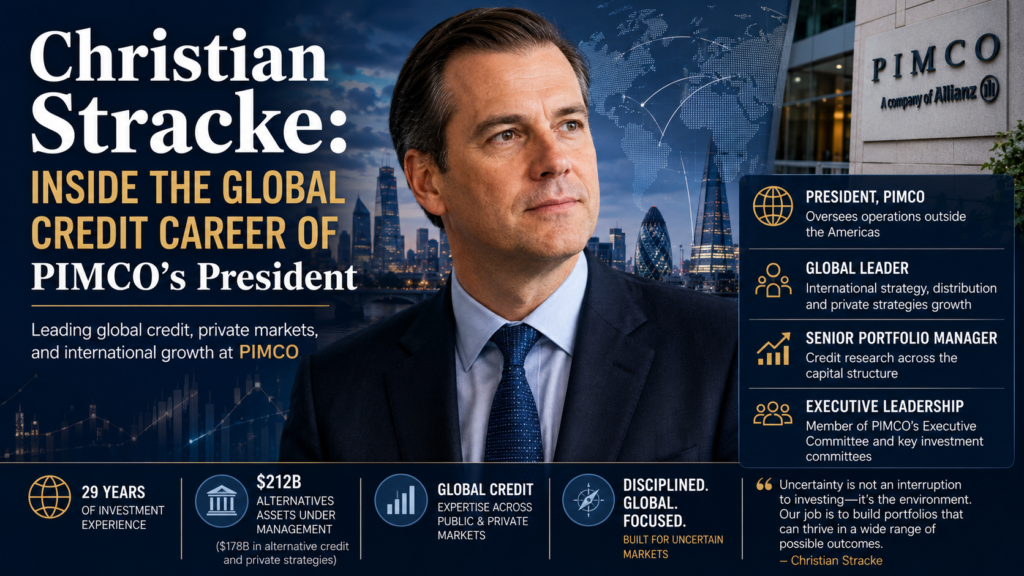
As president of PIMCO, Stracke helps lead one of the most prominent fixed-income investment managers in the world. According to PIMCO, he oversees the firm’s operations outside the Americas, including international strategy, distribution growth, and the expansion of its private strategies platform. He is also a senior portfolio manager, serves on committees connected to alternative credit and private investments, and sits on PIMCO’s Executive Committee.
That combination places Christian Stracke at the meeting point of investment research, portfolio management, private markets, and global business leadership. His career also shows how expertise in emerging economies and corporate credit can lead to an executive position at a major asset manager.
Who Is Christian Stracke?
Building a Career Around Credit and International Markets
Christian Stracke is an American investment executive who serves as PIMCO’s president and a managing director. Based in London, he has spent much of his career analyzing debt markets, corporate borrowers, emerging economies, and the risks that influence fixed-income returns.
PIMCO’s official biography credits Stracke with 29 years of investment experience. His present role requires more than familiarity with bonds. Credit investing can involve evaluating a borrower’s cash flow, debt burden, collateral, refinancing schedule, legal protections, and position within a company’s capital structure.
A company may appear profitable while carrying obligations that become difficult to refinance. Another borrower may have modest growth but own assets that provide lenders with meaningful protection. Credit specialists must identify these differences before market stress makes them obvious.
Stracke earned his undergraduate degree from the University of Chicago. Before moving into finance, he served with the Peace Corps as an agroforestry extension agent in Mauritania, West Africa, according to his official PIMCO biography.
That experience stands apart from the traditional route through investment banking or graduate business school. It also gave Stracke direct exposure to an emerging economy before his professional focus shifted toward international debt markets.
Moving Into Latin American Fixed Income
Before joining PIMCO, Christian Stracke held senior positions focused on Latin American markets. He worked as head of Latin America local-markets strategy at Deutsche Bank and as head of Latin America fixed-income strategy at Commerzbank Securities.
Those responsibilities would have required close analysis of sovereign bonds, currencies, central-bank decisions, inflation, fiscal policy, and international capital flows. Investing in local-market debt is particularly demanding because returns may depend on both the price of a bond and movements in the issuing country’s currency.
A bond can offer a high yield and still generate a poor result when its currency loses substantial value. Conversely, improving economic policy or a strengthening currency may add to the return from an otherwise ordinary fixed-income security.
Stracke later became a senior credit strategist at CreditSights, an independent research company known for corporate-debt analysis. That position expanded his work beyond regional macroeconomics and placed greater emphasis on individual issuers, leverage, balance sheets, and market pricing.
By the time he joined PIMCO in 2008, Stracke had worked across emerging-market strategy, local-currency debt, corporate credit, and institutional research. Each stage developed skills that would later support his responsibilities as a portfolio manager and executive.
Role at PIMCO and Career Highlights
Joining PIMCO During a Defining Credit Crisis
Christian Stracke joined PIMCO in 2008, as the global financial crisis exposed deep weaknesses in banks, mortgage securities, structured products, and corporate funding markets.
Credit analysis became critical during that period. Investors needed to distinguish between securities that had fallen because of broad panic and those whose prices reflected genuine deterioration in the underlying borrower.
Stracke’s background in emerging markets and corporate research was well suited to that environment. Over the following years, he took on increasingly senior responsibilities across PIMCO’s credit, portfolio-management, and international businesses.
PIMCO now identifies him as its president and a managing director. His remit includes operations outside the Americas, international business strategy, distribution expansion, and the growth of private strategies. He also remains involved in portfolio management and serves on the firm’s Executive Committee.
The president’s title can carry different responsibilities at different firms. In Stracke’s case, the documented role combines organizational leadership with continued participation in investment decisions. He is not described solely as an administrator removed from portfolio activity.
Leading Credit Research Across the Capital Structure
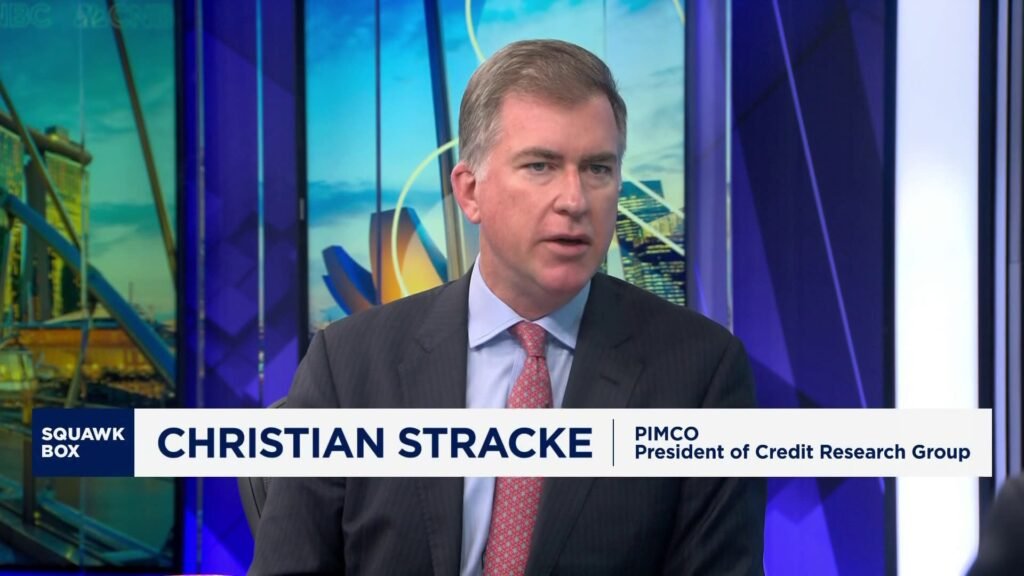
Stracke has also been publicly identified as PIMCO’s global head of credit research. The Milken Institute listed him in that capacity during its 2025 Global Conference, where he appeared on a panel examining the outlook for credit markets.
Credit research across the capital structure covers several types of claims on a borrower. These can include investment-grade bonds, high-yield debt, bank loans, convertible securities, and privately negotiated financing.
Each instrument carries different rights and risks. Senior secured lenders may have first claims on specified collateral, while unsecured bondholders rely more heavily on the borrower’s overall financial strength. Subordinated investors accept a weaker position in exchange for the possibility of higher returns.
Research teams must therefore examine more than revenue and earnings. They evaluate leverage, free cash flow, debt maturities, collateral values, covenant protections, management behavior, competitive pressure, and the terms governing each security.
Stracke’s experience in this area helps explain his involvement in conversations about private credit, bank retrenchment, and the growing overlap between publicly traded bonds and privately originated loans.
Expanding PIMCO’s Private-Market Platform
Private credit has become a larger part of the asset-management industry as investment firms increasingly provide financing directly to companies, property owners, and holders of specialized assets.
PIMCO reports $212 billion in alternatives assets under management, including $178 billion across alternative credit and private strategies. The figure provides a sense of the scale of the platform that Stracke helps oversee and expand, although assets under management are not the same as revenue, profit, or personal compensation.
Private strategies may include corporate lending, real estate credit, specialty finance, asset-based lending, and investments in less-liquid or more complex debt. These markets can offer additional income and stronger lender protections, but they may also be more difficult to value or sell than publicly traded securities.
The expansion of private lending is partly connected to changes in the banking sector. Regulatory requirements, balance-sheet constraints, and risk limits have reduced banks’ appetite for certain loans. Large investment firms have stepped into some of the resulting gaps.
PIMCO has publicly described bank retrenchment as a source of potential opportunity for credit investors.
The opportunity is not free of risk. Private assets may trade infrequently, valuations may rely on models, and investors may need to hold positions for years. Careful underwriting becomes more important when an investor cannot easily sell a loan after the borrower’s condition deteriorates.
Stracke’s role brings together both sides of the business. His research background supports the analysis of borrowers, while his executive responsibilities involve the growth of the platform that originates and manages private investments.
Investment Philosophy and Market Views
Selecting Individual Credits Instead of Buying a Theme
Christian Stracke’s public appearances point to an investment approach built around selection rather than broad enthusiasm for an entire market.
Credit categories can appear uniform from a distance. Investors may refer to high yield, private credit, or emerging-market debt as though each were a single investment. In practice, these categories contain borrowers with widely different finances, assets, industries, and refinancing needs.
Two companies operating in the same sector may present opposite credit profiles. One may generate stable cash flow and carry little debt. The other may depend on repeated borrowing to fund operations and meet existing obligations.
This difference explains why research remains central to credit investing. A portfolio manager cannot rely only on a forecast for interest rates or economic growth. Lower rates may help borrowers refinance, but they cannot repair every weak business model. Higher rates may create stress, but companies with manageable leverage can remain resilient.
Christian Stracke’s documented market insight is that uncertainty should be treated as a persistent feature of investing rather than an unusual interruption. In a 2026 PIMCO discussion, he presented a framework for navigating markets in which geopolitical tension, inflation risk, and credit stress can produce a wide range of outcomes.
That view supports a disciplined approach: assess the borrower, documentation, collateral, price, and potential downside instead of assuming every loan within a popular asset class will behave similarly.
Building Portfolios That Can Withstand Uncertainty
A portfolio designed for only one economic forecast may perform well when that forecast is correct and struggle badly when conditions change.
Credit portfolios can reduce this dependence by spreading exposure across borrowers, industries, countries, maturity dates, and levels of the capital structure. Diversification cannot prevent losses, but it can limit the damage caused by a single company, sector, or economic event.
Portfolio resilience also depends on liquidity. Market disruptions sometimes create attractive prices, but investors can act only when they have cash or assets that can be sold without severe losses.
This creates a balance between opportunity and caution. Holding less-liquid private assets may provide additional yield or contractual protection, while maintaining liquid securities can give a portfolio manager room to respond when markets become volatile.
PIMCO’s investment material has emphasized the role of high starting yields in helping bond income contribute more heavily to total returns. In its 2026 global outlook, the firm said investors could seek diversified, high-quality fixed-income portfolios with local-currency yields in the 5% to 7% range, while acknowledging that returns and volatility remain uncertain.
The principle fits the broader approach associated with Stracke’s work: portfolios should not depend entirely on predicting capital gains or the precise path of monetary policy.
Watching How Interest Rates Affect Borrowers
Interest rates influence both sides of a credit investment. They affect the income available to the lender and the financing burden carried by the borrower.
When rates rise, companies with floating-rate loans may face larger interest payments. Borrowers that need to replace maturing debt can also discover that new financing costs significantly more than the obligations being refinanced.
Lower rates may ease this pressure, but the reason for a rate cut matters. Central banks may reduce rates because inflation is improving, or they may act because economic growth and financial conditions are deteriorating.
A falling policy rate therefore does not automatically make every credit more attractive. Investors still need to examine the borrower’s margins, cash flow, debt structure, and ability to access capital.
Stracke’s research-oriented career reflects this issuer-by-issuer approach. A highly leveraged company may remain vulnerable after rates begin falling, while a stronger borrower may continue meeting obligations during a prolonged period of restrictive policy.
Connecting Public and Private Credit Markets
The distinction between public and private credit is becoming less rigid. A company may use syndicated loans, publicly traded bonds, private financing, and asset-backed structures at different points in its development.
Investors who can compare opportunities across these markets may have an advantage. A private loan may offer stronger documentation but limited liquidity. A public bond may trade more easily but provide weaker lender protections. The better option depends on the compensation offered for each risk.
This convergence is particularly relevant to PIMCO because the firm operates across traditional fixed income and alternative credit. Stracke’s responsibilities place him near the center of that expansion.
The challenge is to avoid treating private markets as automatically superior. Less-frequent trading can make prices appear stable even when underlying risk is increasing. Public markets may display volatility more visibly because securities are priced every day.
A disciplined investor compares expected return, liquidity, documentation, collateral, and downside risk rather than choosing an asset simply because it carries a private or public label.
Net Worth and Compensation
Treating Online Net-Worth Claims With Caution
Christian Stracke’s net worth receives attention online partly because of his senior position at PIMCO and his former marriage to television personality Sutton Stracke.
No authoritative public source, however, provides a complete and independently verified figure for his personal wealth. Websites that publish exact totals may rely on estimated salaries, assumed investment returns, reported property values, or comparisons with other finance executives.
Such calculations can create a false impression of precision. Without personal financial disclosures, audited records, or verified ownership data, a specific Christian Stracke net-worth figure remains speculative.
It is reasonable to infer that a long career in senior investment-management roles may produce substantial compensation. That does not make any particular estimate reliable.
Net worth can also include assets that are difficult to value, privately held investments, retirement accounts, liabilities, real estate, and deferred compensation. Public observers do not have enough information to calculate these components accurately.
Understanding Executive Compensation at an Asset Manager
PIMCO does not publish a straightforward annual salary for Christian Stracke comparable to the named-executive compensation tables included in many public-company filings.
PIMCO is owned by Allianz, but public disclosures do not necessarily provide detailed compensation for every senior investment professional. Pay packages at major asset managers can include a base salary, annual bonuses, deferred awards, long-term incentives, and performance-related compensation.
The final amount may depend on several factors, including investment results, business growth, fundraising, client retention, leadership responsibilities, and the performance of the wider firm.
Portfolio managers may also invest personal capital in funds or strategies, but any claim about Stracke’s specific holdings would require supporting regulatory or financial records.
His position indicates that his compensation is likely substantial relative to most occupations. The precise amount remains private, and unsupported online salary estimates should not be presented as confirmed facts.
Measuring Influence Without Relying on Personal Wealth
Net worth is not the clearest measure of Christian Stracke’s professional importance.
His influence comes from the scale of the markets and business functions he helps oversee. As PIMCO’s president, he participates in senior management. As a portfolio manager and credit specialist, he remains connected to investment decisions. As an international executive, he works across regions with different currencies, regulations, economic cycles, and client needs.
Those responsibilities can affect how institutional capital is allocated, how PIMCO expands its private strategies, and how the firm evaluates changing conditions in global debt markets.
Personal financial estimates may attract search interest, but Stracke’s documented career provides a more reliable measure of his standing within the investment industry.
Compare Christian Stracke’s Major Career Stages
| Career stage | Organization or activity | Primary focus | Skills developed | Connection to current role |
|---|---|---|---|---|
| International service | Peace Corps in Mauritania | Agroforestry and development work | Cross-cultural experience and exposure to an emerging economy | Added an international dimension to his later market career |
| Emerging-market strategy | Deutsche Bank | Latin American local markets | Currency, sovereign-debt, interest-rate, and policy analysis | Built expertise in complex international markets |
| Fixed-income leadership | Commerzbank Securities | Latin American fixed-income strategy | Bond strategy, macroeconomic analysis, and institutional research | Expanded his responsibility across regional debt markets |
| Independent research | CreditSights | Corporate credit strategy | Issuer analysis, leverage assessment, and capital-structure research | Prepared him for a senior credit role at an investment manager |
| Portfolio management | PIMCO | Credit research and investment strategy | Asset selection, risk analysis, and committee leadership | Established his influence across public and private credit |
| Executive leadership | PIMCO presidency | International strategy, distribution, and private-market growth | Organizational leadership and global coordination | Defines his current responsibility outside the Americas |
The progression reveals a consistent professional direction. Stracke moved from international service into emerging-market analysis, then from research into portfolio management and executive leadership.
Each stage broadened the level at which he evaluated financial risk. His work developed from studying countries and currencies to examining companies, debt structures, portfolios, and eventually the international operations of a global investment firm.
Frequently Asked Questions About Christian Stracke
Who is Christian Stracke?
Christian Stracke is an American investment executive who serves as PIMCO’s president and a managing director. Based in London, he oversees the firm’s international operations outside the Americas, according to PIMCO.
What does Christian Stracke do at PIMCO?
Stracke oversees international strategy, distribution expansion, and the scaling of PIMCO’s private strategies platform. He is also a senior portfolio manager, participates in alternative-credit committees, and serves on the Executive Committee.
When did Christian Stracke join PIMCO?
Christian Stracke joined PIMCO in 2008. Before joining the firm, he worked at CreditSights, Commerzbank Securities, and Deutsche Bank in credit and Latin American fixed-income roles.
What is Christian Stracke’s net worth?
Christian Stracke’s exact net worth has not been independently verified. Online figures should be treated as estimates because they are not supported by publicly available personal financial statements or confirmed compensation disclosures.
Where did Christian Stracke study?
According to his official PIMCO biography, Stracke earned his undergraduate degree from the University of Chicago. Before entering finance, he served with the Peace Corps in Mauritania.
Follow Christian Stracke’s Influence Across Global Credit Markets
Christian Stracke’s career shows how focused expertise can develop into broad institutional leadership. His early work in Latin American markets built his understanding of currencies, sovereign debt, inflation, and policy risk. His credit-research experience strengthened his ability to evaluate companies and capital structures. His years at PIMCO placed those skills inside a global investment platform.
His present role extends beyond conventional bond analysis. PIMCO says he oversees international operations, helps expand distribution, supports the growth of private strategies, manages investments, and participates in executive decision-making.
The most credible profile of Christian Stracke is not built around unsupported claims about his personal fortune. It rests on his documented career, his responsibilities at PIMCO, and his public participation in discussions about credit risk, private lending, interest rates, and global uncertainty.
Readers tracking his work should follow PIMCO’s official research, leadership pages, podcasts, and conference appearances. Those sources offer the clearest view of how Stracke approaches global credit markets and how his responsibilities continue to evolve.