
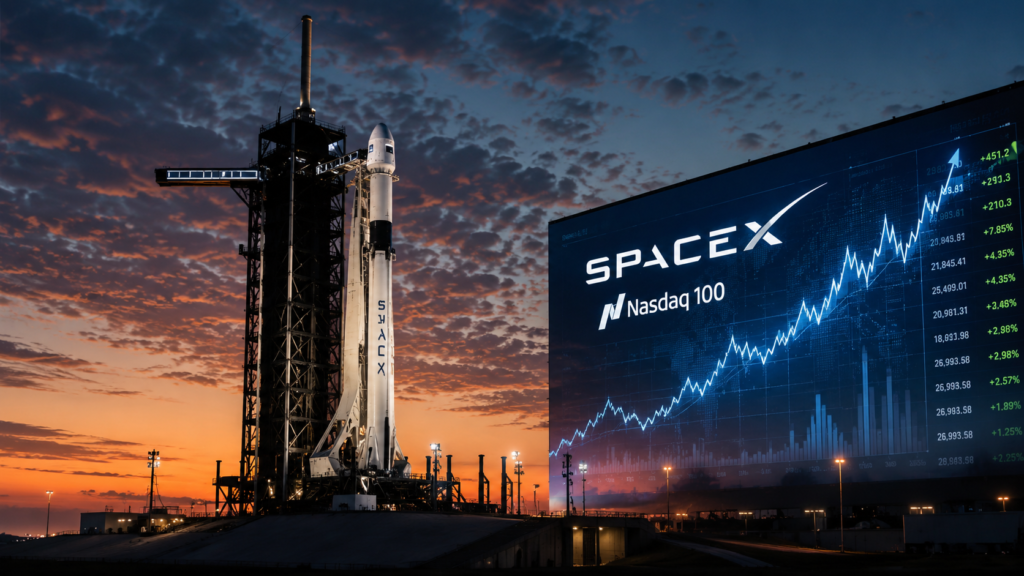
SpaceX will officially join the Nasdaq 100, marking a major milestone for the aerospace company and expanding its presence in one of the world’s most widely followed stock indexes. The addition is expected to trigger billions of dollars in automatic share purchases as index-tracking funds rebalance their portfolios to reflect the change.
Why SpaceX Is Joining the Nasdaq 100
More than 200 investment products collectively managing about $800 billion are linked to the Nasdaq 100. Because these funds are designed to replicate the benchmark, they will be required to buy SpaceX shares once the company is added, creating a wave of passive investment demand. Analysts estimate the inclusion could generate roughly $4.3 billion in automatic buying from index funds.
The fast-track inclusion follows Nasdaq’s rule changes introduced in May. Under the revised methodology, newly listed companies can qualify for the Nasdaq 100 just 15 days after their initial public offering instead of waiting three months. The change was intended to accommodate exceptionally large IPOs such as SpaceX.
SpaceX has already joined benchmark indexes managed by FTSE Russell and MSCI. However, it will not be eligible for the S&P 500 in the near term because S&P Dow Jones Indices has retained its existing requirements, including a minimum one-year waiting period.
What It Means for Investors
Peter Haynes, head of index and market structure research at TD Securities, said the unprecedented size of the SpaceX IPO has pushed index providers to reconsider long-standing eligibility rules. His comments highlight a broader shift: benchmark indexes are evolving to keep pace with a market increasingly shaped by trillion-dollar companies rather than traditional listing timelines.
Despite a market valuation exceeding $2 trillion, SpaceX will initially account for only a small portion of the Nasdaq 100. Less than 5% of its shares are publicly available, limiting its initial weighting to roughly 1% of a typical Nasdaq 100 investment. That weighting could increase as lock-up periods expire and more shares enter the market.
As noted by GrowBusinessMag, the inclusion also underscores how passive investing continues to influence stock demand, especially when newly public companies are added to major indexes.
What’s Next for SpaceX
SpaceX shares remain above their $135 IPO price but below their post-listing peak, reflecting continued investor enthusiasm alongside expectations of volatility. Morningstar analysts continue to value the company below its debut market price, suggesting the stock may experience further swings as trading volumes normalize.
To become eligible for the S&P 500, SpaceX must still deliver four consecutive profitable quarters, a milestone that took Tesla nearly a decade to achieve.
Outlook
Investors will closely watch how sustained index fund demand influences trading activity once the initial rebalancing is complete. Future earnings, additional publicly traded shares, and progress toward S&P 500 eligibility are likely to be the next major catalysts shaping SpaceX’s market performance.