
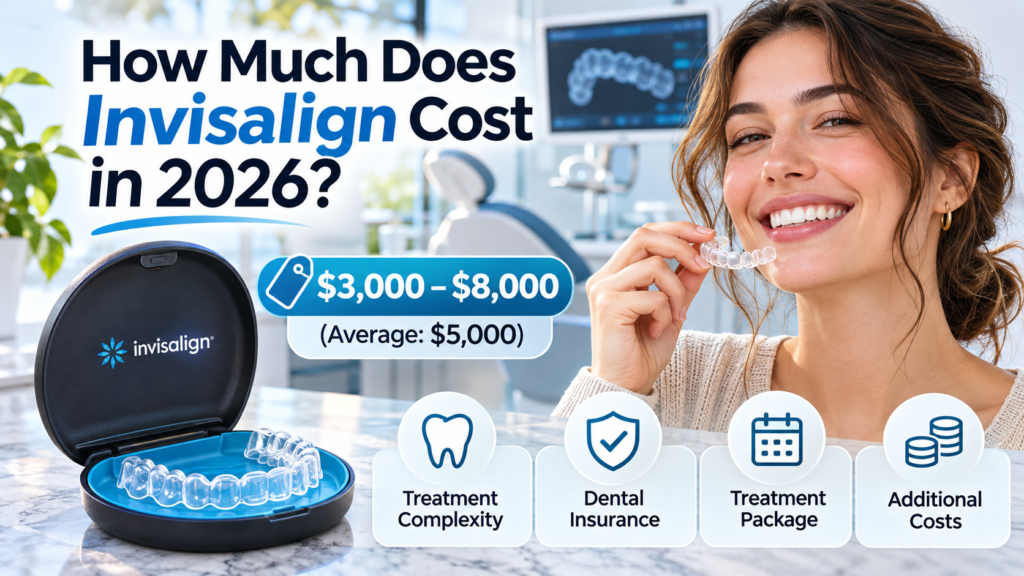
How much does Invisalign cost? In 2026, Invisalign typically costs between $3,000 and $8,000 in the United States, with approximately $5,000 serving as a useful budgeting estimate for comprehensive treatment. Patients with minor alignment problems may pay less, while complex orthodontic cases can cost $9,500 or more.
The final price depends on the condition of your teeth, the type of treatment required, your orthodontist’s fees, and whether your dental insurance includes orthodontic benefits. Additional expenses, such as retainers, replacement aligners, and financing charges, can also affect the total amount you pay.
According to Invisalign’s official pricing information, treatment fees are determined by the provider based on individual clinical requirements. Invisalign also confirms that many dental insurance plans cover its aligners similarly to traditional braces.
Before committing to treatment, understanding these costs can help you avoid unexpected expenses, compare orthodontic providers, and choose a payment arrangement that fits your budget.
1. Calculate the Average Invisalign Cost in 2026
The average Invisalign cost is often estimated at approximately $5,000 in the United States, although patients may receive quotes ranging from $1,800 to $9,500 depending on their orthodontic needs. Most comprehensive treatment estimates fall between $3,000 and $8,000. These are published consumer pricing estimates, not a fixed national price established by Invisalign.
A patient’s treatment cost depends primarily on the complexity of tooth movement, the anticipated number of aligners, and the amount of professional supervision required. Straightening a few mildly crowded teeth generally involves less extensive treatment than correcting substantial crowding, multiple tooth rotations, or complicated bite relationships.
The orthodontist’s location, experience, practice expenses, and included services can further influence the quote. For example, one dental practice may include diagnostic scans, follow-up appointments, and additional aligners in its initial price, while another may charge separately for certain services. Comparing the complete treatment fee is therefore more useful than comparing advertised starting prices.
Invisalign cost breakdown by treatment complexity
| Treatment type | Estimated U.S. cost | Typical needs |
|---|---|---|
| Minor corrections | $1,800–$3,000 | Small gaps and mild crowding |
| Moderate corrections | $3,000–$5,000 | Noticeable spacing or crooked teeth |
| Comprehensive treatment | $3,500–$8,000 | Extensive tooth movements and bite correction |
| Particularly complex treatment | $8,000–$9,500+ | Difficult cases requiring prolonged treatment |
These ranges overlap because treatment fees are individually determined. They are based on published consumer estimates, including GoodRx’s dentist-reviewed Invisalign cost guide, rather than a guaranteed price list for each treatment category.
For budgeting purposes, $5,000 is a reasonable starting figure. However, the only reliable way to establish your actual cost is to obtain a personalized treatment proposal after a dental examination.
2. Compare Invisalign Costs With and Without Insurance
Invisalign costs without insurance generally range from $3,000 to $8,000 for full treatment, while eligible dental insurance can reduce the patient’s out-of-pocket responsibility. Insurance savings depend on the policy’s orthodontic benefits, maximum reimbursement limits, age restrictions, and network requirements.
Some dental insurance plans pay a percentage of eligible orthodontic treatment expenses. Others provide a fixed benefit up to a lifetime orthodontic maximum. A plan covering 50% of treatment does not necessarily pay half of the entire bill because its lifetime limit may restrict the actual payment.
Invisalign reports that qualifying dental insurance benefits may reach $3,000. Its published insurance information also references historical OrthoFi data showing an average orthodontic benefit of $1,772 among a particular group of insured patients who used its verification service in 2021. That historical figure is not a current nationwide average or a guarantee of individual coverage.
Calculate Invisalign costs with insurance
Consider a patient who receives a treatment quote of $5,000 and has a confirmed orthodontic benefit of $1,500.
The estimated payment would be:
- Invisalign treatment fee: $5,000
- Approved insurance benefit: $1,500
- Patient’s remaining balance: $3,500
If the orthodontist offers 24-month financing at 0% interest with no additional fees, the patient could pay approximately $145.83 per month.
However, if the policy excludes adult orthodontics or the lifetime benefit has already been used, the patient might need to pay the entire treatment cost. Patients should therefore request a benefits verification before accepting any quoted insurance savings.
3. Select the Appropriate Invisalign Treatment Package
The Invisalign treatment package recommended by your dental professional can significantly affect the total cost. Limited treatment options are generally less expensive because they address smaller alignment problems, while comprehensive treatment involves more extensive planning and potentially longer treatment.
During the examination, the dentist or orthodontist evaluates the position of the teeth, available space, bite relationships, gum health, and supporting structures. This assessment determines which movements are necessary and whether a limited or comprehensive Invisalign plan can safely achieve the treatment objectives.
Patients should not choose a shorter package solely to save money. A limited plan may straighten visible teeth without addressing an underlying bite problem. If additional correction becomes necessary, the patient could face higher overall treatment expenses.
Compare Invisalign Express pricing
Invisalign Express has historically been used for selected minor alignment problems and may cost approximately $1,800 to $3,000. It can be suitable for certain patients with small gaps, mild crowding, or minor tooth movement after previous orthodontic treatment.
Because Express treatment involves a more limited correction, it generally requires fewer planned aligners than comprehensive treatment. However, its availability, exact scope, and pricing must be confirmed with the provider.
Patients with substantial rotations, significant crowding, or complex bite problems may not qualify for this option.
Review Invisalign Comprehensive pricing
Invisalign Comprehensive is intended for cases requiring more extensive orthodontic correction. Published consumer estimates commonly place comprehensive treatment between $3,500 and $9,500, depending on case difficulty and provider charges.
This treatment approach may be recommended for patients with multiple crooked teeth, substantial gaps, deep bites, crossbites, or other problems that can appropriately be treated with clear aligners.
Patients should confirm whether the package includes additional aligners if teeth do not move exactly as planned. The number and availability of additional aligners can depend on the applicable treatment terms.
Assess Invisalign options for teenagers
Teenagers may also qualify for Invisalign treatment, provided their dental development, alignment needs, and ability to follow wear instructions make aligners appropriate.
Some published estimates place Invisalign treatment for teenagers between $2,000 and $5,000, although more complex cases may fall outside that range.
Parents should ask whether the quoted price includes replacement aligner provisions, monitoring visits, and retainers. They should also check the insurance policy’s dependent age limits and remaining orthodontic benefits.
4. Evaluate the Factors That Affect Invisalign Pricing
Invisalign pricing reflects the work required to move teeth safely into their planned positions. Treatment complexity is one of the most important cost factors because difficult cases may require more aligners, additional procedures, and longer professional monitoring.
An orthodontic examination helps determine whether the patient has crowding, spacing, tooth rotations, overbite, underbite, crossbite, or other alignment concerns. The provider also assesses the health of the teeth and gums and may request X-rays to evaluate structures that cannot be seen in a surface scan.
These findings determine the clinical plan. Although patients with similar-looking teeth may expect similar quotes, differences in the bite and supporting tissues can lead to substantially different treatment needs.
Examine the severity of misalignment
Minor tooth crowding generally requires less extensive movement than severe crowding involving several teeth. Patients with substantial spacing may also need more complicated treatment when the spaces are associated with bite discrepancies.
In some cases, an orthodontist may recommend interproximal reduction, a carefully planned procedure that removes a small amount of enamel between selected teeth to create space.
If the patient requires extractions or additional dental treatment, those services may increase the total expense.
Consider treatment duration
Comprehensive Invisalign treatment often lasts approximately 12 to 18 months, although some cases finish sooner and others require two years or longer.
The treatment timeline depends on the required tooth movements, biological response, patient cooperation, and whether additional aligners become necessary.
Longer treatment does not automatically result in higher fees if the provider charges one comprehensive package price. However, extended care can generate additional charges when services fall outside the original agreement.
Review professional fees and experience
Invisalign providers include general dentists with appropriate training and orthodontists who specialize in diagnosing and treating tooth and jaw alignment problems.
Orthodontists complete additional specialty education after dental school. Their training can be particularly relevant when managing complex bite problems or difficult tooth movements.
A higher professional fee does not guarantee a better result. Patients should evaluate qualifications, experience with comparable cases, treatment planning, and clinical monitoring rather than relying on price alone.
Account for geographic differences
Dental care costs vary across the United States because of differences in rent, staffing expenses, practice overhead, and regional market conditions.
A provider in a major metropolitan area may quote more than a provider in a smaller town. Nevertheless, individual case complexity and included services remain major determinants of price.
Traveling to a lower-priced clinic may save money initially, but patients should consider the time and expense of returning for scheduled appointments.
5. Calculate Invisalign Monthly Payments Before Financing
Invisalign monthly payments can make orthodontic treatment more accessible to patients who prefer not to pay several thousand dollars upfront. The monthly amount depends on the financed balance, repayment term, down payment, interest rate, and financing fees.
For example, financing $5,000 over 24 months at 0% interest results in payments of approximately $208.33 per month. Extending repayment to 36 months reduces the payment to approximately $138.89. These calculations assume no additional charges.
Invisalign confirms that participating providers may offer flexible financing plans, including arrangements with low or no down payment. However, the manufacturer does not establish one standard monthly payment for every patient.
Compare estimated Invisalign monthly payments
| Amount financed | 12 months | 24 months | 36 months |
|---|---|---|---|
| $3,000 | $250.00 | $125.00 | $83.33 |
| $4,000 | $333.33 | $166.67 | $111.11 |
| $5,000 | $416.67 | $208.33 | $138.89 |
| $6,000 | $500.00 | $250.00 | $166.67 |
| $8,000 | $666.67 | $333.33 | $222.22 |
These are illustrative calculations assuming 0% APR, no down payment, and no fees. Final installments may differ slightly because of rounding.
Calculate payments after a down payment
A down payment reduces the balance that needs financing.
For example, if treatment costs $5,000 and the patient pays $1,000 upfront, the remaining balance is $4,000. Financing that balance over 24 months without interest produces payments of approximately $166.67.
Patients should confirm whether the provider requires an initial payment before ordering aligners.
Review financing interest and fees
Not every orthodontic payment plan is interest-free. Third-party lenders may charge interest based on the applicant’s credit profile and repayment term.
Patients should review the annual percentage rate, total amount financed, finance charges, late fees, and any deferred-interest provisions.
A smaller monthly payment can become more expensive overall if it involves a longer loan with substantial interest.
6. Identify Additional Invisalign Costs Before Treatment
The advertised Invisalign price may not cover every service required throughout treatment. Patients should obtain a written estimate that distinguishes included procedures from separately billed expenses.
Potential additional services include consultations, X-rays, digital scans, dental treatment before orthodontics, replacement aligners, refinement stages, and retainers. Some providers include many of these services in one package, while others charge separately.
These differences can affect the true value of a treatment proposal. A clinic advertising a lower starting fee may ultimately cost more if essential services are excluded.
Verify consultation and diagnostic fees
Before starting Invisalign, the provider must evaluate the patient’s oral health and orthodontic needs.
Diagnostic records may include dental photographs, digital impressions, intraoral scans, and X-rays when clinically indicated.
Some practices offer complimentary consultations, while others charge for examinations or diagnostic records. Patients should ask whether these fees are included in the final treatment quote.
Confirm attachment and refinement costs
Invisalign attachments are small, tooth-colored composite features bonded to selected teeth. They help aligners control specific tooth movements.
Refinement aligners may be recommended when the actual tooth positions differ from the original plan or additional adjustments are necessary.
Patients should ask whether attachment placement and removal, additional scans, and refinement aligners are included. Coverage of these services can depend on the package and provider agreement.
Check replacement aligner charges
Aligners can be damaged, lost, or accidentally discarded. Replacing a tray may require a new order or an adjustment to the treatment schedule.
Some plans include limited replacement provisions, while others charge separately.
Patients should ask what to do if an aligner is lost and whether replacement fees apply before treatment begins.
Budget for retainers
Retainers are an important part of maintaining orthodontic results. Teeth can shift after Invisalign treatment, so many patients need long-term retainer use.
Options include clear removable retainers, traditional removable retainers, and fixed retainers. Invisalign also offers Vivera retainers, but their price is determined by the provider.
According to Invisalign’s official FAQs, Vivera retainer costs depend on individual needs. Patients should confirm whether the first retainer set and future replacements are included in the quoted treatment fee.
7. Compare Invisalign Costs With Traditional Braces
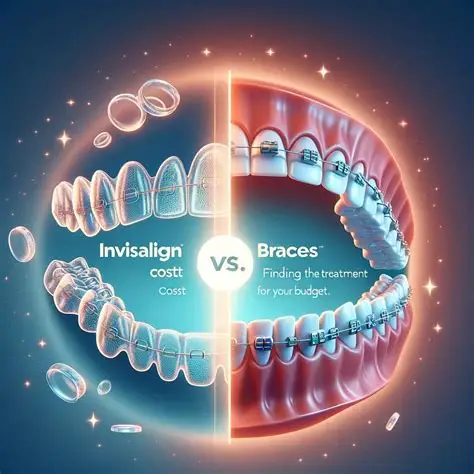
Invisalign and traditional braces often cost similar amounts, although the most suitable treatment depends on the patient’s orthodontic condition. Invisalign generally costs $3,000 to $8,000 for a typical comprehensive course, while metal braces commonly fall within a comparable range.
Traditional braces use brackets and wires that remain attached to the teeth throughout active treatment. Invisalign uses a series of removable clear aligners that gradually reposition teeth according to a professionally developed plan.
Both approaches can address a variety of alignment and bite problems. However, certain complex movements or jaw relationships may be better managed with braces or additional orthodontic treatment. A dentist or orthodontist should assess these factors before recommending one option.
Compare appearance and daily convenience
Invisalign aligners are transparent and generally less noticeable than metal braces. They can also be removed for eating, brushing, and flossing.
Traditional braces remain attached to the teeth, so patients do not need to remember to wear them throughout the day. However, fixed appliances require careful cleaning around brackets and wires.
For adults who prefer discreet orthodontic treatment, Invisalign’s appearance may be an important benefit. For patients who may struggle with consistent aligner wear, braces can be more practical.
Compare treatment responsibilities
Invisalign states that patients typically need to wear their aligners for 20 to 22 hours daily for the best results.
Aligners should generally be removed before meals and for oral hygiene. They should be cleaned according to the manufacturer’s and provider’s instructions.
Metal braces do not have the same removable-wear requirement, but patients must avoid damaging brackets and wires and follow professional dietary and hygiene guidance.
Compare the complete treatment value
The least expensive option is not always the best choice when treatment effectiveness, comfort, and long-term stability are considered.
An orthodontist can explain whether Invisalign and braces are likely to produce comparable results for a particular case.
Patients should compare total prices, expected treatment duration, clinical limitations, appointment requirements, and retention costs before making a decision.
8. Verify Dental Insurance Coverage for Invisalign
Dental insurance can reduce Invisalign expenses, but patients should verify benefits before beginning treatment. Coverage is generally available only when the policy includes orthodontic services and the patient meets the plan’s eligibility requirements.
Some plans cover orthodontic treatment for children but exclude adults. Other policies apply waiting periods, provider network requirements, or lifetime maximums.
Invisalign’s official insurance information explains that some plans cover a percentage of treatment, while others pay a fixed amount. The actual benefit can vary considerably between insurers and individual contracts.
Confirm orthodontic treatment eligibility
Patients should contact the insurer and ask whether Invisalign is covered under the orthodontic benefit.
They should also confirm whether the plan distinguishes between clear aligners and conventional braces.
A policy that covers routine dental examinations and cleanings does not necessarily include orthodontic treatment.
Check lifetime orthodontic maximums
A lifetime orthodontic maximum limits how much the insurance plan will contribute toward eligible orthodontic care over the applicable coverage period.
For example, a plan with a $2,000 lifetime orthodontic maximum may contribute no more than that amount even if the treatment costs $6,000.
Previous orthodontic claims may reduce the remaining benefit, depending on policy rules.
Request a pre-treatment benefits estimate
The orthodontic practice may be able to submit a proposed treatment plan to the insurance company for a benefits estimate.
This estimate can help patients understand their likely financial responsibility before agreeing to treatment.
However, insurance estimates do not always guarantee payment. Final benefits may depend on eligibility, policy status, completed services, and claim processing.
9. Use HSA and FSA Benefits to Manage Invisalign Expenses
Eligible patients may be able to pay for Invisalign using funds from a Health Savings Account (HSA) or healthcare Flexible Spending Account (FSA). These arrangements can provide tax advantages when funds are used for qualified medical and dental expenses.
The Internal Revenue Service recognizes qualifying dental treatment, including braces, as medical care under applicable federal tax rules. Invisalign also identifies HSA and FSA funds as possible treatment payment options. However, eligibility should be confirmed with the account administrator because individual circumstances and documentation requirements can vary.
Using eligible pre-tax funds does not reduce the provider’s fee. Instead, it may lower the effective after-tax cost of the expense.
Review HSA eligibility and balances
An HSA is available to individuals who meet specific federal eligibility requirements, generally involving qualifying health plan coverage.
Eligible account holders can use tax-advantaged HSA funds for qualified medical and dental expenses.
Patients should verify that the expense qualifies and retain invoices and supporting documentation. HSA funds should not be used to claim duplicate tax benefits for the same expense.
Check FSA reimbursement rules
Healthcare FSAs allow eligible employees to set aside funds for qualifying expenses under their employer’s plan.
Unlike HSAs, FSAs generally have plan-year spending rules, although some plans offer permitted carryover or grace-period arrangements.
Patients planning to start Invisalign near the end of a benefit year should confirm payment timing and reimbursement requirements before scheduling treatment.
Calculate potential tax advantages
Suppose a patient uses $3,000 of eligible tax-advantaged funds toward Invisalign treatment.
If the patient would otherwise have paid that expense using after-tax earnings, the tax benefit may reduce the effective financial burden.
The actual savings depend on the patient’s tax situation, account type, and applicable federal and state rules. Patients seeking personalized tax advice should consult a qualified tax professional.
10. Avoid Unsafe Shortcuts When Comparing Clear Aligner Prices
Patients should not select orthodontic treatment based exclusively on the lowest advertised price. Clear aligners move teeth through living bone and supporting tissues, making professional diagnosis and ongoing monitoring essential.
The American Association of Orthodontists warns that orthodontic treatment without appropriate professional supervision can create risks involving the teeth, gums, and bite. In September 2026, the organization also highlighted new FDA consumer guidance emphasizing professional oversight of clear aligner treatment.
Lower-cost aligner services may differ in the examinations, diagnostic imaging, monitoring, and treatment support they provide. Those differences should be investigated before comparing prices.
Confirm the provider’s professional qualifications
Patients should establish whether the treatment will be planned and supervised by a licensed dentist or orthodontist.
They should also ask who will perform the examination, review diagnostic records, evaluate progress, and manage complications.
A properly supervised treatment plan should account for the patient’s overall oral health, not simply the appearance of the front teeth.
Verify in-person examination requirements
An orthodontic assessment may identify gum disease, tooth decay, bone loss, or bite problems that need attention before aligner treatment.
These findings may not be apparent from photographs or surface impressions alone.
Patients should avoid beginning tooth movement without an appropriate clinical assessment. Additional dental treatment may be necessary to establish a healthy foundation for orthodontics.
Consider the cost of correcting unsuccessful treatment
An inadequate orthodontic plan may leave alignment problems unresolved or require further care.
Potential complications can include unwanted tooth movement, bite changes, gum problems, or other issues requiring professional assessment.
The cost of corrective treatment can outweigh the savings from a cheaper initial option. Choosing appropriate professional supervision is therefore an important financial and clinical consideration.
11. Reduce Invisalign Costs Through Careful Treatment Planning
Patients can often make Invisalign more affordable by comparing detailed treatment proposals, reviewing financing arrangements, and maximizing eligible insurance benefits. The goal should be to reduce unnecessary expenses without compromising appropriate professional care.
Obtaining estimates from multiple qualified providers can reveal differences in fees, treatment approaches, and package inclusions. Each provider should explain the proposed correction and identify any services not covered by the quoted amount.
Patients should compare the total expected expense rather than focusing on promotional starting prices. A lower quote may not represent better value if it excludes retainers, refinements, or other services likely to be needed.
Compare more than one orthodontic consultation
An additional consultation may help clarify whether a patient needs limited treatment or a more comprehensive plan.
Patients should ask each provider to describe the proposed movements, estimated duration, treatment limitations, and alternatives.
The resulting written estimates can be compared according to both clinical recommendations and total fees.
Explore available payment arrangements
Some providers offer installment plans directly through their practices. Others work with outside financing companies.
Patients should compare the full repayment cost, including any interest or administrative fees.
A payment plan should fit comfortably within the household budget without creating unnecessary financial pressure.
Follow aligner wear instructions
Wearing Invisalign aligners consistently supports the planned treatment schedule.
Patients should follow the provider’s wear instructions, maintain good oral hygiene, and attend recommended appointments.
If an aligner no longer fits correctly, causes unusual symptoms, or is lost, the patient should contact the treating provider rather than independently changing the treatment sequence.
Plan for retention from the beginning
Orthodontic treatment does not end financially when the final active aligner is removed.
Patients may need retainers for many years, potentially with periodic replacement.
Including long-term retention expenses in the initial budget provides a more realistic understanding of the overall investment.
12. Request a Personalized Invisalign Quote Before Starting Treatment

A personalized Invisalign consultation provides the most reliable estimate of actual treatment expenses. Published national prices cannot account for each patient’s dental condition, bite relationship, insurance status, or treatment goals.
During the consultation, the provider examines the teeth and supporting tissues, reviews relevant dental history, and identifies the orthodontic problems requiring correction. Digital records and X-rays may be recommended to support diagnosis and treatment planning.
The provider should then present a proposed plan outlining expected treatment duration, estimated fees, available payment options, and retention requirements. Patients should receive enough information to make an informed decision without feeling pressured to accept treatment immediately.
Ask important questions about the full price
Before approving treatment, ask the provider:
- How much will my complete Invisalign treatment cost?
- Which Invisalign package is recommended for my case?
- Are examinations, scans, and X-rays included?
- Are all planned aligners and monitoring appointments covered?
- Will I pay extra for attachments or refinement aligners?
- Does the price include retainers?
- How much will my insurance contribute?
- Can I pay monthly without interest?
- Are replacement aligners included if I lose or damage a tray?
- Could the total fee change if treatment takes longer than expected?
These questions can help clarify the patient’s financial obligations and reveal differences between treatment packages.
Review the treatment agreement carefully
A written agreement should identify the total fee, payment schedule, included services, and potential additional charges.
It should also explain how the practice handles treatment delays, missed appointments, replacement appliances, and situations in which the original plan needs revision.
Patients should understand the agreement before making a deposit or authorizing financing.
Confirm the clinical plan and expected results
The final decision should account for more than cosmetic improvement.
Patients should understand how the proposed treatment is expected to affect tooth position and bite function, as well as any important limitations or risks.
An appropriate Invisalign plan should be based on individual clinical findings, professional judgment, and realistic treatment goals.
13. Verify Invisalign Pricing and Clinical Information With Trusted Sources
Patients can make more informed financial decisions by checking treatment information against established professional and regulatory sources. Manufacturer guidance can explain Invisalign products and payment options, while dental professional organizations provide broader advice on orthodontic diagnosis, supervision, and safety.
Pricing websites can help establish national budgeting estimates, but their figures may come from surveys, historical fee data, or reported consumer expenses. A published average does not necessarily represent the fees charged in a patient’s location.
When reviewing online cost information, look for a publication or review date, a clearly identified source, an explanation of the pricing range, and disclosure of any commercial relationships. These details help distinguish useful cost guidance from unsupported promotional claims.
Review authoritative Invisalign resources
Invisalign official website: Invisalign Cost and Payment Information
Provides manufacturer information on treatment pricing, insurance contributions, payment arrangements, and how doctors determine treatment fees.
American Association of Orthodontists: At-Home Orthodontics: Cons and Considerations
Explains professional supervision requirements and potential risks associated with orthodontic treatment outside a traditional clinical setting.
Internal Revenue Service: Publication 502: Medical and Dental Expenses
Provides federal guidance on qualifying medical and dental expenses, tax deductions, and restrictions involving reimbursed expenses.
GoodRx: Invisalign Cost Without Insurance
Offers a dentist-reviewed consumer cost comparison, including published estimates for limited and comprehensive Invisalign treatment.
Invisalign official FAQs: Treatment, Maintenance, and Retainers
Explains aligner use, typical daily wear requirements, and considerations related to retainers.
These references support the general pricing and treatment information in this article. The exact cost and suitability of Invisalign must still be determined through an individual dental assessment.
Frequently Asked Questions About Invisalign Costs
How much does Invisalign cost for adults?
Invisalign typically costs $3,000 to $8,000 for adults in the United States. Minor corrections may cost less, while complex treatment can exceed $8,000. An orthodontic consultation is necessary to determine the actual fee.
How much does Invisalign cost per month?
Monthly payments depend on the treatment balance and financing agreement. A $5,000 treatment financed over 24 months at 0% interest would cost approximately $208.33 per month without a down payment or additional fees.
How much does Invisalign cost without insurance?
Without insurance, comprehensive Invisalign treatment commonly costs $3,000 to $8,000, although published estimates for all treatment categories extend from approximately $1,800 to $9,500. The amount depends on case complexity and the provider’s pricing.
Does insurance cover Invisalign treatment?
Some dental insurance plans cover Invisalign under their orthodontic benefits. Coverage may be based on a percentage of approved expenses or a fixed lifetime maximum. Patients should verify adult eligibility, provider network requirements, and remaining benefits.
Is Invisalign cheaper than traditional braces?
Invisalign and metal braces often have comparable prices. One may cost less than the other depending on the patient’s orthodontic needs, provider fees, and included services. Treatment suitability should be considered alongside cost.
Is Invisalign worth the cost?
Invisalign may provide good value for patients who want discreet, removable orthodontic treatment and can consistently follow the required wear schedule. Its suitability depends on the patient’s alignment concerns, oral health, expected results, and financial circumstances. A licensed dental professional can help determine whether it is an appropriate option.
Conclusion
Understanding how much Invisalign costs involves more than comparing the advertised price of clear aligners. In 2026, most U.S. patients can use $3,000 to $8,000 as a general budgeting range, with approximately $5,000 serving as a common planning estimate. Actual fees may fall outside this range because every orthodontic case requires individual evaluation.
Dental insurance, HSA or FSA benefits, and flexible payment plans can help eligible patients manage their expenses. However, the full financial commitment should also account for diagnostic services, refinement aligners, replacement trays, retainers, and financing charges.
For the most reliable estimate, consult a qualified Invisalign provider, request a complete written treatment quote, and verify your insurance benefits before starting. Choosing a clinically appropriate treatment plan with transparent pricing is the most effective way to balance the cost of Invisalign with the goal of achieving healthy, lasting orthodontic results.