
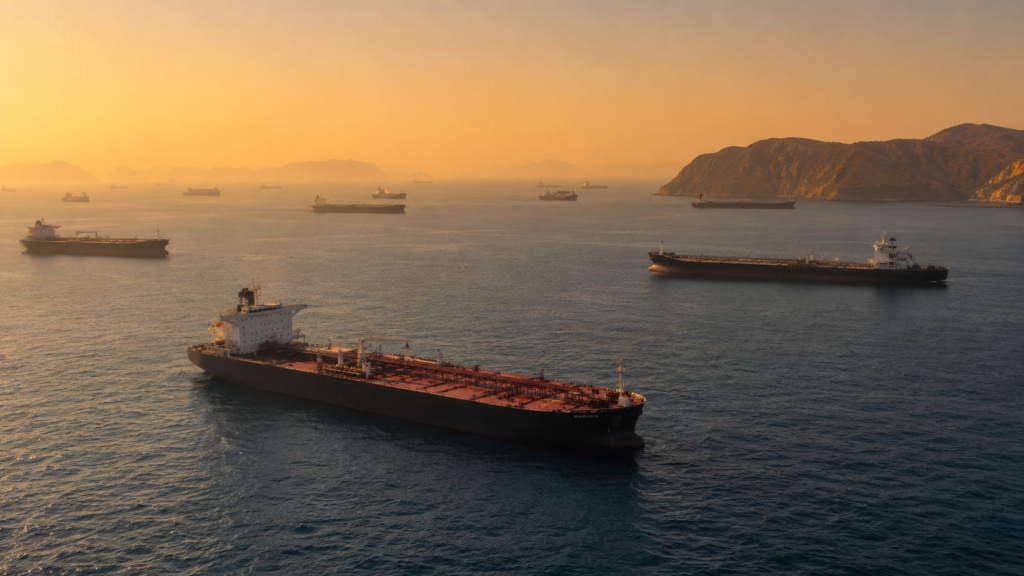
Iran has once again declared the Strait of Hormuz closed, but for much of the global shipping industry, the announcement changes little. Maritime traffic through the strategic waterway had already slowed sharply in recent weeks, with ship operators, insurers, and crews remaining cautious despite diplomatic efforts that had previously reopened the strait earlier this month.
The Strait of Hormuz remains one of the world’s most important energy chokepoints. According to the U.S. Energy Information Administration (EIA), roughly 20% of global petroleum liquids consumption passes through the waterway, underscoring its significance to international energy markets. The route became a flashpoint earlier this year during the Strait of Hormuz oil crisis, when tanker traffic collapsed amid the conflict. Before the conflict, approximately 100 to 120 oil tankers transited the route daily.
Shipping Traffic Remains Far Below Normal Levels
While vessel movements briefly increased after Iran temporarily reopened the strait earlier this year, the rebound has been modest. Industry analysts report that tanker traffic improved slightly before retreating again following the cancellation of talks intended to finalize details of a broader agreement between Iran and the United States.
The hesitation reflects a market still assessing risk rather than responding to political announcements. As oil analyst Tom Kloza has noted, confidence is often the last thing to return after a maritime disruption. Many operators appear unwilling to become the first major test case for a route that remains clouded by uncertainty.
Mines Continue to Restrict Navigation
One of the most immediate obstacles remains the reported presence of naval mines in parts of the waterway. Shipping organizations say only limited traffic corridors near the coastlines of Oman and Iran are currently considered safe for navigation.
Those available routes bring their own challenges. Concentrated vessel movements in narrow channels increase the likelihood of congestion, navigational errors, and operational delays, making shipowners reluctant to accelerate their return.
Insurance and Crew Challenges Add Pressure
Beyond security concerns, commercial barriers continue to complicate any meaningful reopening. Many maritime insurers have not fully restored war-risk coverage, leaving shipowners exposed to substantial financial liabilities in the event of damage or disruption.
Insurance availability has become almost as important as physical access to the strait itself. Without adequate coverage, operators face risks that many boards and financiers are unwilling to accept, regardless of political developments.
At the same time, an estimated 20,000 seafarers remain aboard ships stranded in the Persian Gulf. Some vessels have been anchored for months, raising practical concerns about maintenance, fuel supplies, crew welfare, and operational readiness.
Oil Supply Chains Face a Slow Restart
The disruption extends beyond shipping lanes. Energy production and refining operations across the Gulf were scaled back during the conflict as export routes became uncertain. Restoring those facilities requires confidence that maritime access can be maintained consistently rather than temporarily.
As GrowBusinessMag has frequently highlighted in its coverage of global trade disruptions, supply chains rarely return to full capacity immediately after a ceasefire or political agreement. Physical infrastructure, logistics planning, insurance coverage, and workforce availability all take time to stabilize.
For now, Iran’s latest declaration regarding the Strait of Hormuz highlights a reality already recognized across the shipping industry: even if political agreements remain intact, mines, insurance gaps, stranded crews, and operational uncertainty are likely to keep trade flows and oil exports below normal levels for months to come.