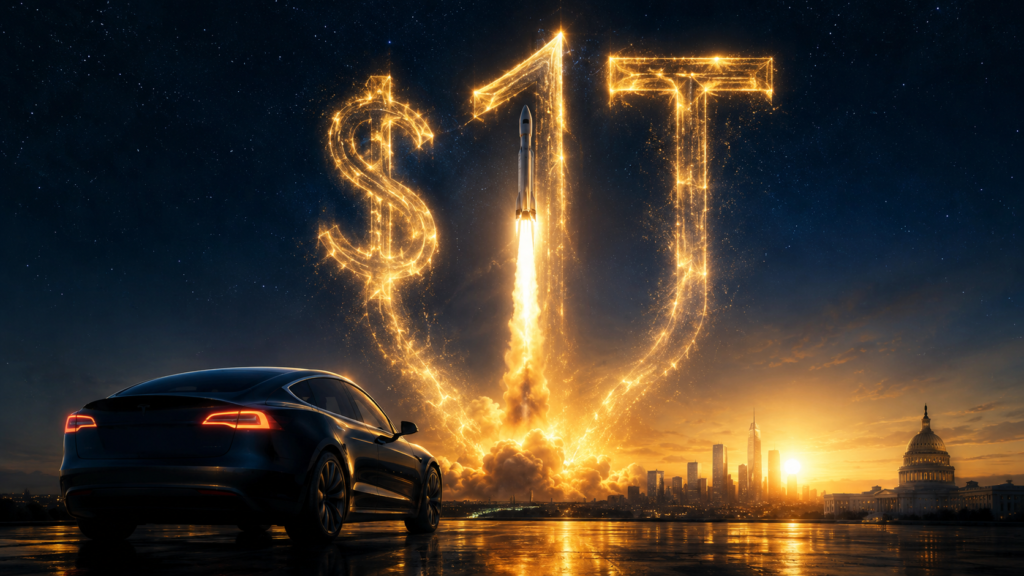
Elon Musk has reached a milestone once considered unimaginable, becoming the world’s first trillionaire after SpaceX completed a record-breaking initial public offering that ranks among the most significant market debuts in modern financial history. The listing pushed Musk’s fortune beyond the trillion-dollar threshold, reflecting investor conviction that his companies will play a central role in the future of space transportation, artificial intelligence, robotics, and autonomous mobility.
Government Support Helped Build the Foundation
Yet the foundation beneath that extraordinary wealth was built during years when both SpaceX and Tesla relied heavily on government-backed support. Reporting highlighted by GrowBusinessMag shows that federal grants, contracts, loans, and regulatory incentives provided critical funding at moments when access to private capital was far less certain.
NASA’s Early Backing Fueled SpaceX’s Growth
For SpaceX, a defining moment arrived in 2006 when NASA awarded the company a $278 million grant to help develop the Falcon rocket platform and Dragon spacecraft. At the time, the funding represented a substantial share of the company’s available capital and helped validate its technology in the eyes of investors. Support continued in 2008 with a groundbreaking $1.6 billion NASA contract, awarded when SpaceX was facing intense financial strain. Musk has publicly acknowledged that the company would likely not have reached its current position without NASA’s early partnership.
Tesla Benefited From Loans, Tax Credits, and Regulatory Incentives
Tesla’s growth story was also shaped by government programs. In 2010, the automaker secured a $465 million low-interest loan from the U.S. Department of Energy, funding that helped bring the Model S to market. Federal incentives further strengthened demand. According to the U.S. Treasury Department, consumers received more than $2 billion in clean-vehicle tax credit benefits covering over 300,000 vehicles in 2024 alone, underscoring the scale of federal support behind EV adoption.
Another major financial tailwind came from Tesla’s sale of emissions credits to competing automakers that failed to meet regulatory standards. Those transactions generated billions of dollars over the years and provided a significant source of earnings while the company expanded manufacturing capacity and worked toward sustained profitability.
Looking for an in-depth review of DeepSeek.com? Discover why this rapidly growing AI platform is attracting attention from users around the world.
Wall Street Expectations Now Drive Musk’s Fortune
Today, however, Musk’s fortune is driven less by government assistance and more by market expectations. Tesla’s valuation increasingly reflects investor belief in future robotaxi services and humanoid robotics rather than vehicle sales alone. As technology analyst Dan Ives has noted in various assessments of Tesla, much of the company’s market value is tied to expectations about future innovation rather than its current automotive business.
The Debate Over Public Investment and Private Wealth
The scale of public support behind two of the world’s most valuable companies continues to fuel debate over whether taxpayers should have shared directly in the upside. Some argue government funding helped create immense private wealth, while others point to the technological advances, jobs, and industrial leadership that emerged from those investments.
As markets absorb the impact of SpaceX’s blockbuster IPO, Musk’s trillion-dollar milestone is likely to sharpen discussions about how breakthrough industries are financed. The story of SpaceX and Tesla may become a defining case study in how public investment, entrepreneurial risk-taking, and investor optimism combine to create the next generation of transformational companies.