
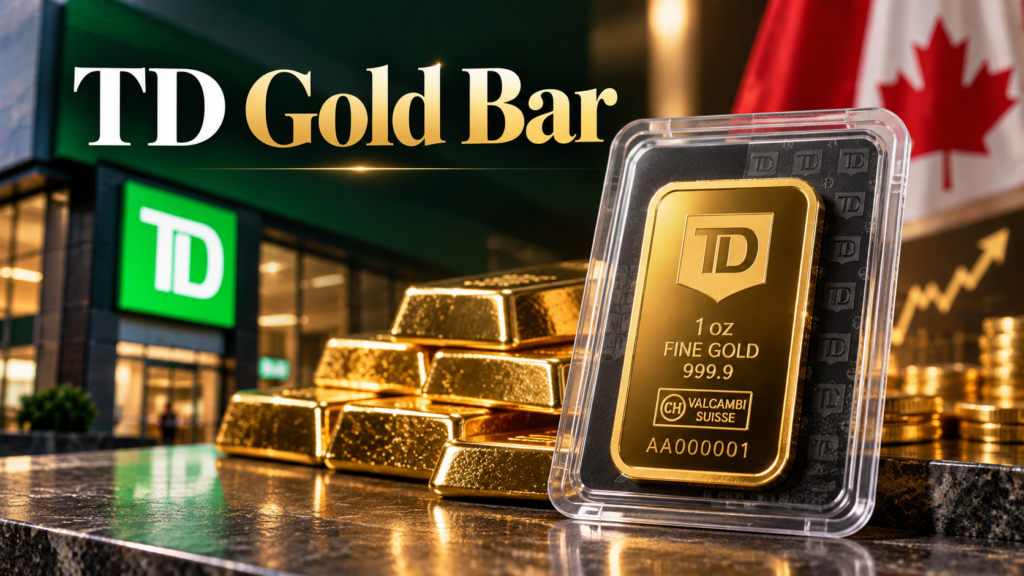
A TD gold bar is an investment-grade gold bullion product sold by TD Precious Metals, part of TD Bank Group in Canada. Standard TD gold bars contain 99.99% pure gold and are available in different sizes, ranging from 1 gram to 10 troy ounces. They are designed for people who want to own physical gold as an investment, store of value, or precious metal gift.
The popular 1 oz TD gold bar is manufactured by Valcambi, a Swiss refinery accredited by the London Bullion Market Association (LBMA). It features the TD shield logo, a purity marking, a serial number, and an assay mark. TD supplies this product in tamper-resistant packaging to help protect the bar and its identifying information.
TD gold bar prices change according to international gold markets, exchange rates, bar weight, and retail premiums. Buyers can purchase eligible products through TD’s precious metals website or at participating bank branches. However, buying physical gold involves more than selecting a bar. Investors should understand the purchase premium, storage expenses, authenticity verification, and potential resale value before spending money.
This guide explains how to choose a TD gold bar, compare prices in Canadian dollars, make a secure purchase, verify genuine bullion, and evaluate whether physical gold fits your financial objectives.
1. Identify the Features and Purity of a Genuine TD Gold Bar
A genuine TD gold bar is a refined precious metal product sold under TD’s branding, with identifying markings that specify its gold content and origin. Standard investment-grade TD gold bars have a fineness of 999.9, meaning they contain 99.99% pure gold. This high purity makes them suitable for investors primarily interested in the market value of gold rather than jewelry or decorative uses.
TD’s modern one-ounce gold bar was introduced in 2019 and is manufactured by Valcambi, a recognized Swiss precious metals refinery. According to TD’s official product information, the bar carries the TD shield logo, an individual serial number, and Valcambi’s assay mark. The product arrives in protective packaging designed to discourage tampering and reduce unnecessary handling. These details provide buyers with an identifiable set of specifications to check.
The value of a TD gold bar comes mainly from its fine-gold content rather than its appearance. Branding, packaging, and manufacturing quality can influence buyer confidence and retail premiums, but they do not eliminate gold price fluctuations. Anyone purchasing a bar should confirm its stated weight, metal purity, manufacturer, and seller before completing the transaction.
Inspect the TD Shield Logo
The TD shield is a recognizable feature of modern TD-branded bullion.
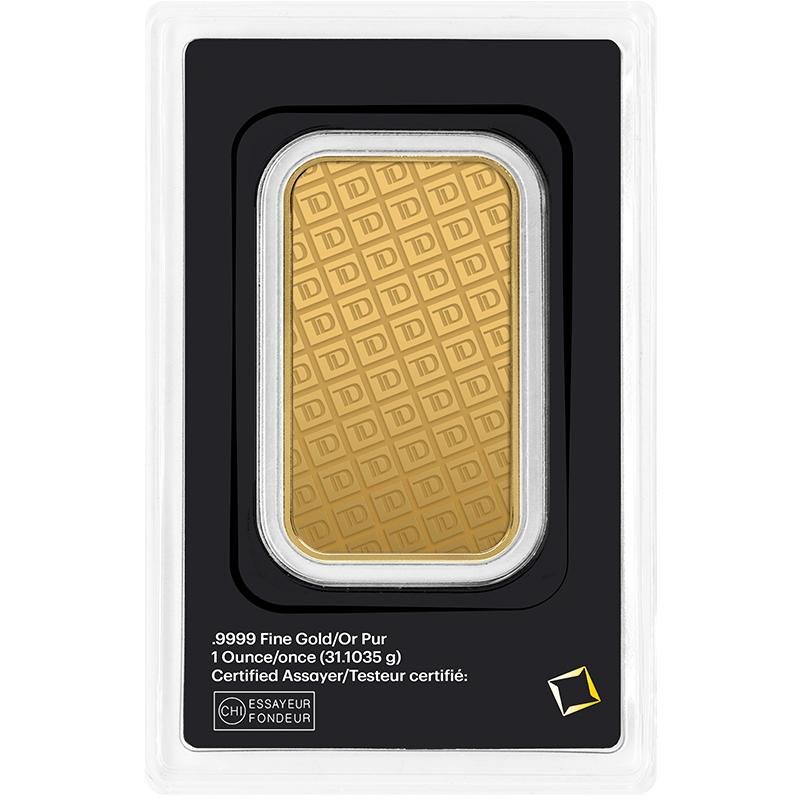
On the standard one-ounce product, the logo appears on the front of the bar, while the reverse features a repeating TD design. Older bars and different denominations may have variations in their appearance.
Compare markings with official images for the exact product and production period.
Confirm the 999.9 Gold Fineness
The number 999.9 describes the bar’s purity in parts per thousand.
A fineness of 999.9 means the metal contains at least 99.99% gold under the stated specification. It does not mean the gold is entirely free of trace impurities.
This purity is commonly used for investment bullion and allows easy comparison with other high-purity bars.
Check the Valcambi Assay Mark
Valcambi is a Switzerland-based precious metals refiner with LBMA accreditation.
Its assay mark identifies the refinery associated with the product’s manufacture and quality specifications.
While the mark is an important identifying feature, it should not be treated as conclusive proof of authenticity without considering the product’s source and other verification methods.
Preserve the Original Packaging
TD’s one-ounce gold bars come in tamper-resistant protective packaging.
Keeping the bar sealed reduces direct contact with its surface and preserves the printed product information.
Original packaging may make resale verification more convenient, although professional buyers can still require independent testing.
2. Compare TD Gold Bar Sizes Before Choosing a Weight
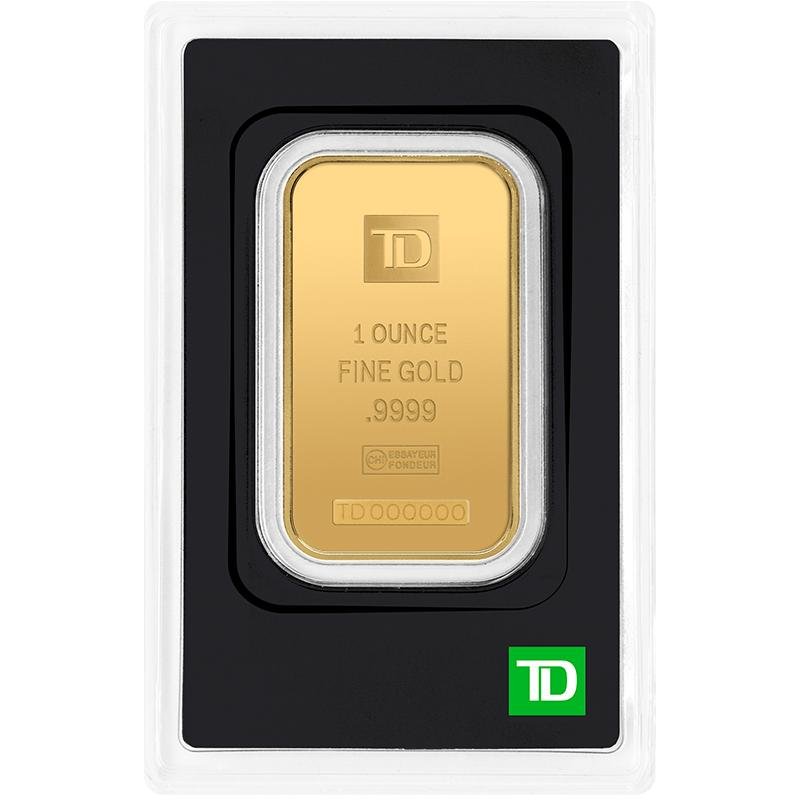
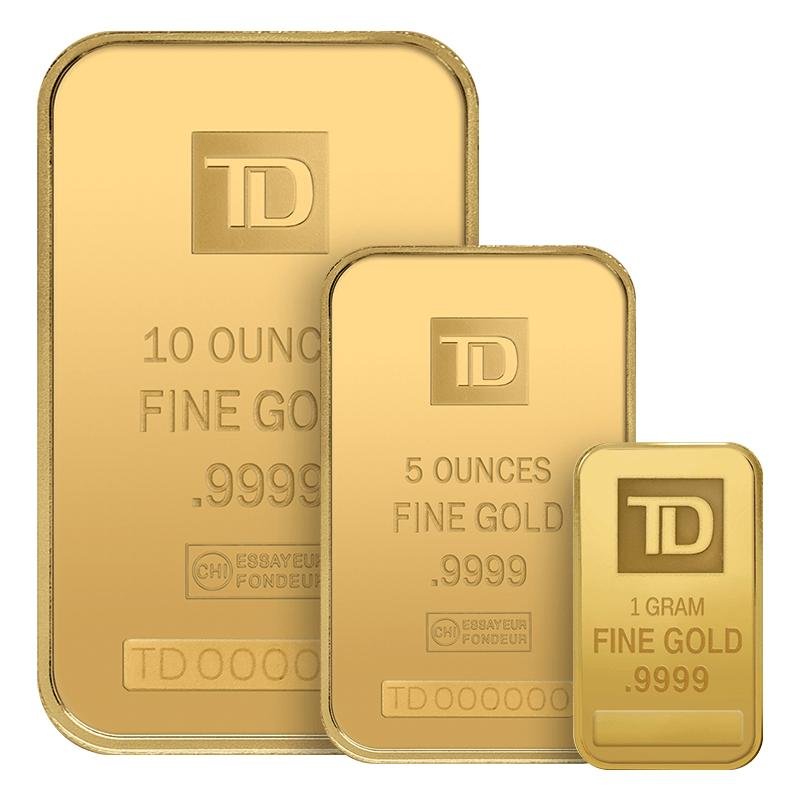
TD Precious Metals offers gold bars in a range of sizes to accommodate different purchase budgets. Smaller bars offer access to physical bullion without the cost of a full ounce, while larger bars commonly provide lower premiums relative to the amount of gold purchased.
TD’s published gold catalog includes bars weighing 1 gram, 2.5 grams, 5 grams, 10 grams, 20 grams, 50 grams, 100 grams, 1/4 ounce, 1/2 ounce, 1 ounce, 5 ounces, and 10 ounces. Not every product is available online or in stock at all times. Some larger bars may require an in-branch purchase rather than a standard online transaction.
The best size depends on how much gold a buyer wants to own and how it might eventually be sold. Multiple smaller bars allow partial liquidation, but their combined acquisition premiums can be higher than those of a single larger bar. Larger products may be more cost-efficient per gram, but selling only a portion of the gold becomes more difficult.
| TD gold bar size | Gold weight in grams | Typical consideration |
|---|---|---|
| 1 gram | 1.0000 g | Small purchases and gifts |
| 2.5 grams | 2.5000 g | Entry-level physical gold |
| 5 grams | 5.0000 g | Moderate purchase budget |
| 10 grams | 10.0000 g | Balance of flexibility and value |
| 20 grams | 20.0000 g | Medium-sized bullion purchase |
| 50 grams | 50.0000 g | Larger gold accumulation |
| 100 grams | 100.0000 g | High-value gold holding |
| 1/4 troy ounce | 7.7759 g | Fractional-ounce investment |
| 1/2 troy ounce | 15.5517 g | Mid-sized ounce denomination |
| 1 troy ounce | 31.1035 g | Widely recognized investment size |
| 5 troy ounces | 155.5174 g | Substantial bullion holding |
| 10 troy ounces | 311.0348 g | Large investment purchase |
Choose a 1 Gram TD Gold Bar for Small Purchases
A one-gram bar requires less initial capital than a larger denomination.
It can be suitable for a gift or for someone who wants to begin owning physical gold with a relatively small amount.
However, its per-gram retail price can be considerably higher because fixed manufacturing and distribution costs are spread over less gold.
Compare 5 Gram and 10 Gram Bars
Five-gram and ten-gram bars provide a middle option between entry-level products and one-ounce bullion.
These denominations can offer lower premiums than very small bars while remaining easier to sell individually than much larger products.
Always compare actual per-gram costs, because pricing differences can vary among products.
Consider the 1 oz TD Gold Bar for Standardized Bullion Ownership
The one-ounce TD gold bar is one of the most recognizable products in the range.
It contains one troy ounce, or approximately 31.1035 grams, of gold. A troy ounce is heavier than the ordinary ounce used in everyday measurements.
Its standardized size makes comparisons with other investment gold bars straightforward.
Evaluate Larger Bars Carefully
Five-ounce and ten-ounce gold bars involve a considerable upfront investment.
Although large bars may offer favorable pricing per unit of gold, they are less convenient for investors who might need to sell small amounts.
Buyers should evaluate their liquidity needs, storage arrangements, and insurance before choosing larger denominations.
3. Check the TD Gold Bar Price in Canadian Dollars
TD gold bar prices fluctuate with international gold prices, Canadian dollar exchange rates, and TD’s retail pricing. The official TD Precious Metals website provides product prices that may update during the trading day, and final pricing is confirmed at checkout.
For a dated reference, TD’s official listing displayed a 1 oz TD gold bar price of C$6,149.79 on October 10, 2026, for eligible customer purchases paid from a TD bank account. The same listing displayed C$6,334.28 for card payment at the listed quantity tier. These figures illustrate the difference between payment methods and should not be treated as a live quote for October 12 or a guaranteed transaction price.
C$6,149.79
One-ounce TD gold bar, listed TD bank-account payment price for the 1–9 unit quantity tier.
View TD’s latest listed price
The amount a buyer pays can include a premium over the value of the underlying metal. This premium compensates the seller for production, distribution, handling, and other commercial costs. Comparing bars using their final checkout price rather than the headline gold quotation gives a more realistic understanding of the investment.
Monitor the Gold Spot Price
The spot price is a benchmark market quotation for gold, generally expressed per troy ounce.
Gold is internationally traded primarily in U.S. dollars, so the Canadian-dollar value also responds to currency movements.
A change in the CAD/USD exchange rate can raise or lower Canadian gold prices even when the U.S.-dollar spot quotation remains unchanged.
Calculate the Retail Premium
The premium measures how much more the buyer pays than the underlying gold value.
Suppose a one-ounce bar has a gold value of C$6,000 and a retail purchase price of C$6,150.
The C$150 difference equals a 2.5% premium. This is a hypothetical example, not a verified TD premium.
Compare Payment Method Pricing
TD may list different product prices depending on the payment method.
Bank-account payment can be priced below eligible card payments, as demonstrated by TD’s product listings.
Check the total price before completing checkout, particularly for purchases involving multiple bars.
4. Purchase a TD Gold Bar Through an Official Sales Channel
The most straightforward way to buy a TD gold bar is through the official TD Precious Metals online store or an eligible TD Canada Trust branch. These channels provide direct access to product descriptions, posted prices, and purchasing requirements.
TD states that its online transaction limit is C$24,999.99 per 24 hours for TD customers and C$2,999.99 for non-TD customers. Purchases that exceed the online limit may be arranged through a branch. In-branch precious metals purchases must be funded through an eligible TD Canada Trust deposit account in good standing.
Buying directly from the seller provides a clearer transaction record than purchasing through an unknown private individual. Nevertheless, customers should still verify the selected product, check its availability, and review all conditions. TD’s published terms state that orders cannot be cancelled after the final order confirmation, making careful review particularly important.
Visit the TD Precious Metals Website
Open TD’s official precious metals website and choose the gold bullion category.
Filter available products by weight and review the applicable description, price, and product status.
Check for branch-only designations before assuming a bar can be delivered through an online order.
Select the Required Quantity
Choose the number of bars according to the desired total gold weight and purchase budget.
TD sometimes displays quantity discounts for larger orders, but a bulk purchase also increases the buyer’s financial exposure.
Calculate the total cost and compare it with other available denominations before proceeding.
Review Customer and Payment Requirements
Customers purchasing online must follow TD’s applicable payment and identity verification procedures.
TD customers may have access to certain payment-related pricing benefits and account services.
Non-customers can purchase eligible products within the published transaction limits, subject to TD’s checkout requirements.
Confirm the Purchase Details
Before completing the transaction, verify the product name, size, purity, quantity, price, and delivery arrangement.
Read the cancellation terms and confirm the amount charged to the selected payment method.
Retain the order confirmation and invoice as evidence of purchase.
5. Arrange Safe Delivery and Storage for Your Gold Bar
TD offers eligible customers physical delivery and secure storage options for precious metals purchases. Home delivery allows buyers to receive and hold their gold, while professional storage keeps the bullion in a secured facility under the relevant service agreement.
For eligible Canadian orders, TD advertises free shipping on purchases of C$500 or more, excluding secure storage orders. Its product information states that packing and dispatch may take up to five business days, followed by approximately two to seven business days in transit. These are general service estimates rather than guaranteed arrival dates.
TD also offers Secure Storage to qualifying customers. According to its published terms, gold held through this service is stored in an insured facility operated by Brink’s in Toronto. Storage can reduce the inconvenience of personally safeguarding bullion but introduces service conditions and potential ongoing fees.
Choose Home Delivery
Home delivery gives the purchaser direct physical possession of the gold.
The buyer becomes responsible for securing the bar after it has been received.
Inspect the shipment for visible damage, confirm the product against the invoice, and keep purchase documents somewhere secure.
Consider Branch Collection
An eligible branch pickup arrangement may appeal to customers who do not want valuable metal delivered directly to a residential address.
Check availability, pickup procedures, and identification requirements before placing the order.
The suitability of branch pickup depends on the customer’s location and the options offered for the specific purchase.
Compare Professional Storage Options
Professional storage can reduce home-security concerns and simplify certain ownership arrangements.
Before enrolling, confirm the fee schedule, custody agreement, insurance provisions, withdrawal procedures, and whether selling stored gold is permitted online.
Storage costs reduce the net investment return and should be included when comparing physical gold with other investment choices.
Protect Gold Kept at Home
Investors choosing home storage should consider a suitably secured safe and appropriate insurance coverage.
Standard homeowners’ insurance may have specific limits or exclusions for bullion.
Maintain private ownership records and avoid unnecessarily disclosing storage details.
6. Verify a TD Gold Bar Before Buying or Selling
Authenticity verification begins with comparing the gold bar’s weight, purity, refinery information, and physical markings against official specifications. A genuine TD gold bar should match the appropriate product design, but professional verification may still be necessary.
The modern one-ounce TD gold bar includes a serial number, TD shield, Valcambi assay mark, and tamper-resistant packaging. These details make product identification easier, but counterfeiters can imitate branded markings and packaging. A convincing visual appearance alone is not sufficient proof that a bar contains the correct quantity of fine gold.
The seller’s credibility is therefore an important part of authentication. Direct purchase from TD provides a documented retail source, while privately acquired bullion deserves additional checks. For significant purchases, buyers can consult an established precious metals dealer equipped to perform suitable tests.
Compare the Bar With Official Product Images
Examine the TD shield, text placement, font appearance, purity stamp, and refinery mark.
Be sure to compare the same bar size and product edition.
Legitimate design differences can occur between production years, so a mismatch with an unrelated bar design is not necessarily evidence of counterfeiting.
Check the Serial Number and Assay Details
Identify the serial number printed on the bar and compare it with any corresponding packaging information.
Look for inconsistencies, altered surfaces, or damaged labels.
Serial numbers support identification but cannot independently authenticate gold because counterfeit products may reproduce them.
Confirm the Stated Gold Weight
Professional buyers use precision scales and other measurement tools to assess physical bullion.
A one-troy-ounce bar has a standardized gold weight of approximately 31.1035 grams.
Packaging adds weight and should not be included in a direct comparison with the metal’s specified mass.
Use Professional Testing When Necessary
Precious metals specialists may use X-ray fluorescence, electrical conductivity analysis, density measurements, or ultrasound.
Different testing methods detect different problems, and no single basic home test proves authenticity in every situation.
For expensive bars purchased through secondary markets, professional examination is generally more dependable than visual inspection alone.
7. Compare TD Gold Bars With Royal Canadian Mint Products
TD-branded gold bars and Royal Canadian Mint bullion products both offer exposure to physical gold, but their manufacturing sources, designs, premiums, and resale conditions may differ. The most useful comparison is between products containing equivalent amounts of fine gold.
The standard one-ounce TD bar is manufactured by Valcambi. In comparison, the Royal Canadian Mint produces its own bullion bars and coins, including Canadian Gold Maple Leaf coins. TD’s online catalog has listed products from both sources, allowing buyers to compare certain alternatives through one retailer.
A recognizable brand may help establish buyer familiarity, but it does not guarantee a better investment return. When weight and purity are equivalent, the total acquisition premium, resale quote, storage costs, and transaction convenience become important factors.
| Comparison factor | TD gold bar | Royal Canadian Mint bullion |
|---|---|---|
| Brand | TD Precious Metals | Royal Canadian Mint |
| Manufacturer | Valcambi for the modern 1 oz TD bar | Royal Canadian Mint |
| Common investment purity | .9999 | .9999 for many products |
| Product formats | Gold bars | Gold bars and coins |
| Purchasing channels | TD online store and eligible branches | Mint distributors, bullion dealers, and selected TD offerings |
| Primary investment value | Fine gold content | Fine gold content |
| Resale price | Depends on buyer and market conditions | Depends on buyer and market conditions |
| Guaranteed profit | No | No |
Compare Equivalent Weights and Purities
Choose products with comparable gold content before evaluating price differences.
A one-ounce .9999 TD bar and a one-ounce .9999 Royal Canadian Mint product contain essentially the same standardized amount of fine gold.
Their retail prices may still differ because of manufacturing and distribution costs.
Compare Recognition and Resale Acceptance
Both TD and the Royal Canadian Mint are familiar names in Canada’s precious metals market.
Dealer preferences can differ depending on the specific product and its condition.
A recognizable product may be easier to identify, but the actual resale amount must still be confirmed with a buyer.
Evaluate the Total Purchase Premium
The lowest percentage premium can be appealing for investors whose main objective is gold ownership.
However, buyers should also consider storage, future selling arrangements, and whether a smaller or larger denomination better suits their financial needs.
A small difference in acquisition cost is not the only consideration.
8. Calculate the Potential Profit and Loss From TD Gold Bars
The financial return on a TD gold bar depends on the amount paid to purchase it, the amount received when selling it, and the costs incurred during ownership. Physical bullion does not produce interest or dividend income, so investors generally depend on favorable price changes to earn a gain.
A buyer who purchases gold at a retail premium may need the market price to increase before the bar can be sold profitably. Dealers typically purchase bullion at a different price from their retail selling price. This buy-sell spread creates a financial hurdle even when gold prices remain relatively stable.
Consider a hypothetical investor who buys a bar for C$6,150 and later receives a C$6,600 resale offer. If the investor has paid C$100 in storage and transaction expenses, the net gain before any applicable taxes would be C$350.
Estimate the Break-Even Point
The break-even resale amount must cover the original purchase and all associated costs.
For a purchase of C$6,150 with C$100 in expenses, the buyer needs C$6,250 in net proceeds to recover the total amount spent.
Any additional selling fees increase the required resale price.
Account for Gold Market Volatility
Gold prices respond to interest rates, currency movements, inflation expectations, economic uncertainty, and international demand.
These factors can cause substantial short-term fluctuations.
Investors should not assume that gold will necessarily preserve its purchasing power over every time period.
Consider the Cost of Ownership
Secure storage, insurance, transportation, and dealer spreads can reduce overall returns.
Even a bar whose market value increases may produce a disappointing outcome if costs are high.
Compare expected expenses before committing to long-term ownership.
Evaluate Gold Within a Diversified Portfolio
Gold may be considered as one component of a broader investment strategy.
It behaves differently from income-producing assets because it does not generate cash flows while held.
The appropriate allocation depends on personal financial goals, time horizon, liquidity needs, and willingness to accept price risk.
9. Sell a TD Gold Bar at a Competitive Resale Price
TD customers can inquire about selling physical precious metals through TD branches. The bank states that its precious metals buyback pricing is based on prevailing market rates. However, a particular repurchase amount is not guaranteed, and applicable eligibility and transaction conditions still apply.
The resale value of a gold bar primarily reflects its verified fine-gold content, current market conditions, and the purchasing dealer’s pricing. A dealer may also consider the bar’s condition, origin, packaging, and whether additional testing is needed. The original retail premium is not necessarily recoverable.
Comparing available buyback quotations can help an owner understand the realistic cash value of the bar. The relevant figure is the amount the owner will receive after any fees, rather than the price at which a dealer currently advertises the same product for sale.
Request a Current TD Buyback Quote
Contact TD to confirm that the relevant branch can assist with the proposed sale.
Provide details such as the bar’s weight, manufacturer, purity, and packaging condition.
Ask about identification documents, account requirements, and how long a quoted price remains valid.
Compare Precious Metals Dealer Offers
Other reputable bullion dealers may also purchase TD gold bars.
Request quotes for the same product within a short time frame to minimize the impact of market price changes.
Compare final proceeds after any testing, handling, or payment fees.
Maintain the Bar’s Condition
Avoid unnecessary handling, scratching, or opening sealed packaging.
An intact assay package can make verification easier for a prospective buyer.
If packaging has been damaged, the underlying gold retains its metal content, although the buyer may require additional inspection.
Keep Records of the Sale
Preserve the original invoice and final selling receipt.
Records can support cost-base calculations and establish when the asset was bought and sold.
This documentation is particularly relevant when determining income tax consequences.
10. Review Canadian Tax Rules Before Investing in TD Gold Bars
Canadian tax rules distinguish qualifying investment-grade precious metals from ordinary gold products such as jewelry. For GST/HST purposes, gold in bar, ingot, coin, or wafer form generally must meet a purity threshold of at least 99.5% and satisfy the applicable recognition and product-form conditions.
The Canada Revenue Agency explains that qualifying precious metal transactions are generally exempt financial services, while certain first supplies by refiners are zero-rated. Standard .9999 TD gold bars exceed the gold purity threshold, although the applicable treatment of any transaction must still be determined from its specific facts.
The income tax treatment of a future sale is a different matter. A gain on investment gold may be taxable, and the calculation depends on the acquisition cost, proceeds, transaction expenses, and ownership circumstances. Registered investment account rules also contain additional conditions for qualifying bullion.
Confirm GST/HST Treatment
Before purchasing, confirm that the selected product meets the required purity, form, and recognition standards.
Investment bullion is treated differently from lower-purity gold jewelry or decorative products.
The tax treatment of a qualifying precious metal sale is not the same as an exemption from all possible taxes connected with ownership.
Record Capital Gains and Losses
Keep records of the purchase price, acquisition fees, and eventual resale proceeds.
These figures help establish the adjusted cost base and resulting gain or loss.
Special rules may apply to certain personal-use property and business activities, so the classification of the holding matters.
Check TFSA and RRSP Eligibility
The CRA permits certain gold bars as qualified investments for registered plans when prescribed conditions are met.
Qualifying bars must meet requirements involving minimum purity, an LBMA-accredited refiner, identifying hallmarks, and an approved acquisition source. Additional custody and plan-administration conditions also apply.
Buying a TD bar personally does not automatically make it eligible for direct deposit into a TFSA or RRSP.
Obtain Professional Tax Guidance When Appropriate
Tax advice is particularly useful for substantial bullion holdings, estate transfers, business purchases, and registered-plan investments.
A qualified Canadian tax adviser can assess applicable rules based on the investor’s actual circumstances.
This helps prevent assumptions about tax benefits that may not apply to a particular transaction.
11. Avoid Common Mistakes When Buying TD Gold Bars
Buying physical gold requires attention to more than the seller’s brand reputation. The most common purchasing mistakes involve overpaying premiums, underestimating storage expenses, relying on unreliable sellers, and misunderstanding how resale pricing works.
A buyer who chooses multiple small bars without comparing cost per gram may pay a higher total premium than necessary. Likewise, someone who uses the current retail selling price to estimate the cash resale value may overstate what the investment is worth. Understanding the difference between the dealer’s selling price and buying price is essential for realistic planning.
Investors should also evaluate security and liquidity. Gold held at home needs appropriate protection, while larger bars may require more careful arrangements when sold. Choosing the right denomination and seller from the beginning can reduce some of these difficulties.
Avoid Paying Unnecessarily High Premiums
Compare equivalent gold weights across different denominations and reputable sellers.
Calculate the percentage premium rather than comparing only the total purchase amounts.
A smaller bar may be convenient, but convenience can come with a higher per-gram cost.
Avoid Unverified Online Listings
Counterfeit bullion and misleading advertisements can appear on third-party marketplaces.
A seller offering a gold bar significantly below its metal value deserves particular scrutiny.
Use trusted payment arrangements and professional verification when dealing with privately sold bullion.
Avoid Assuming a Guaranteed Return
Gold has experienced periods of strong performance and periods of decline.
TD branding does not provide principal protection or a guaranteed investment return.
Investors should consider whether they can tolerate losses and hold the asset through market volatility.
Plan Storage and Resale in Advance
Determine how the purchased bar will be stored, insured, and eventually sold.
A clear ownership plan can help control costs and reduce operational risks.
These decisions are especially important for high-value gold bars and long holding periods.
12. Find Answers to Frequently Asked Questions About TD Gold Bars
How much is a 1 oz TD gold bar in Canada?
The price changes with the gold market and TD’s retail pricing. For example, TD listed its one-ounce gold bar at C$6,149.79 on October 10, 2026, for eligible TD bank-account payment. This historical quote is not a guaranteed current price. Check the official TD Precious Metals website for the latest listing and final checkout amount.
Are TD gold bars made of real gold?
Yes. Genuine standard TD gold bars contain investment-grade fine gold, commonly marked .9999 to indicate 99.99% purity. The modern one-ounce TD bar is manufactured by Valcambi and carries identifying markings, including a serial number and assay mark.
Can I buy a TD gold bar without a TD account?
Yes. Eligible non-TD customers can purchase selected gold products through TD’s online store, subject to payment requirements and a published C$2,999.99 per-24-hour transaction limit. TD customers have a higher online limit, while branch purchases require an eligible TD Canada Trust deposit account.
Is buying a TD gold bar a good investment?
A TD gold bar can provide direct ownership of physical gold, which may suit investors seeking precious metals exposure. However, it carries market risk, retail premiums, storage costs, and potential resale spreads. Whether it is suitable depends on the buyer’s investment objectives and financial circumstances.
Can I sell a TD gold bar back to TD Bank?
TD provides precious metals buyback services for eligible customers through its branches. The amount offered depends on prevailing market conditions and applicable pricing and transaction policies. Contact TD before selling to confirm requirements and obtain a current quote.
Do I pay tax when buying a TD gold bar in Canada?
Qualifying investment-grade gold bullion generally receives exempt or zero-rated GST/HST treatment under Canadian rules, depending on the transaction. However, selling the gold at a gain may result in income tax obligations. The correct treatment depends on the product and the owner’s circumstances.
Conclusion
A TD gold bar offers a practical way to purchase physical investment-grade gold through a major Canadian financial institution. TD Precious Metals sells bullion in multiple denominations, allowing buyers to choose between smaller bars with lower initial purchase costs and larger bars that may offer more favorable pricing per gram.
The standard one-ounce TD gold bar contains .9999 fine gold and is manufactured by Valcambi, an LBMA-accredited Swiss refiner. Its TD branding, serial number, assay mark, and protective packaging provide useful identification features, while purchasing directly through TD establishes a documented transaction history.
However, the investment decision should depend on more than the quality of the gold. Buyers need to compare the retail price with the value of the underlying metal, account for storage and insurance, understand resale spreads, and review the applicable Canadian tax treatment.
For investors focused on physical gold ownership, comparing denominations and obtaining current quotes are essential first steps. Maintaining purchase records, choosing secure storage, and planning an eventual resale can also improve the overall ownership experience.
Ultimately, the most informed approach to buying a TD gold bar is to select a verified product at a transparent price while recognizing that gold remains a market-priced asset with no guaranteed return.
Sources and Editorial Review
This guide prioritizes official TD product information and Canada Revenue Agency guidance for statements about bar specifications, purchasing arrangements, tax rules, and investment account eligibility. Price examples are identified by date, and no firsthand assay testing, personal purchases, or independent product inspections are claimed.