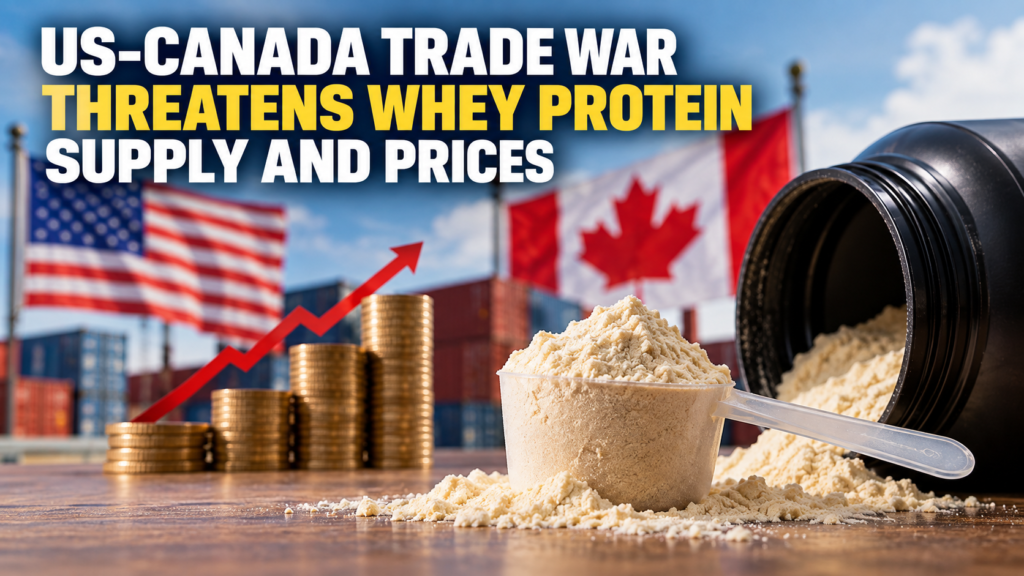
The US-Canada trade war is creating new pressure on whey protein supplies, prices and manufacturers, adding trade-related costs to a market already experiencing strong demand. Whey protein is widely used in powders, shakes, protein bars and other high-protein foods, making disruptions important for both the sports nutrition industry and everyday consumers.
According to the USDA data cited in the original reporting, whey protein concentrate prices had already increased substantially before the latest trade restrictions. New tariffs could intensify those pressures, particularly for Canadian manufacturers that rely on US suppliers.
Prepare for Higher Whey Protein Costs
Canada’s 50% tariffs on certain US whey products significantly increase the potential cost of importing this important protein ingredient. Canadian manufacturers can produce whey domestically, but some processed, higher-protein forms are not available in sufficient quantities to easily replace US supplies.
Jim McMahon, CEO of British Columbia-based protein powder manufacturer Fit Foods LP, told CNN that his company purchases its whey from the United States because of limited availability in Canada. Ahead of the tariffs, the company reportedly accumulated about six months of inventory.
That strategy can provide temporary protection against shortages, but stockpiling creates additional financing, storage and logistics expenses.
| Market Factor | Potential Effect |
|---|---|
| 50% Canadian tariff on US whey | Higher import costs |
| Restrictions on Canadian whey | Reduced cross-border supply |
| Limited processing alternatives | Harder supplier replacement |
| Strong protein demand | Continued price pressure |
Adjust Protein Manufacturing Supply Chains
Manufacturers can explore alternatives such as pea protein, but replacing whey is not necessarily straightforward.
Whey contributes more than protein content. Its taste, texture, solubility and functional properties can influence how powders, snacks and other foods perform. Changing ingredients may therefore require recipe reformulation, testing, revised nutrition information and new supplier arrangements.
Aaron Skelton, president of the Canadian Health Food Association, told CNN that businesses were encountering challenges while evaluating alternatives. His comments highlight a central supply-chain problem: trade policies can change rapidly, while food manufacturing systems often require considerably more time to adjust.
Monitor Whey Protein Prices and Availability
Trade tensions are arriving during an already challenging period for whey buyers.
USDA figures cited by CNN showed whey protein concentrate reaching about $13 per pound in June, approximately 250% higher than a year earlier. Wholesale prices subsequently declined to roughly $10 to $11 per pound, according to the report.
Those wholesale changes do not necessarily appear immediately on store shelves. Manufacturers may have existing inventory or supply contracts, meaning higher ingredient costs can take time to affect retail protein powder and food prices.
Expect Pressure on Protein Powder Prices
Consumers in both the United States and Canada could eventually encounter higher prices for products containing whey, although Canadian manufacturers face particularly significant exposure because of tariffs on US supplies.
Kathleen Wolfley, vice president at agricultural data provider Ever.Ag Insights, told CNN she expects ready-to-mix and ready-to-eat whey products to experience price inflation through the end of the year and into early next year.
The eventual retail impact will depend on tariffs, wholesale whey prices, available inventories, sourcing decisions and how much additional cost manufacturers choose or are able to absorb.
Conclusion
The US-Canada trade war is adding uncertainty to the whey protein market at a time of strong consumer demand and elevated wholesale prices. Manufacturers may respond through stockpiling, alternative sourcing, reformulation or higher retail prices. For consumers, the key indicators to watch are whey availability, wholesale pricing and future changes to US-Canada trade restrictions.
Frequently Asked Questions
Could whey protein prices increase?
Yes. Tariffs and elevated wholesale costs can increase manufacturers’ expenses, although the timing and size of retail price changes will vary.
Why is Canada dependent on US whey?
The United States has greater cheese production and processing capacity, providing larger supplies of certain processed whey ingredients.
Can pea protein replace whey?
It can replace whey in some products, but manufacturers may need to reformulate recipes because the proteins have different functional and sensory characteristics.
Which products could be affected?
Protein powders, shakes, bars, snacks and other ready-to-eat foods containing whey protein could experience supply or pricing pressure.
Where do the price figures come from?
The wholesale whey figures referenced in the original report were attributed to data from the US Department of Agriculture (USDA).