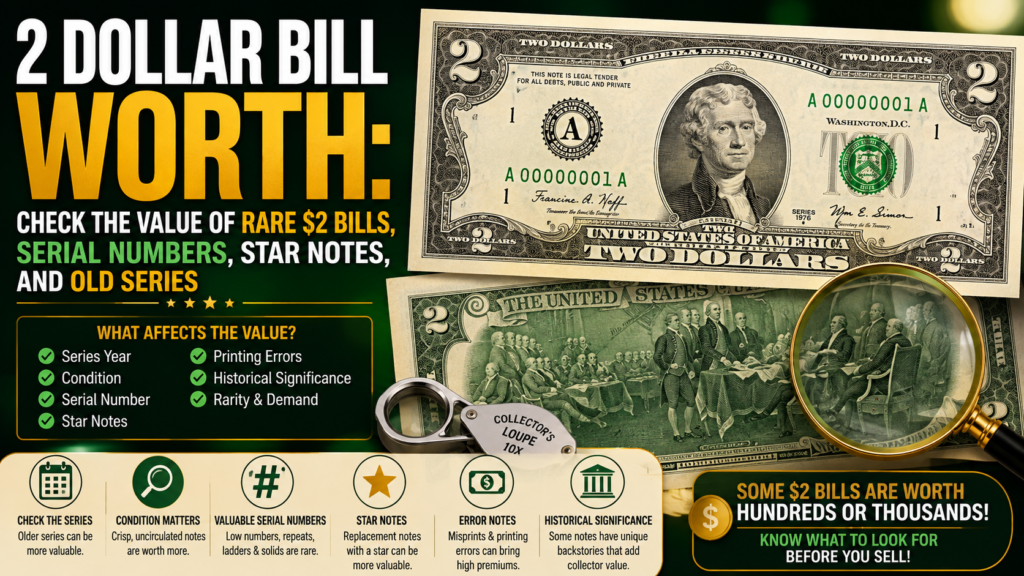
Determining 2 dollar bill worth requires more than looking at the year printed on the note. Most modern $2 bills remain worth their $2 face value, but certain notes can command higher prices because of their series, condition, serial number, star designation, printing errors, or historical significance. Some exceptional examples have sold for hundreds or even thousands of dollars, while ordinary circulated bills may have little or no collector premium.
The United States has issued different types of $2 notes for more than a century. Modern Federal Reserve $2 notes feature Thomas Jefferson on the front and a depiction based on John Trumbull’s Declaration of Independence painting on the reverse. The current design was introduced with the Series 1976 note as part of the United States Bicentennial period. According to the U.S. Currency Education Program, all genuine U.S. currency issued since 1861 remains valid at its full face value.
Collectors, however, may pay more than face value when a particular $2 note has characteristics that make it scarce or desirable. Checking those characteristics systematically provides a much more reliable valuation than comparing the note with expensive listings on online marketplaces.
Identify the Series Year Printed on Your $2 Bill
Start by locating the series year on the front of your $2 bill. The year provides an important starting point because it identifies the general issue and helps distinguish modern Federal Reserve Notes from earlier forms of United States currency.
Modern $2 Federal Reserve Notes use the design introduced in 1976. The U.S. Currency Education Program identifies the current $2 note design as having been issued from 1976 to the present. These notes feature Thomas Jefferson on the front and the signing of the Declaration of Independence on the reverse.
A Series 1976 bill is therefore not automatically rare. Millions of people saved $2 bills during the Bicentennial period, meaning surviving examples remain available to collectors. A circulated Series 1976 note with a normal serial number generally attracts much less interest than an exceptional example with an unusual serial number, printing feature, or documented historical connection.
Later-series $2 Federal Reserve Notes can also carry premiums under the right circumstances. A newer note with an extremely unusual serial number may be more collectible than an ordinary note that is several decades older.
Earlier $2 notes deserve closer examination. United States Notes, for example, can be identified by characteristics that differ from modern Federal Reserve Notes. The history of the denomination includes numerous designs and issuing systems, so an older note should not be valued solely according to its printed denomination.
Examine the Condition Before Estimating the Value
Inspect the physical condition of the bill because condition can dramatically influence collector value. Two $2 notes from the same series and printing can sell for different amounts when one is heavily circulated and the other remains crisp and nearly untouched.
Look for folds, creases, stains, writing, torn edges, missing corners, discoloration, pinholes, and other signs of circulation. A note that has spent years folded inside a wallet will generally be less desirable than a note preserved flat with sharp corners and original paper quality.
Collectors and professional grading services use standardized grading systems to describe paper money condition. Higher grades indicate stronger preservation. Notes described as uncirculated have not experienced ordinary circulation wear, although professional grading involves more detailed standards than simply deciding whether a bill appears clean.
Paper quality also matters. Modern Federal Reserve note paper consists of approximately one-fourth linen and three-fourths cotton and contains red and blue security fibers, according to the U.S. Currency Education Program. Genuine notes also have distinctive raised printing.
Do not wash, iron, flatten aggressively, tape, laminate, or chemically clean a collectible bill. Attempts to improve its appearance can reduce its collector value. Preservation is usually more important than cosmetic alteration.
| Bill characteristic | General effect on collector interest |
|---|---|
| Heavy folds, stains, or writing | Usually lowers value |
| Normal circulated condition | Often limited premium for modern notes |
| Crisp, clean condition | Can improve desirability |
| Uncirculated condition | May command a higher premium |
| Professionally graded high-grade note | Easier for collectors to evaluate |
| Damage or repairs | Usually reduces collector demand |
Inspect the Serial Number for Valuable Patterns
Read the serial number carefully because unusual number combinations can transform an otherwise common $2 bill into a collectible note. Serial numbers appear twice on the front of modern Federal Reserve Notes and consist of letters and numbers.
Low serial numbers are among the most recognizable collectible patterns. A note numbered 00000001, for example, has substantially different collector appeal from a random eight-digit number. Single-digit, two-digit, and very low serial numbers can attract substantial premiums.
The potential difference can be dramatic. Paper Money Guaranty reported that a 1976 $2 Federal Reserve Note from the San Francisco district carrying serial number 2 and graded PMG 64 Choice Uncirculated EPQ realized $13,200 at a Heritage Auctions sale in July 2022. That result involved an exceptionally scarce low-number note and does not indicate that ordinary 1976 $2 bills are worth thousands of dollars.
Collectors also seek other recognizable patterns. A repeater uses a sequence that repeats, such as 12341234. A radar reads the same forward and backward. Solid serial numbers use the same digit repeatedly, while ladder numbers follow an ascending or descending numerical pattern.
Birthday or date-style serial numbers can attract buyers when the digits correspond to a recognizable date. Their value can be more subjective because demand may depend on finding a buyer who considers that particular date meaningful.
Fancy serial numbers receive premiums because they are mathematically unusual or visually memorable. The underlying note does not necessarily need to be old for the serial number itself to create collector demand.
Check for a Star Beside the Serial Number
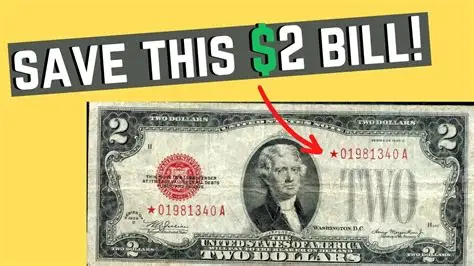
Look for a star symbol within or beside the serial number. A $2 bill containing this symbol is commonly called a star note or replacement note.
The Bureau of Engraving and Printing uses replacement notes when defective notes are identified during the production process. Rather than reproducing the exact original serial number, replacement notes are identified by a star designation.
The American Numismatic Association explains that star notes have historically carried a value somewhat above legal-tender value in some circumstances, with the premium depending on denomination and condition. The presence of a star, however, does not automatically make every replacement note rare or highly valuable.
Scarcity depends on factors such as the printing run, Federal Reserve district, series, surviving population, and condition. Some replacement-note printings are much harder to locate than others.
Collectors should therefore avoid statements such as “every $2 star note is valuable.” A more accurate approach is to identify the complete series, district, serial number, and star placement before checking comparable sales.
A high-grade star note from a scarce printing may have meaningful collector value. A common star note in heavily circulated condition may command only a modest premium.
Compare Red Seal and Green Seal $2 Bills
Check the color of the Treasury seal and serial numbers because seal color can help identify the type of $2 note you possess. Modern Federal Reserve $2 notes carry a green Treasury seal.
Earlier United States Notes are commonly associated with red seals and represent a different category of paper currency. The U.S. Currency Education Program notes that United States Notes were characterized by red seals and serial numbers and continued circulating until that class of currency was discontinued in 1971.
Red-seal $2 bills frequently generate collector interest because they belong to earlier issues rather than the modern Federal Reserve design introduced in 1976. Their market value depends heavily on series and condition.
A worn red-seal bill is not necessarily worth a fortune simply because it looks old. Collectors evaluate the exact issue and preservation level. Conversely, a particularly scarce variety in excellent condition can be significantly more desirable.
Green-seal bills should not automatically be dismissed either. A green-seal Series 1976 or later note can carry a premium if it has a rare serial number, replacement-star designation, printing error, unusual provenance, or exceptionally high grade.
Seal color therefore functions as an identification clue rather than a complete valuation method.
Look for Genuine Printing Errors and Unusual Features
Examine the bill for authentic production errors that occurred during printing. Legitimate error notes can have collector value because the Bureau of Engraving and Printing uses quality-control systems intended to prevent defective currency from entering circulation.
Possible error categories include misaligned printing, ink-related errors, cutting errors, offset transfers, improperly positioned seals, and other production abnormalities. The exact nature and severity of the error influence demand.
The American Numismatic Association notes that error notes can carry numismatic value above face value and that more dramatic errors often attract greater collector interest.
Damage that happens after a bill enters circulation is not the same as a printing error. A crooked cut caused during manufacture may interest collectors, whereas a bill cut with scissors after circulation does not become a valuable mint error. Similarly, missing ink caused by a genuine production problem differs from ink that has been chemically removed.
Suspected errors should therefore be evaluated carefully before attaching a large valuation. Professional authentication can be especially useful for dramatic errors because altering paper currency is possible.
Avoid modifying a note to make an apparent error more dramatic. Any alteration can destroy collector confidence and reduce value.
Evaluate 1976 $2 Bills Separately
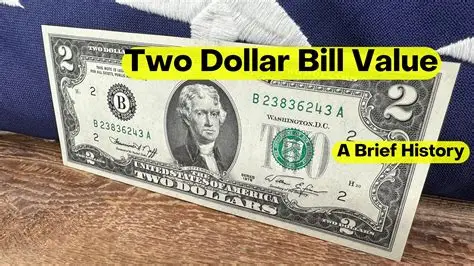
Give Series 1976 notes special attention because they are among the $2 bills most frequently saved and searched by owners. The denomination was reintroduced as a Federal Reserve Note in 1976 in connection with the United States Bicentennial. The reverse design depicts the signing of the Declaration of Independence.
Many people saved these notes when they were introduced, sometimes obtaining postal cancellations associated with the first issue. As a result, special combinations of postal markings, stamps, serial numbers, and preserved condition can create separate collecting categories.
Recent auction results demonstrate how strongly special characteristics influence prices. In June 2026, Heritage Auctions sold a group of five postally cancelled Series 1976 $2 Federal Reserve Notes graded PMG Choice Uncirculated 64 for $195.20. The notes included postal cancellations and stamps, making them different from ordinary circulated Series 1976 bills.
Another Heritage sale in July 2026 involved 42 consecutive Series 1976 $2 Federal Reserve Notes in Choice Crisp Uncirculated or better condition. The group realized $256.20.
These examples illustrate an important valuation principle: a $2 bill’s year alone does not establish its price. Quantity, condition, serial-number arrangement, postal history, and special features can produce very different results.
| Type of $2 bill | Key feature to examine | Potential collector significance |
|---|---|---|
| Modern circulated $2 bill | Condition and serial number | Often near face value unless unusual |
| Series 1976 note | Condition, district, serial number | Common overall, but special examples can carry premiums |
| Star note | Replacement designation | Premium depends on scarcity and condition |
| Fancy serial-number note | Numerical pattern | Can attract specialist collectors |
| Low serial-number note | Very small serial number | Potentially substantial premium |
| Older red-seal note | Series and condition | Often more collectible than ordinary modern notes |
| Printing-error note | Authenticity and severity | Genuine dramatic errors may command premiums |
| Postally cancelled 1976 note | Date, stamp, cancellation, condition | Separate Bicentennial collecting interest |
Verify Whether an Online Price Reflects a Real Sale
Compare completed transactions rather than relying on asking prices when researching how much a $2 bill is worth. Anyone can list a common note online for $500, $5,000, or even more, but the listing price does not prove that a buyer will pay that amount.
Auction records provide stronger evidence because they show prices actually realized by buyers and sellers. Even then, compare like with like. A professionally graded, extremely low serial-number bill cannot be used as the valuation benchmark for a worn bill with an ordinary serial number.
For example, the documented $13,200 sale of a Series 1976 $2 note with serial number 2 demonstrates the importance of exceptional serial numbers. It does not establish a $13,200 value for Series 1976 notes generally.
Recent results also show how groups of collectible notes can sell for amounts that are meaningful but far below sensational social-media claims. This is why owners should compare the exact series, Federal Reserve district, condition, grading status, serial-number type, and special characteristics.
Market prices also change. Collector demand, the number of similar notes offered for sale, and broader numismatic trends can influence realized prices over time.
Confirm That the $2 Bill Is Genuine
Inspect the bill’s physical characteristics before researching a large collector value. Counterfeit or altered notes have no legitimate numismatic value as genuine currency.
The U.S. Currency Education Program states that modern Federal Reserve Note paper contains approximately 25 percent linen and 75 percent cotton along with red and blue security fibers. Raised printing also contributes to the distinctive feel of genuine currency.
The modern $2 note does not contain every security feature found on higher denominations. Its design has remained substantially unchanged since 1976 because the denomination has historically experienced relatively little counterfeiting.
Owners should be especially careful when a supposed rarity contains a dramatic printing anomaly, unusual serial number, or altered appearance. Professional authentication may be appropriate when significant money is involved.
Do not attempt destructive authenticity tests. Cutting, chemically treating, or otherwise damaging a bill can eliminate any collector premium it might have had.
Protect a Potentially Valuable $2 Bill Properly
Handle a potentially collectible bill carefully once you identify features that may make it valuable. Physical damage can permanently reduce its grade and market appeal.
Hold the note by its edges using clean, dry hands. Avoid repeatedly folding or unfolding it. Do not write on the bill, attach adhesive tape, staple it, laminate it, or place it where moisture can cause staining.
A currency holder made from archival-safe material can protect the note from handling while allowing both sides to remain visible. Storage conditions should be dry and stable, away from direct sunlight, excessive heat, and high humidity.
If several bills have sequential serial numbers, keep them together until you understand whether the group has additional collector value. Consecutive runs can attract interest in certain circumstances, particularly when the notes are uncirculated.
Preservation is especially important before professional grading. A new fold created while researching the note can permanently change its condition.
Request Professional Grading When the Value Justifies It
Consider professional grading when the note appears rare enough that authentication and an independent condition assessment could materially affect its sale.
Professional paper-money grading companies examine authenticity, condition, and other characteristics before sealing qualifying notes in protective holders with grade information. Collectors may prefer professionally graded notes when large sums are involved because grading reduces uncertainty about condition.
Not every $2 bill needs grading. Paying a grading fee for an ordinary modern bill worth approximately face value may make little financial sense. Grading is more reasonable when the bill has a scarce series, important serial number, star designation, dramatic printing error, exceptional condition, or another feature capable of supporting a meaningful premium.
Before submitting a note, research comparable graded examples and calculate expected costs. Shipping, insurance, grading fees, seller commissions, and auction fees can all reduce the amount an owner ultimately receives.
An appraisal from a knowledgeable paper-money dealer or numismatic specialist can also provide useful guidance before grading.
Determine Where to Sell a Valuable $2 Bill
Choose the selling method according to the bill’s likely value and collector audience. Ordinary notes may not justify the fees involved in a major auction, while scarce or exceptional notes can benefit from exposure to specialized currency collectors.
Local coin and currency dealers provide convenience and may offer immediate purchase opportunities. Their offers typically need to leave room for resale profit, so the amount offered may be below the price a collector eventually pays.
Online marketplaces provide access to large audiences but require careful descriptions, quality photographs, secure shipping, and awareness of seller fees. Completed-sale data can also help establish realistic expectations.
Specialist auction houses can be appropriate for high-value notes, rare serial numbers, major errors, or historically significant pieces. Auction houses can provide authentication expertise, catalog descriptions, and access to established collectors.
Before accepting an offer, understand whether the quoted amount represents the hammer price, total price including buyer’s premium, or net proceeds to the seller. Those figures can differ substantially.
Review Common Questions Before You Sell or Keep a $2 Bill
How much is a regular $2 bill worth?
Most ordinary modern $2 bills in circulated condition are generally worth their $2 face value unless they possess a collectible feature. A special serial number, star designation, printing error, exceptional grade, or scarce variety can increase collector value.
Is a 1976 $2 bill worth more than $2?
Some Series 1976 $2 bills are worth more than face value, but the year alone does not make the note rare. Condition, serial number, Federal Reserve district, postal cancellation, star designation, and other features must be considered. Exceptional Series 1976 notes have realized large auction prices, but ordinary examples should not be valued using those rare sales.
Are $2 bills with red seals valuable?
Older red-seal $2 United States Notes can have collector premiums, depending on their series, scarcity, and condition. An old or red seal is an important identification feature, but it does not guarantee a specific value.
Are $2 star notes worth money?
Star notes can be more collectible because they are replacement notes. Their value depends on the specific series, printing run, scarcity, condition, and collector demand. Some are relatively common, while others are considerably harder to find.
Which serial numbers make a $2 bill valuable?
Collectors frequently seek extremely low serial numbers, repeaters, radars, solid numbers, ladders, and other distinctive patterns. The strongest premiums are generally associated with patterns that are genuinely scarce and easy to recognize.
Can a $2 bill really be worth thousands of dollars?
Yes, but such examples are exceptional. PMG documented a Series 1976 $2 Federal Reserve Note with serial number 2 that realized $13,200 at auction in 2022. That price was driven by the extremely low serial number, condition, and collector demand, not simply because it was a $2 bill.
Make a Final Value Decision Before Selling Your $2 Bill
The most reliable way to determine 2 dollar bill worth is to evaluate the complete note rather than focus on one characteristic. Begin with the series year, then examine its seal, physical condition, serial number, star designation, printing characteristics, Federal Reserve district, and any unusual historical features.
Most modern circulated $2 bills remain close to their $2 face value, which means finding an older-looking bill does not automatically mean discovering a valuable collectible. Genuine rarity usually comes from a combination of scarcity, condition, distinctive features, and collector demand.
Serial numbers deserve particular attention because extraordinary numbers can produce dramatic premiums. Star notes and legitimate printing errors may also increase value, while older red-seal notes belong to collectible issues that should be evaluated separately from modern Federal Reserve Notes.
Verified auction results are more useful than eye-catching online asking prices. A rare $2 bill can sell for hundreds or thousands of dollars, but those exceptional results should never be applied to ordinary notes without comparable characteristics.
If your bill has an extremely low serial number, an unusual star-note variety, an apparent printing error, excellent uncirculated condition, or an older scarce series, preserve it carefully and consider professional evaluation before selling. A methodical assessment provides the clearest answer to how much a $2 bill is actually worth and helps separate genuine collectible value from exaggerated online claims.