
The question “how much money does Jeff Bezos make a second?” appears to have a simple numerical answer. In practice, the result changes depending on whether “make” refers to salary, total compensation, investment gains, stock sales, or changes in estimated net worth.
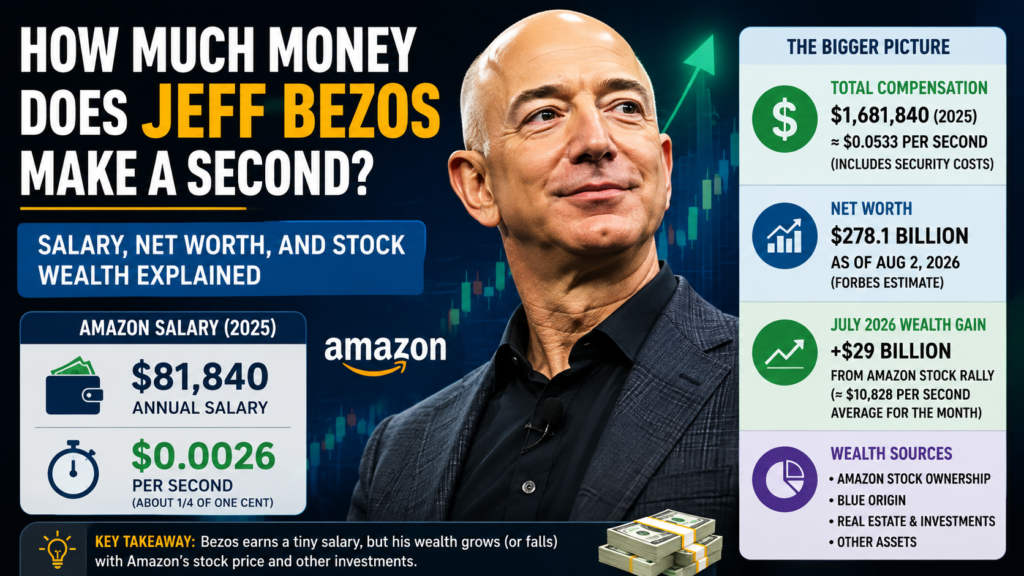
Based on his annual Amazon salary of $81,840, Jeff Bezos earns about $0.0026 per second, or roughly one-quarter of one cent. That calculation is accurate as a salary average, but it does not explain how he accumulated a fortune worth hundreds of billions of dollars.
Bezos’ wealth comes primarily from assets, especially his ownership of Amazon stock. Those holdings can gain or lose billions of dollars as Amazon’s share price changes, even though no corresponding cash payment reaches his bank account. Forbes estimated his net worth at approximately $278.1 billion on August 2, 2026, demonstrating both the scale and the time-sensitive nature of billionaire valuations.
Understanding the difference between wages and asset appreciation provides a more useful answer than simply dividing his net worth by the number of seconds in a year.
Calculate Jeff Bezos’ Amazon Salary Per Second
Begin with the amount Amazon officially reports as Bezos’ salary. The company’s 2026 proxy statement lists his 2025 base salary as $81,840. Amazon also states that Bezos requested no additional cash compensation because his substantial ownership already connects his financial interests to the company’s performance.
A standard 365-day year contains 31,536,000 seconds. Dividing the annual salary by that figure produces the following result:
$81,840 ÷ 31,536,000 = approximately $0.002595 per second
Rounded to four decimal places, Bezos earns about $0.0026 per second in salary.
| Time period | Estimated salary |
|---|---|
| Per second | $0.0026 |
| Per minute | $0.16 |
| Per hour | $9.34 |
| Per day | $224.22 |
| Per week | $1,573.85 |
| Per month | $6,820 |
| Per year | $81,840 |
These figures distribute the salary evenly across the entire year, including weekends, holidays, and hours when Bezos is not working. They are mathematical averages, not a description of Amazon’s payroll schedule.
The surprisingly small per-second figure shows why salary is not a reliable measure of a founder’s overall financial power. Bezos became wealthy through ownership in a rapidly growing company, not through a large annual paycheck.
Separate Salary From Total Reported Compensation
Amazon reports more than Bezos’ base salary in its executive compensation disclosures. Its 2026 proxy statement lists his total reported compensation for 2025 as $1,681,840. That figure consists of his $81,840 salary and $1.6 million in other compensation related to security arrangements.
Dividing $1,681,840 by the number of seconds in a standard year produces an average of approximately $0.0533 per second, or just over five cents.
That number should not be presented as ordinary income. Amazon explains that it provides security for certain senior executives because of their prominence and considers those costs necessary for the company’s benefit. The money pays for protective services rather than functioning as unrestricted cash that Bezos can spend personally.
The salary-based answer is therefore more precise:
Jeff Bezos receives about $0.0026 per second in Amazon salary.
A total-compensation calculation reaches about five cents per second, but most of that amount represents company-funded security expenses rather than take-home pay.
Measure His Wealth Through Amazon Ownership
Bezos’ Amazon shares are far more important to his financial position than his salary. As a founder and major shareholder, he benefits when investors assign a higher value to the company.
A shareholder’s wealth changes with the market price of the stock. When Amazon shares rise, the estimated value of Bezos’ remaining stake rises with them. When the share price falls, his net worth can decline sharply, even though the number of shares he owns has not changed.
This mechanism explains how Bezos can appear to “make” billions of dollars in a day. The gain usually reflects a higher market valuation of assets he already owns. It is not a salary payment, cash bonus, or direct transfer from Amazon.
The distinction matters because stock-based wealth remains exposed to market conditions. A gain visible on a billionaire ranking can reverse during the next trading session. Bezos would need to sell shares or use them in another financial transaction before converting that portion of his fortune into spendable cash.
Avoid Treating Net-Worth Growth as Income
Net worth measures the estimated value of assets minus liabilities at a particular time. Income measures money earned or received during a period. The two concepts are related, but they are not interchangeable.
If Bezos’ estimated net worth increases by $1 billion in one day, dividing that change by 86,400 seconds produces approximately $11,574 per second. The arithmetic is correct, but describing the result as an hourly wage would be misleading.
The increase may result from Amazon shares becoming more valuable rather than from Bezos receiving $1 billion in cash. If the stock falls the following day, much of the apparent gain may disappear.
Industry observers note that per-second billionaire calculations are most meaningful when they are labeled as changes in estimated wealth, not recurring earnings. This distinction prevents readers from confusing market fluctuations with salary or realized income.
Forbes’ estimate of $278.1 billion on August 2, 2026, should therefore be treated as a dated snapshot. Real-time rankings change as public share prices, private-company estimates, asset transfers, and other financial information are updated.
Compare Common Per-Second Calculations
Online articles use several formulas to estimate how much Jeff Bezos makes each second. These formulas can produce radically different answers because they measure different things.
The salary method divides $81,840 by the number of seconds in a year. It produces approximately $0.0026 per second and answers how much Amazon pays Bezos in base salary.
The compensation method divides $1,681,840 by the seconds in a year. It produces approximately $0.0533 per second, but the figure includes $1.6 million in company-funded security arrangements.
A net-worth-growth method measures how much his estimated fortune changed over a selected period. If his net worth increased by $20 billion over one year, the average increase would equal about $634 per second. That result would apply only to the dates selected and would not represent a guaranteed future rate.
Another method divides his entire fortune by one year. Using a net worth of $278.1 billion would produce approximately $8,818 per second. That calculation does not measure earnings at all. It converts decades of accumulated wealth into an artificial annual rate.
A reliable answer must identify the formula, source, and valuation date rather than presenting one dramatic number without explanation.
Account for Amazon’s Share-Price Movements
Amazon’s stock price has a major influence on Bezos’ reported wealth because a substantial portion of his assets remains tied to the company.
Forbes reported that his fortune increased by an estimated $29 billion during July 2026, as Amazon shares gained approximately 14%. That change brought his estimated wealth to about $278 billion at the beginning of August.
Spread evenly across a 31-day month, a $29 billion increase would equal roughly:
$29 billion ÷ 2,678,400 seconds = about $10,828 per second
This is the article’s clearest real-world statistic for illustrating the scale of market-driven wealth. It does not mean Amazon paid Bezos nearly $11,000 every second. It means the estimated value of his assets increased by that average amount during a particular month.
The figure could move in the opposite direction during a market decline. A fall in Amazon’s share price can reduce his estimated wealth by billions without requiring him to spend or transfer any money.
Include Blue Origin and Other Assets
Amazon is the largest publicly visible component of Bezos’ wealth, but it is not his only major asset.
He founded Blue Origin, a privately held aerospace company involved in rockets, spacecraft, launch services, and space infrastructure. Unlike Amazon, Blue Origin does not have a publicly quoted share price. Outside analysts must estimate its value using private transactions, comparable companies, funding information, and available business data.
Bezos also owns The Washington Post through a private company. His broader financial position may include real estate, investment funds, venture-capital holdings, cash, and proceeds from earlier Amazon stock sales.
These assets are more difficult to value than publicly traded securities. A stock exchange provides a visible market price for Amazon shares, while a private business may go months or years without a transaction that establishes a new valuation.
Differences in methodology explain why wealth rankings may publish different totals for Bezos on the same day. Each publication may apply its own assumptions to private companies, property, debt, charitable transfers, and other less transparent holdings.
Recognize the Effect of Amazon Stock Sales
A stock sale converts one form of wealth into another. It does not necessarily create new wealth at the moment of the transaction.
Suppose an investor holds $100 million in shares and sells $10 million of them. Before the transaction, the investor owns $100 million in stock. Afterward, the investor may hold approximately $90 million in shares and $10 million in cash, before taxes and transaction costs.
The investor’s assets have changed form, but the initial total remains close to $100 million.
Bezos has sold significant amounts of Amazon stock over the years. Those sales can provide liquidity for taxes, investments, philanthropy, Blue Origin, property purchases, and personal spending. However, the full proceeds should not automatically be called new income.
Part of a sale may represent a taxable capital gain, calculated by comparing the sale price with the owner’s cost basis. Another part represents the return of value already held in the investment.
For this reason, a large stock transaction cannot be converted into a dependable per-second earning rate without creating a distorted impression.
Distinguish Realized and Unrealized Gains
An unrealized gain occurs when an asset becomes more valuable while its owner continues to hold it. A realized gain generally occurs when the asset is sold for more than its cost basis.
Suppose Bezos owns Amazon shares valued at $10 billion at the start of a year and $12 billion at the end. His estimated wealth has risen by $2 billion, but the increase remains unrealized while he continues to own the shares.
If he sells some of the stock, the transaction may create a realized gain. The taxable amount depends on factors including the acquisition cost, sale price, holding period, and applicable tax rules.
This distinction prevents a common misunderstanding. A billionaire may become significantly wealthier on paper without receiving equivalent cash income.
It also works in reverse. An unrealized loss can reduce reported net worth without immediately affecting the owner’s cash balance. The investment remains capable of recovering value if market conditions improve.
Factor in Taxes and Charitable Transfers
Gross salary is not the same as take-home pay. Bezos’ $81,840 salary is reported before federal, state, and other applicable taxes.
Investment transactions can create different obligations. Long-term capital gains, short-term gains, interest, dividends, wages, and business income may be taxed under different rules. The amount Bezos retains from a stock sale depends on the transaction’s structure and his cost basis.
Charitable giving can also reduce personal net worth without representing consumption or a market loss. When money or assets move into a charitable organization, foundation, or irrevocable philanthropic structure, that value may no longer be counted as part of the donor’s personal fortune.
Public wealth rankings attempt to account for major known transfers, but outsiders do not have complete access to Bezos’ tax returns, liabilities, trusts, or private financial records.
No public calculation can therefore determine exactly how much after-tax money he receives every second. The most defensible figures are based on disclosed salary and clearly dated estimates of asset value.
Place His Salary in Amazon’s Business Context
Bezos’ $81,840 salary is unusually small relative to Amazon’s scale. The company reported $717 billion in revenue for 2025, up 12% from $638 billion in 2024. Amazon Web Services generated $129 billion, while the North American segment produced $426 billion and the international segment generated $162 billion.
The contrast between Amazon’s revenue and Bezos’ salary reinforces the role of ownership in his wealth. His financial connection to the company does not depend on receiving a conventional executive paycheck.
Amazon’s proxy statement says he has never received stock-based compensation from the company. Instead, the shares he acquired as founder provided the ownership position that later became extraordinarily valuable.
This arrangement differs from that of executives who receive annual stock awards as part of their compensation. Bezos’ wealth reflects the long-term appreciation of an existing founder stake, even as sales and transfers have reduced that stake over time.
Use the Most Accurate Keyword Answer
The clearest response to the keyword is:
Jeff Bezos makes approximately $0.0026 per second from his annual Amazon salary of $81,840. His total wealth does not increase at a fixed rate because most of it is tied to investments whose values change constantly.
A broader compensation calculation produces about $0.0533 per second, based on total reported compensation of $1,681,840. However, $1.6 million of that amount represents security-related costs paid by Amazon, not ordinary cash salary.
Calculations based on net-worth growth can reach thousands of dollars per second. During July 2026, for example, Forbes estimated that his wealth rose by $29 billion, equivalent to an average increase of about $10,828 per second during that month. That result describes asset appreciation over a selected period, not a recurring paycheck.
The answer should therefore state which measurement is being used rather than suggesting that Bezos receives one fixed amount every second.
Apply a Reliable Formula to Future Estimates
Updated calculations should begin with a clearly identified source and date.
For salary, use:
Annual salary ÷ seconds in the year = salary per second
For a standard year:
$81,840 ÷ 31,536,000 = $0.002595 per second
For changes in net worth, use:
Ending net worth − starting net worth ÷ seconds in the period
The result should be labeled as an average change in estimated wealth. It should not be described as salary, income, or cash earnings unless the underlying data actually measures those categories.
A leap year contains 31,622,400 seconds, so the result will differ slightly when a calculation covers 366 days.
Sources should also be matched carefully. An opening figure from Forbes should not be compared with a closing figure from another wealth index without acknowledging that the organizations may use different valuation methods.
Amazon’s SEC filings are the strongest source for compensation information because they provide official salary, benefits, and executive-compensation disclosures. Real-time wealth publications are more appropriate for current net-worth estimates, provided the valuation date appears alongside the number.
Summarize How Much Jeff Bezos Makes a Second

Jeff Bezos earns approximately $0.0026 per second in Amazon salary, based on the $81,840 annual salary disclosed in Amazon’s 2026 proxy statement. His total reported compensation averages about five cents per second, although most of that amount covers corporate security rather than cash wages.
His much larger financial gains come from asset ownership. Forbes estimated his net worth at about $278.1 billion on August 2, 2026, after reporting that his fortune rose by approximately $29 billion during July as Amazon shares climbed.
Those market-driven changes can be expressed as per-second averages, but they are neither stable nor guaranteed. They represent fluctuations in asset value, not money continuously deposited into his account.
The most accurate answer therefore depends on the measurement: about one-quarter of one cent per second in salary, roughly five cents per second in reported compensation, and a highly variable amount when changes in investment value are included.