
Publishing on a third-party website can help writers and businesses place their ideas beyond their own blogs, but visibility alone does not make a platform valuable. Editorial standards, audience relevance, link policies, content ownership, transparency, and long-term accessibility all shape whether an article submission supports a credible publishing strategy.
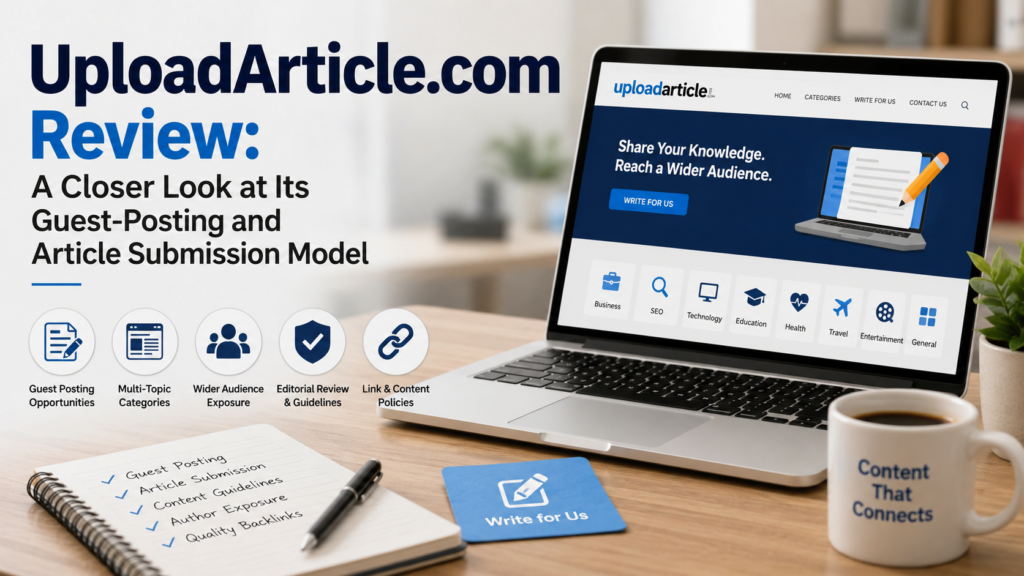
uploadarticle.com presents itself as a multi-topic publishing website with a “Write for Us” opportunity for outside contributors. Its publicly visible content covers subjects such as SEO, business, technology, digital marketing, education, health, travel, entertainment, and general-interest topics.
This review is based on the platform’s public-facing website and related published information. It does not reflect personal use, independent testing, or verification of the site’s traffic, editorial performance, customer service, or SEO value. Any writer considering the platform should confirm its current rules directly before submitting original content, personal information, or payment.
Explore What UploadArticle.com Is
uploadarticle.com appears to function as a broad article-publishing and guest-posting website rather than a specialist trade publication. Its homepage displays articles from multiple categories and promotes an opportunity for writers to share content with a wider online audience.
The broad category structure may suit contributors whose subjects cross traditional industry boundaries. A marketing writer might submit an article about local search, while a business contributor could discuss customer retention, workplace technology, entrepreneurship, or operational planning. Education and general categories appear to provide room for instructional or informational material that does not belong to a narrowly defined professional journal.
That flexibility should not be mistaken for automatic acceptance or verified editorial quality. A “Write for Us” invitation typically means that a website is open to reviewing outside submissions. It does not necessarily mean that every article is accepted, professionally edited, fact-checked, widely distributed, or indexed by search engines.
The platform should also be distinguished from an academic journal, regulated news organization, or peer-reviewed publication. Its public presentation suggests a web-content model built around contributor articles. Writers should assess it according to the standards that matter for that model, including clarity of terms, author attribution, topic relevance, editorial review, and treatment of outbound links.
Review the Available Content Categories
The site’s public pages show content spanning business, SEO, education, entertainment, technology-related subjects, and general topics. This variety may make the platform accessible to many contributors, but it also places more responsibility on writers to choose a focused subject and the most appropriate category.
Prepare SEO and Digital Marketing Content
SEO and digital marketing articles may address keyword research, technical optimization, social media, analytics, content planning, email marketing, paid campaigns, or online branding. A credible submission should explain a specific problem rather than repeat broad claims about gaining traffic or ranking first.
Writers should support search-related recommendations with current documentation or reliable research. Search practices change, and advice that once appeared effective may become obsolete or conflict with search-engine policies. Claims about rankings, backlinks, and organic growth should therefore be framed as possibilities rather than predictable results.
The continued popularity of written content helps explain why businesses explore external publishing. In the Content Marketing Institute’s 2024 B2B research, 94% of surveyed marketers said their organizations used short articles or posts, making them the most widely used content format in the study. That statistic demonstrates the importance of article-based marketing, but it does not establish that publication on any particular website will produce traffic, leads, or search gains.
Develop Business and Entrepreneurship Articles
Business submissions may cover leadership, sales, customer service, budgeting, startup planning, productivity, workplace culture, or business technology. The strongest articles usually define the reader clearly and offer advice suited to that reader’s circumstances.
A guide for a new freelancer, for example, should not assume the same resources, staff, or legal structure as an established corporation. Specificity makes an article more useful and reduces the reliance on generic advice.
Contributors should take additional care with financial, legal, employment, or tax topics. These areas may require jurisdiction-specific information, professional review, or clear disclaimers. Unsupported recommendations can weaken both the article and the author’s credibility.
Create Technology and Software Content
Technology articles may discuss software platforms, mobile applications, cybersecurity, artificial intelligence, data management, consumer devices, or cloud services. Writers should separate verified functions from marketing language and avoid presenting planned features as currently available.
Prices, product specifications, security practices, and compatibility requirements can change quickly. A useful technology article should identify when its information was checked and rely on primary documentation wherever possible.
Commercial relationships should also be disclosed. A writer who works for, represents, or receives compensation from a featured company should not present promotional material as an independent review.
Cover Education and General Topics
Education content may include study techniques, online learning, professional qualifications, classroom technology, career development, or student productivity. General-interest categories may accommodate additional subjects, but broad placement does not remove the need for accuracy and a defined purpose.
A well-prepared general article should still answer a clear reader question. It should use logical headings, reliable sources, practical detail, and language appropriate to its intended audience.
Health, child development, finance, and other sensitive topics require particular caution. Contributors should avoid diagnosing conditions, promising outcomes, or replacing qualified professional guidance with generalized online advice.
Follow How the Submission Process Appears to Work
A contributor interested in uploadarticle.com would typically begin by reviewing the site’s current “Write for Us,” article submission, or contact information. The platform’s public homepage promotes contributor participation, although the exact requirements should be checked at the time of submission because policies may change.
Writers should not rely entirely on third-party summaries of the process. Similar names and related domains appear in search results, and information published elsewhere may refer to a different website or an outdated procedure.
Check the Current Contribution Guidelines
The first step is to locate the platform’s active submission rules. Look for requirements covering topics, word count, originality, formatting, images, author biographies, commercial references, and outbound links.
Clear policies make it easier to determine whether the platform fits the proposed article. When a rule is missing or ambiguous, the contributor should request clarification before providing original work.
Particular attention should be given to publication rights. A writer needs to know whether the article must remain exclusive, whether it can later be republished, and whether the platform may edit, remove, or reuse it.
Choose the Closest Category
The selected category should reflect the article’s main purpose rather than every subject mentioned in the draft. An article about improving an ecommerce website’s conversion rate may fit digital marketing more closely than general business, even though it discusses revenue.
Accurate placement can help editors assess relevance and may help readers find the article within the site. When a draft overlaps several categories, the writer should choose the one that best matches the reader’s primary question.
Prepare an Original Draft
A guest post should provide useful information rather than serve mainly as a container for a backlink. A focused headline, direct opening, descriptive subheadings, evidence-based explanations, and a practical conclusion usually create a stronger submission.
Writers should not submit copied material, lightly altered versions of other articles, or machine-generated drafts that have not been checked carefully. The named author remains responsible for factual accuracy, source quality, and originality.
Industry observers note that third-party publishing tends to be more credible when the article can stand on its own without a promotional link. That principle gives contributors a practical test: the content should remain useful even if all references to the author’s company are removed.
Provide Author and Media Information Carefully
The platform may request a name, email address, biography, profile image, social link, or website address. Contributors should provide only information they are prepared to make public.
Images should be original, properly licensed, or clearly available for reuse. A picture appearing in a search result is not automatically free to publish.
The author biography should be accurate and restrained. Claims about qualifications, clients, achievements, or experience should be verifiable and relevant to the subject.
Allow for Editorial Review
Submitting an article does not necessarily mean it will be published. The platform may review a draft for relevance, originality, formatting, grammar, promotional language, or compliance with its policies.
Contributors should not assume a publication date or response time unless one is clearly stated. They should retain a dated copy of the submitted article, correspondence, agreed terms, and any transaction record.
Consider the Potential Benefits
Publishing through uploadarticle.com may provide several possible advantages, depending on its actual readership, editorial treatment, search visibility, and alignment with the contributor’s subject. These are potential outcomes, not guarantees.
Reach Readers Beyond an Owned Website
An external article may introduce a writer’s work to people who do not visit the writer’s own website. The value of that exposure depends on whether the platform attracts readers who are genuinely interested in the topic.
Before submitting, review several recently published articles. Examine the relevance of their categories, the quality of the writing, the visibility of author information, and whether the pages appear maintained.
A platform’s description of its audience should not be treated as independently verified traffic data. Writers seeking measurable exposure should ask whether audience information or analytics are available.
Add Work to a Writing Portfolio
A published byline may support a writer’s portfolio, particularly when the article demonstrates subject knowledge, sound research, and clear communication. Freelancers, consultants, founders, and early-career professionals may find external samples useful when approaching potential clients or employers.
The value of a portfolio piece comes primarily from the quality of the work. A published link cannot compensate for inaccurate claims, weak structure, or overtly promotional writing.
Writers should also consider whether they will remain comfortable being associated with the platform and article over time.
Increase Brand Recognition
A useful article may introduce readers to an author, organization, or area of expertise. This tends to work best when the contributor solves a real problem and limits direct promotion.
Brand recognition can be difficult to measure without referral, engagement, or conversion data. Contributors should use trackable links when permitted and review their own analytics instead of assuming that publication creates meaningful awareness.
A byline, biography, and relevant company reference may contribute to visibility, but the scale of that effect cannot be known without evidence.
Generate Possible Referral Visits
When author links or contextual references are permitted, an article may send visitors to the contributor’s website. The number and value of those visits will depend on the article’s visibility, reader intent, placement, and relevance.
A link should lead to a resource that genuinely helps the reader. Excessive commercial anchors or unrelated destinations may reduce trust and could conflict with the platform’s editorial policies.
Referral traffic should be measured separately from search rankings. A post may attract some direct visits without having a meaningful effect on organic visibility.
Expand a Distribution Strategy
Third-party publishing may complement a company blog, newsletter, social channels, podcast, or public-relations program. It can give an organization another format for presenting expertise to different audiences.
External publishing should not replace owned content. A business has more control over articles hosted on its own website, including updates, design, lead capture, calls to action, and long-term availability.
A balanced strategy may use external articles for selective reach while keeping the most valuable resources on channels the business controls.
Examine SEO Expectations Realistically
Some contributors may evaluate uploadarticle.com mainly as a link-building opportunity. That approach requires caution because no guest post can guarantee improved rankings.
Search engines assess links according to relevance, placement, context, and broader linking patterns. A link may be followed, nofollowed, sponsored, removed, redirected, ignored, or affected by later changes to the page.
The article itself may or may not be indexed, and an indexed page may not rank for commercially valuable searches. Third-party authority scores can provide limited comparative information, but they are not search-engine guarantees and do not predict the performance of every page.
A more defensible approach is to submit content because it serves a relevant audience. Any link should support the reader and fit naturally within the article. Contributors should avoid keyword-heavy anchors, repeated placements, or arrangements designed primarily to manipulate rankings.
SEO value should therefore be considered alongside editorial quality, audience fit, referral potential, author presentation, and brand safety.
Check Important Details Before Using the Platform
The most important questions concern the terms under which the article will be accepted, edited, published, linked, and retained.
Verify Ownership and Republishing Rights
Contributors should determine whether they retain copyright and what publishing permission they grant to the platform. Some websites request exclusivity, while others allow republication after a specified period.
Do not assume that an article can be removed, updated, or republished later. When the terms are unclear, ask for confirmation in writing.
Writers should also keep the original draft and supporting research in their own records.
Confirm Fees and Commercial Terms
Article platforms may accept unpaid contributions, charge for sponsored placement, offer paid editorial services, or use different terms for commercial links. The current arrangement should be verified before a contributor submits content or makes a payment.
Any fee should be accompanied by a clear explanation of what it covers. Payment should not be interpreted as proof of editorial endorsement or a promise of traffic, indexing, leads, or rankings.
Contributors should be cautious when significant claims are made without written terms or supporting evidence.
Inspect the Link Policy
Check how many links are allowed, whether they must be informational, and whether commercial relationships require disclosure. Determine whether the platform reserves the right to change or remove links after publication.
Agencies acting for clients should disclose their role and obtain approval for the final text and destination URLs. A business remains responsible for how its brand is represented, even when another party manages the placement.
Sponsored or affiliate relationships should be labeled in accordance with relevant regulations and platform rules.
Evaluate the Editorial Standard
Read a representative sample of current articles across several categories. Look for coherent organization, responsible claims, credible sourcing, author attribution, and evidence of proofreading.
A high volume of content does not necessarily prove strong editorial oversight. Likewise, one weak article does not establish that every page has the same standard.
The practical question is whether the platform’s overall presentation supports the contributor’s reputation and intended audience.
Review Privacy and Contact Information
Before creating an account or sharing personal data, examine the available privacy policy and contact details. Consider how the platform says it handles names, email addresses, account information, and uploaded material.
Do not submit confidential client information, private business records, unpublished research, or sensitive personal documents without a clear reason and an appropriate agreement.
Writers should also use unique account credentials and avoid reusing passwords from other services.
Check Publication and Indexing Status
A contributor seeking public visibility can inspect recent articles to see whether pages load correctly, display author information, and appear in relevant searches.
Search indexing can change, and the treatment of one article does not predict the treatment of another. Still, a review of recent pages may reveal whether the platform’s published content remains accessible and maintained.
Contributors should revisit their article after publication and keep a record of the live URL.
Compare UploadArticle.com With Other Publishing Options
The table below summarizes practical differences between uploadarticle.com and several common publishing routes. It does not rank individual websites or confirm that every provider follows the same policies.
| Publishing option | Typical purpose | Editorial control | Possible advantage | Main consideration |
|---|---|---|---|---|
| Multi-category submission website | Contributor articles and guest posts | Controlled mainly by the platform | May accommodate several subject areas | Terms, fees, audience, and links require verification |
| Personal or company blog | Owned publishing and lead generation | High | Full control over updates, branding, and calls to action | Requires promotion and ongoing maintenance |
| Specialist industry publication | Expert content for a defined readership | Usually high | May offer stronger topical relevance | Acceptance standards can be demanding |
| Sponsored-content website | Paid brand placement | Varies | Commercial terms may be agreed in advance | Sponsorship should be disclosed clearly |
| Social publishing platform | Fast distribution and interaction | Shared with the platform | Built-in audience and sharing functions | Visibility depends on platform policies and algorithms |
| Email newsletter | Direct communication with subscribers | High | Strong control over audience relationships | Requires an established and engaged list |
| Peer-reviewed journal | Formal academic publication | Very high | Scholarly review and citation potential | Strict methods and longer review periods |
The appropriate channel depends on the objective. A company seeking conversions may prioritize its own website. A consultant building authority in a specialized field may prefer a respected trade publication. A writer seeking a broad web byline may consider a general submission platform after reviewing its terms.
Improve the Quality of a Submission
A strong guest post begins with a specific reader problem. Broad topics such as “Digital Marketing Tips” often produce predictable advice. A narrower subject, such as “How Local Retailers Can Audit Inconsistent Business Listings,” creates more room for practical detail.
The opening should tell readers what they will learn and why it matters. Each heading should move the discussion forward rather than restating the title in different words.
Statistics, regulations, health information, product specifications, and financial claims should be supported by credible sources. Primary documents, recognized research organizations, government publications, and official product documentation are generally stronger than anonymous summaries.
The article should disclose commercial relationships and avoid fabricated examples. A hypothetical scenario should be identified as hypothetical rather than presented as a client result.
The conclusion should help readers decide what to do next without turning into an aggressive sales pitch. Proofreading should include names, dates, citations, links, capitalization, formatting, and image permissions.
Decide Whether the Platform Fits Your Goal
uploadarticle.com may merit consideration for contributors seeking a multi-category publishing outlet, but its suitability will depend on the goal and the terms available when the article is submitted.
A writer seeking a portfolio sample should examine byline presentation and long-term page accessibility. A business interested in referral traffic should evaluate audience relevance and link rules. A marketer considering SEO should focus on editorial fit and avoid assuming that publication itself will improve rankings.
Recent content can provide clues about the platform’s subject range and publishing style, but it cannot verify readership, conversions, or editorial consistency. Those areas require direct evidence.
The platform is best assessed as one possible channel within a broader content strategy. Businesses should continue investing in their own websites, email lists, and other channels they can control.
Frequently Asked Questions
Is uploadarticle.com a guest-posting website?
The website publicly promotes a “Write for Us” opportunity and displays contributor-style articles across multiple categories. Prospective writers should check the current submission page to confirm whether contributions are open and whether different terms apply to editorial and commercial posts.
Does the platform guarantee SEO results?
No guest-posting platform can reasonably guarantee search rankings, traffic, leads, or sales. Outcomes depend on relevance, content quality, competition, link treatment, indexing, technical factors, and search-engine decisions.
Which topics appear suitable for submission?
The site currently displays content related to subjects such as SEO, business, education, entertainment, technology, and general-interest topics. The accepted category list and editorial priorities should be verified before drafting.
Can contributors submit previously published work?
That depends on the platform’s current originality and republication rules. Writers should confirm whether submissions must be exclusive and whether previously published material requires disclosure or canonical attribution.
How should a writer evaluate the site before submitting?
Review recent articles, author profiles, submission terms, privacy information, contact details, editorial presentation, link practices, fees, and publication rights. Any important condition that is not clearly stated should be clarified in writing.
Make an Informed Submission Decision
uploadarticle.com appears to provide a broad publishing route for contributors working in SEO, business, technology, digital marketing, education, and general-interest fields. Its public content suggests an active multi-category model, but its audience quality, editorial consistency, traffic, and marketing value should not be assumed without further evidence.
Treat the site as a possible distribution channel rather than a guaranteed growth tool. Review the latest contribution rules, inspect recently published articles, confirm ownership and payment terms, and submit only original work that reflects well on the named author or business.
The most sensible next step is to compare the platform’s current terms with your specific objective. Proceed only when its category fit, editorial approach, publication rights, costs, and link policies are clear enough to support an informed decision.