
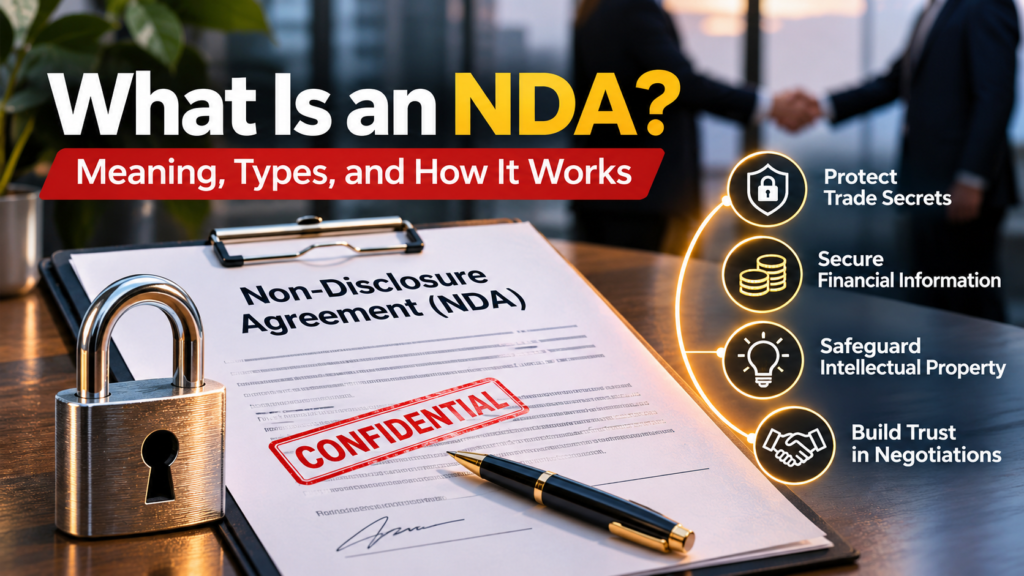
An NDA (Non-Disclosure Agreement) is a legally binding contract designed to protect confidential information from unauthorized disclosure or misuse. Businesses, employees, freelancers, investors, and professional organizations use NDAs to safeguard trade secrets, intellectual property, financial records, and sensitive business information.
When two parties need to share private information, an NDA establishes clear rules about how that information can be accessed, used, stored, and disclosed. These agreements are particularly important in employment relationships, business partnerships, investment negotiations, and projects involving proprietary technology.
Understanding what is an NDA helps individuals recognize their legal responsibilities before signing a confidentiality agreement. It also allows businesses to protect valuable information without unnecessarily restricting legitimate professional activities.
This guide explains the meaning of an NDA, its different types, how non-disclosure agreements work, their essential clauses, legal consequences, and practical considerations before signing.
Understand What an NDA Means and How It Works
An NDA stands for Non-Disclosure Agreement, a contract in which one or more parties agree to keep specified information confidential. It establishes legal obligations that restrict unauthorized disclosure and may also limit how the receiving party can use the protected information.
An NDA generally involves two roles: the disclosing party and the receiving party. The disclosing party provides confidential information, while the receiving party agrees to protect it according to the agreement. In some situations, both participants exchange sensitive information and accept confidentiality obligations. The contract identifies the protected material, permitted uses, restrictions, and duration of these responsibilities.
For example, a software company may hire a freelance developer to improve an application. Before providing access to its source code, product roadmap, and technical documentation, the company asks the developer to sign an NDA. The agreement allows the developer to use the information for the assigned project but restricts disclosure to competitors or unauthorized individuals.
The National Institute of Standards and Technology (NIST) recognizes NDAs as agreements specifying information that signatories undertake not to disclose. This definition reflects their central purpose: establishing responsibilities for information that must remain confidential.
An NDA does not automatically make every conversation or document confidential. Its protection depends on the contract’s terms, the nature of the information, and applicable law.
Identify the Main Purposes of a Non-Disclosure Agreement
The primary purpose of a non-disclosure agreement is to protect valuable information while allowing individuals and organizations to collaborate. An NDA helps establish confidentiality expectations before sensitive material is shared and provides a contractual basis for addressing unauthorized use or disclosure.
Businesses commonly use NDAs to safeguard commercial information, protect competitive advantages, support confidential negotiations, and maintain trust between professional parties. The agreement can restrict information sharing to authorized individuals and specify the activities for which protected material may be used.
Protect Trade Secrets and Proprietary Knowledge
Trade secrets can include formulas, algorithms, manufacturing processes, technical methods, and specialized business practices that derive value from remaining secret.
For example, a food manufacturer may use an NDA to restrict access to a proprietary recipe or production method. The agreement helps prevent an authorized recipient from disclosing that information to competing businesses.
Secure Financial and Commercial Information
Organizations regularly exchange financial forecasts, pricing structures, operating costs, profit margins, and investment information.
An NDA can restrict the use of these records to a particular transaction, such as evaluating an acquisition or negotiating a partnership.
Safeguard Intellectual Property During Collaboration
Companies often share product designs, unpublished inventions, software documentation, and research findings with external specialists.
An NDA can protect this information during development or evaluation. However, confidentiality agreements do not automatically establish intellectual property ownership or replace patents, copyrights, and other legal protections.
Build Trust During Business Negotiations
Confidentiality agreements help organizations discuss potential opportunities without immediately exposing sensitive business plans.
For example, two businesses exploring a joint venture may exchange operational information and strategic projections under a mutual NDA.
The agreement establishes expectations before either company makes a final commercial commitment.
Identify the Information Protected by an NDA
An NDA protects information identified as confidential under its terms, subject to applicable legal restrictions. Protected material may include written documents, digital records, verbal discussions, technical files, presentations, and other sensitive information exchanged for an authorized purpose.
A well-drafted agreement should describe protected information clearly enough for the receiving party to understand its obligations. Some NDAs protect only documents specifically marked confidential. Others cover broader categories of information, including information disclosed during meetings or demonstrations.
Common examples include:
- Trade secrets: Proprietary formulas, manufacturing processes, algorithms, and confidential technical methods.
- Business plans: Expansion strategies, product launches, marketing campaigns, and internal operational proposals.
- Financial information: Revenue forecasts, financial statements, budgets, pricing models, and profit margins.
- Customer information: Confidential client lists, customer preferences, purchasing histories, and private business relationships.
- Technical information: Source code, software architecture, engineering specifications, research findings, and development documentation.
- Employee information: Confidential personnel files, internal organizational records, and sensitive employment information where lawful to protect.
- Commercial negotiations: Proposed acquisitions, investment discussions, supplier agreements, and confidential partnership terms.
However, not all information can be protected simply by including it in an NDA.
Common confidentiality exclusions include information that becomes publicly available without a contractual breach, information already lawfully known to the recipient, information independently developed without using protected material, and information lawfully received from an unrestricted third party.
These exclusions help distinguish legitimately confidential information from knowledge that cannot reasonably be controlled through a private agreement.
Compare the Different Types of NDAs
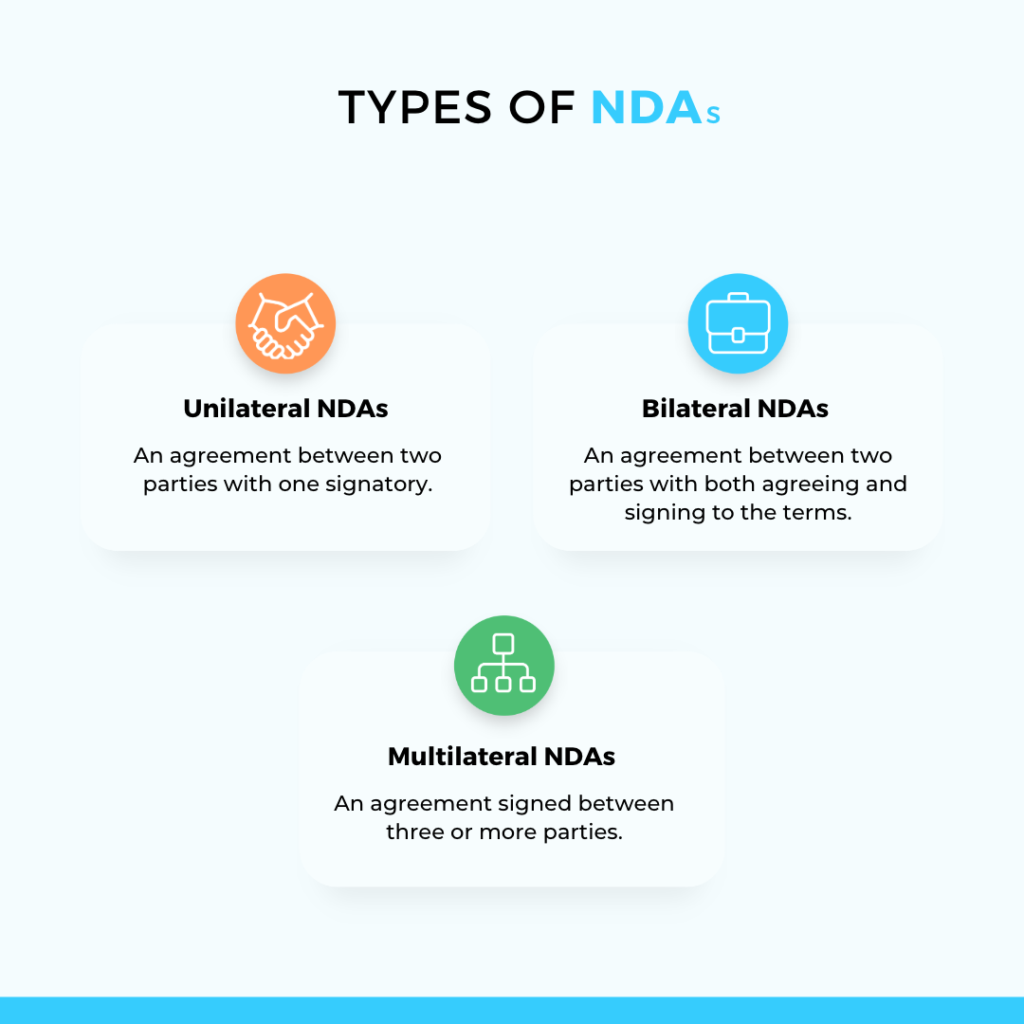
The appropriate type of NDA depends on how many parties will share confidential information and which participants must protect it. The three common structures are unilateral, mutual, and multilateral non-disclosure agreements.
Each arrangement establishes different confidentiality responsibilities. Selecting the correct structure helps ensure that the agreement reflects the actual exchange of information rather than imposing unnecessary or incomplete obligations.
| Type of NDA | How It Works | Common Use |
|---|---|---|
| Unilateral NDA | One party discloses confidential information, and another party agrees to protect it. | Employment, freelancing, contractor relationships |
| Mutual NDA | Both parties exchange confidential information and accept confidentiality obligations. | Business partnerships, joint ventures, negotiations |
| Multilateral NDA | Three or more parties establish confidentiality responsibilities under one agreement. | Research projects, multi-company collaborations |
Use a Unilateral NDA for One-Way Information Sharing
A unilateral NDA, also called a one-way NDA, protects information disclosed by one party to another.
The disclosing party provides confidential material, while the receiving party agrees to restrict unauthorized access, disclosure, or use.
For example, a company may provide confidential customer information to an external consultant. The consultant may access the information to complete the agreed assignment but cannot share it with unrelated third parties.
Unilateral NDAs are common when employers, businesses, and clients disclose information to employees, freelancers, suppliers, or service providers.
Use a Mutual NDA When Both Parties Share Information
A mutual NDA, sometimes called a bilateral NDA, establishes confidentiality obligations for both participants.
This arrangement is suitable when two organizations expect to exchange commercially sensitive information.
For example, a software company and a financial services provider may discuss developing a payment platform. The software company shares technical architecture, while the financial services provider shares confidential operational requirements.
Both organizations must protect the information received from the other.
Use a Multilateral NDA for Multiple Participants
A multilateral NDA establishes confidentiality obligations among three or more parties involved in the same project or transaction.
For example, a research initiative may involve a university, a technology company, and a manufacturing business. Each participant may need access to confidential findings or development information.
A multilateral agreement can coordinate these responsibilities within one contract, although drafting may become more complicated when different participants have different disclosure rights.
The UK Intellectual Property Office provides example one-way and mutual NDAs that illustrate common agreement structures.
Review the Essential Clauses in a Non-Disclosure Agreement
An NDA should contain clear provisions defining confidentiality obligations, permitted activities, and contractual remedies. These clauses determine which information receives protection and how the parties must handle it.
Most confidentiality agreements include identification of the parties, a definition of confidential information, a permitted-purpose clause, confidentiality obligations, disclosure exceptions, and a duration clause. Depending on the relationship, they may also include intellectual property provisions, security requirements, governing law, and dispute-resolution procedures.
Define the Parties Involved
The agreement should identify the individuals or legal organizations participating in the confidential relationship.
Correct names and legal details help establish who owes confidentiality obligations and who is entitled to enforce them.
When an organization signs an NDA, the person executing it should have appropriate authority to act on its behalf.
Specify Confidential Information
The confidentiality clause explains which materials, communications, or records are protected.
It may identify business plans, trade secrets, financial information, software documentation, research data, or other commercially sensitive material.
Clear definitions reduce disputes about whether particular information falls within the agreement.
Establish Permitted Uses
An NDA should explain the specific purpose for which confidential information may be used.
For example, a potential investor may receive financial records solely to evaluate an investment opportunity.
Using those records to support an unrelated commercial activity could violate the permitted-purpose clause.
Set the Confidentiality Duration
The duration clause explains how long confidentiality obligations continue.
Some agreements establish fixed periods, while others impose longer restrictions for particular information, such as trade secrets.
The appropriate period depends on the nature of the information and applicable law.
Include Disclosure Exceptions
Most NDAs recognize circumstances in which confidentiality restrictions do not apply.
These often include public information, independently developed knowledge, information previously lawfully known to the recipient, and disclosures authorized by the disclosing party.
Agreements should also preserve disclosures required or protected by law.
Explain Legal Remedies
The remedies clause may describe consequences when a party breaches the agreement.
Depending on the circumstances and applicable law, possible remedies include monetary damages, an injunction, or other available legal relief.
A contract cannot guarantee that every requested remedy will be awarded by a court.
Follow the NDA Signing Process Correctly
Signing an NDA involves reviewing the proposed terms, confirming the parties’ responsibilities, and formally executing the agreement. Whenever possible, the parties should complete this process before exchanging confidential material.
The signing process should establish what information will be shared, how it may be used, who can access it, and how long confidentiality requirements will continue. Both parties should also understand their rights regarding lawful disclosures and the consequences of breaching the contract.
The process generally includes the following steps:
- Identify the parties: Record the correct legal names of the individuals or organizations involved.
- Determine the NDA type: Select a unilateral, mutual, or multilateral agreement based on the information exchange.
- Define protected information: Specify the documents, records, conversations, and other material covered.
- Explain permitted uses: Identify the business or professional purpose for which the information may be accessed.
- Establish confidentiality obligations: Describe how the recipient must protect, store, and share information.
- Review exclusions: Confirm that the agreement permits disclosures that are legally required or protected.
- Set the duration: Establish when obligations begin and how long they continue.
- Confirm governing law: Identify the jurisdiction and appropriate dispute-resolution provisions.
- Execute the agreement: Obtain signatures from the individuals or authorized representatives.
- Store the signed document: Maintain an accessible, secure record for future reference.
After signing, the receiving party must comply with the applicable confidentiality requirements.
For example, a freelance designer who signs an NDA may need to store client files securely, limit access to authorized collaborators, and avoid publishing unfinished designs without permission.
Signing the agreement is only the beginning of confidentiality compliance. Effective protection also depends on appropriate information-handling procedures.
Apply NDAs in Employment and Workplace Relationships
Employers use NDAs to protect confidential information employees may encounter during their work. These agreements can safeguard customer information, internal business strategies, proprietary software, research findings, and commercially sensitive records.
An employment NDA may be a standalone contract or a confidentiality clause within an employment agreement. It may apply throughout employment and, for specified information, after the working relationship ends. The employer should explain what is protected, why confidentiality is necessary, and which activities remain lawful.
For example, an employee at a technology company may access unpublished product specifications and source code. An NDA may prevent the employee from sharing this material with competitors or using it to support an unrelated commercial project.
Protect Information During Employment
Employees frequently access sensitive information through company databases, email systems, documents, and internal communication platforms.
An NDA can clarify that access for legitimate work purposes does not authorize unrestricted distribution.
Employers should support confidentiality requirements through information security policies, access controls, and appropriate employee training.
Maintain Confidentiality After Employment Ends
Certain confidentiality obligations may continue after an employee resigns, retires, or is dismissed.
For example, a former employee may remain responsible for protecting proprietary formulas or confidential technical information learned during employment.
However, an NDA should not automatically be interpreted as preventing someone from joining a competitor or using general professional knowledge.
Preserve Protected Employee Rights
Confidentiality agreements must operate within applicable employment law.
For example, UK employment guidance from Acas explains that NDAs cannot prevent protected whistleblowing or reporting crimes to the police. Additional restrictions apply to certain workplace disclosures.
These protections vary between jurisdictions, making the governing law particularly important when assessing an employment NDA.
Use NDAs in Business Partnerships and Investment Discussions
Business partnerships and investment negotiations often require organizations to exchange private commercial information. NDAs help establish confidentiality obligations before parties review information that could affect competition, valuation, or strategic decision-making.
These agreements commonly protect financial statements, operational records, pricing information, product plans, proprietary technology, and customer information. The NDA should identify the specific transaction or evaluation purpose and restrict use of the information beyond that purpose.
Protect Information During Investment Evaluations
Companies seeking investment may share revenue projections, business plans, operational forecasts, and confidential financial records.
An NDA can establish restrictions when investors review such information.
However, some investors decline NDAs during preliminary discussions. Businesses can reduce risk by sharing general information initially and reserving highly sensitive records for later evaluation stages.
Secure Confidential Partnership Negotiations
Organizations considering partnerships may need to discuss internal processes, market opportunities, and strategic objectives.
A mutual NDA can protect information exchanged during those discussions.
For example, two companies exploring a distribution partnership may need to exchange private pricing models and customer demand forecasts.
Protect Merger and Acquisition Information
Mergers and acquisitions commonly involve detailed financial and operational reviews.
Potential buyers may receive confidential contracts, employee information, customer records, and business forecasts.
An NDA can restrict disclosure and limit the use of information to evaluating the proposed transaction.
Maintain Confidentiality in Supplier Relationships
Manufacturers, distributors, and service providers may receive confidential product designs, production methods, purchasing requirements, and commercial specifications.
A properly drafted NDA helps define appropriate use of these materials during the supplier relationship.
Protect Intellectual Property and Confidential Technology
An NDA can support intellectual property protection by restricting the disclosure and unauthorized use of confidential technical information. This is particularly useful when businesses collaborate with developers, manufacturers, researchers, or product designers.
Protected material may include unpublished inventions, source code, algorithms, engineering drawings, prototypes, and specialized manufacturing processes. The agreement should define the materials shared and clarify the purpose for which recipients may use them.
For example, a startup developing an electronic device may share prototype specifications with a manufacturing partner. An NDA can help prevent the manufacturer from disclosing those specifications to unrelated companies.
However, an NDA does not automatically give the disclosing party patent protection or establish ownership of newly developed inventions.
Businesses should use appropriate intellectual property agreements when they need to assign ownership, license technology, establish development rights, or address inventions created during collaboration.
A confidentiality agreement is therefore one component of a broader intellectual property protection strategy, rather than a complete substitute for other legal safeguards.
Compare an NDA With Other Common Legal Agreements
An NDA primarily protects confidential information, while other commercial contracts establish different legal rights and obligations. Understanding the distinction prevents confusion when a document includes confidentiality provisions alongside employment, intellectual property, or competitive restrictions.
For example, a non-compete agreement may seek to restrict certain competitive activities, while a non-solicitation agreement may restrict particular efforts to recruit clients or employees. An intellectual property assignment concerns ownership rights rather than confidentiality alone.
| Agreement | Primary Purpose | Common Application |
|---|---|---|
| Non-Disclosure Agreement | Protect specified confidential information | Employment, consulting, partnerships |
| Non-Compete Agreement | Restrict certain competitive activities where legally permitted | Employment, sale of a business |
| Non-Solicitation Agreement | Restrict specified solicitation activities | Employment and business relationships |
| Employment Agreement | Establish employment rights, duties, and compensation | Employer-employee relationships |
| Service Agreement | Define services, deliverables, payment, and responsibilities | Freelancers and consultants |
| Intellectual Property Assignment | Transfer specified intellectual property rights | Inventions, software, creative work |
A single contract may contain several of these provisions.
For example, a freelance development agreement might include payment terms, project deadlines, confidentiality requirements, and intellectual property ownership clauses.
Each provision serves a different purpose and may be subject to different legal requirements.
Evaluate Whether an NDA Is Legally Enforceable
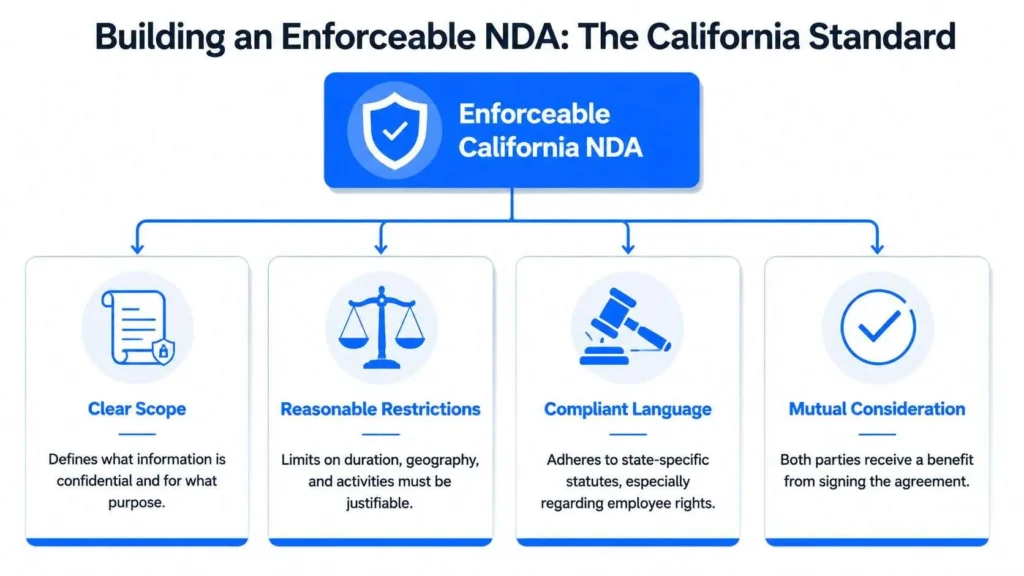
An NDA can be legally enforceable when it satisfies the relevant requirements of contract law and contains lawful confidentiality obligations. However, enforceability depends on the contract’s wording, the governing jurisdiction, and the circumstances of the dispute.
Courts may consider whether the parties entered into a valid agreement, whether the protected information was adequately identified, and whether the restrictions conflict with applicable law or public policy. The rules governing contract formation and remedies can differ significantly between countries.
According to Cornell Law School’s Legal Information Institute, NDAs operate through contract law, but statutory protections and public policy can limit their enforcement.
Confirm the Legal Validity of the Agreement
An enforceable NDA must satisfy applicable contract formation requirements.
Depending on the jurisdiction, relevant issues may include consent, lawful purpose, contractual certainty, capacity, and consideration or an applicable legal alternative.
Agreements involving fraud, unlawful pressure, or prohibited terms may face legal challenges.
Assess the Reasonableness of Confidentiality Restrictions
An NDA should establish clear obligations that protect legitimate confidential information.
Overly broad language may create uncertainty or raise enforceability concerns, particularly when the agreement attempts to restrict lawful activity unrelated to protected information.
The legal outcome depends on the jurisdiction and specific wording.
Understand Available Legal Remedies
A party harmed by an NDA breach may seek compensation or other relief.
Possible remedies include monetary damages for established losses and court orders intended to prevent further unauthorized disclosure.
The availability of these remedies depends on applicable law, evidence, and the nature of the breach.
Recognize the Limits of Confidentiality Obligations
An NDA cannot necessarily prohibit every disclosure.
For example, UK law protects qualifying whistleblowing disclosures even when an employee has signed a confidentiality agreement.
Similarly, applicable laws may protect disclosures to regulators, law enforcement authorities, legal advisers, or other authorized recipients.
Anyone uncertain about these rights should obtain advice based on the relevant jurisdiction.
Determine How Long an NDA Remains Effective
An NDA remains effective for the period established by its terms, subject to applicable law. Some agreements specify a fixed confidentiality period, while others impose longer obligations for certain types of information.
The duration often depends on how long the information is expected to remain sensitive. Financial forecasts or short-term business plans may lose commercial relevance relatively quickly, while proprietary manufacturing methods and confidential technical knowledge may require longer protection.
The UK Intellectual Property Office notes that confidentiality periods of three or five years are commonly used, although some categories of information may justify longer protection.
It is also important to distinguish the agreement’s term from the duration of confidentiality obligations.
For example, an NDA may govern information exchanged during a six-month evaluation project but require the recipient to maintain confidentiality for three years after the project ends.
The parties should examine both provisions before signing.
An NDA also does not automatically remain enforceable forever simply because it contains an indefinite duration clause. The validity of continuing restrictions depends on applicable law and the nature of the protected information.
Review Important Terms Before Signing an NDA
Before signing an NDA, review its confidentiality obligations, disclosure restrictions, duration, and potential legal consequences. Understanding these provisions can help prevent accidental violations and identify terms that require clarification or negotiation.
Particular attention should be given to the definition of confidential information, authorized recipients, permitted uses, disclosure exceptions, and post-termination obligations. The agreement should also explain how protected documents must be returned or destroyed when the relationship ends.
Consider the following questions before signing:
- Which information is confidential? Confirm that the protected material is described clearly.
- How may the information be used? Determine whether use is limited to a specific project or transaction.
- Who can access it? Check whether employees, subcontractors, and professional advisers may receive information under appropriate safeguards.
- How long do restrictions last? Review the confidentiality period and any continuing obligations.
- Which disclosures are permitted? Confirm that the agreement recognizes applicable legal requirements and protected rights.
- Who owns the information? Check whether the document includes intellectual property assignment or licensing provisions.
- What happens after termination? Understand any requirements to return, delete, or securely retain records.
- Which law governs the agreement? Identify the applicable jurisdiction and dispute procedures.
- What happens if the NDA is breached? Review provisions concerning damages, injunctions, legal costs, and other remedies.
Employees and contractors should also look for restrictions unrelated to confidentiality, such as non-compete or non-solicitation clauses.
The Acas guidance on using NDAs fairly recommends clear wording, reasonable time to review agreements, and opportunities to obtain advice without undue pressure.
When an NDA contains significant financial obligations or unfamiliar restrictions, obtaining legal advice before signing can help clarify the risks.
Avoid Common Mistakes When Creating an NDA
An effective NDA requires precise drafting and practical confidentiality procedures. Common mistakes include vague definitions, excessive restrictions, missing disclosure exceptions, unclear duration clauses, and inadequate procedures for handling sensitive information.
A generic confidentiality agreement may not suit every business relationship. For example, an NDA designed for a freelance writer may not address the technical requirements of a software development project or the complex information exchange involved in a corporate acquisition.
One common mistake is defining virtually all information as confidential without distinguishing public knowledge from protected material. This can create uncertainty and disputes.
Another mistake is failing to describe the permitted use of information. A recipient may understand that disclosure is restricted but remain unsure whether the information can be used for research, internal analysis, or unrelated business activities.
Organizations may also overlook authorized third-party access. Accountants, lawyers, subcontractors, and technical advisers may need to review confidential information for legitimate purposes. The agreement should address such access appropriately.
Finally, businesses should not rely solely on a signed NDA to protect their information.
Practical safeguards such as restricted document access, secure file storage, employee training, and controlled information sharing can reduce the likelihood of accidental disclosure.
Respond Properly When Someone Breaches an NDA
A suspected NDA breach should be assessed by reviewing the agreement, preserving relevant evidence, and identifying the information allegedly disclosed or misused. Taking appropriate action can help limit further exposure and establish whether a contractual violation occurred.
The affected party should examine the signed agreement, relevant communications, disclosed documents, and any available records showing how information was accessed or shared. Evidence should be preserved lawfully, without unauthorized access to accounts or systems.
For example, if a contractor sends confidential product specifications to an unauthorized competitor, the company may need to determine whether the information was covered by the NDA, whether the recipient lacked authorization, and whether further disclosure is likely.
Possible responses include requesting that the disclosure stop, seeking the return or deletion of information, negotiating a resolution, or consulting legal counsel about available remedies.
In serious cases, the affected party may seek court intervention to prevent additional disclosure or pursue compensation for legally recoverable losses.
However, a disclosure is not necessarily a breach simply because a party considers it sensitive. Contractual exceptions, lawful authorization, and statutory protections may apply.
A careful legal assessment should establish whether the conduct actually violated an enforceable obligation.
Find Answers to Frequently Asked Questions About NDAs
1. What does NDA stand for?
NDA stands for Non-Disclosure Agreement. It is a contract that protects specified confidential information and establishes restrictions on unauthorized disclosure or use.
2. Is an NDA legally binding?
Yes, an NDA can be legally binding when it meets applicable contract-law requirements. However, certain clauses may be unenforceable if they violate the law, conflict with public policy, or fail other legal requirements.
3. Can I refuse to sign an NDA?
Yes, you can generally refuse to sign a proposed NDA. However, the other party may decide not to share confidential information or proceed with a proposed business arrangement. Employment-related consequences depend on local law and the circumstances.
4. How long does an NDA last?
An NDA may impose confidentiality obligations for a fixed period, such as two, three, or five years. Some agreements contain longer restrictions for trade secrets. The duration depends on the contract and applicable law.
5. What happens if you break an NDA?
Breaching an enforceable NDA may lead to a breach-of-contract claim, monetary damages, a court injunction, or other available remedies. The outcome depends on the agreement, the evidence, the nature of the violation, and applicable law.
6. Does an NDA prevent someone from reporting illegal activities?
Not necessarily. Many jurisdictions protect certain reports of unlawful conduct, whistleblowing disclosures, or communications with authorized authorities. The specific rights and exceptions depend on the applicable law.
Protect Confidential Information With a Properly Structured NDA
An NDA, or Non-Disclosure Agreement, is a legal tool that helps individuals and organizations protect confidential information while maintaining productive professional relationships. These agreements are widely used in employment, freelancing, technology development, investment negotiations, and business partnerships.
Understanding what an NDA is involves recognizing how the agreement works, which information it protects, the different NDA types, and the contractual responsibilities it creates.
A well-structured NDA clearly identifies confidential information, establishes permitted uses, defines reasonable confidentiality periods, includes appropriate exceptions, and explains available remedies for unauthorized disclosure.
Before signing an NDA, review its terms carefully, understand your responsibilities, and confirm that its restrictions comply with applicable law. For significant business transactions or complex employment arrangements, professional legal advice can provide additional protection.
When properly drafted and supported by responsible information-handling practices, a non-disclosure agreement can reduce confidentiality risks, protect commercially valuable information, and create clearer expectations between the parties involved.