
Knowing the official CPP payment dates can make monthly budgeting easier for Canadians who depend on Canada Pension Plan retirement, disability, survivor, or children’s benefits. CPP benefits are generally paid once per month, with most payments arriving near the end of the month.
For 2026, the Government of Canada has published 12 scheduled CPP payment dates. The next scheduled CPP payment date as of September 17, 2026, is September 25, 2026. The remaining payments for the year are scheduled for October 28, November 26, and December 22.
The same published CPP schedule applies to several Canada Pension Plan benefits, including the CPP retirement pension, CPP disability benefit, children’s benefits, and survivor benefits. However, receiving a payment on the scheduled date can depend on the payment method, financial institution processing, and whether Service Canada has accurate banking and personal information.
This guide explains the 2026 CPP payment schedule, direct deposit timing, mailed cheque considerations, benefit amounts, delayed payments, CPP and OAS payment timing, taxation, cost-of-living adjustments, and the steps recipients can take when an expected payment does not arrive.
Check the Official CPP Payment Dates for 2026
Use the Government of Canada’s published schedule when planning around CPP payments. Service Canada administers Canada Pension Plan payments, and the federal government’s benefits calendar lists each official payment date for the year.
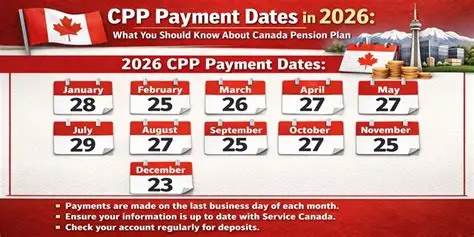
The complete CPP payment dates for 2026 are:
| Month | CPP Payment Date 2026 | Day |
|---|---|---|
| January | January 28, 2026 | Wednesday |
| February | February 25, 2026 | Wednesday |
| March | March 27, 2026 | Friday |
| April | April 28, 2026 | Tuesday |
| May | May 27, 2026 | Wednesday |
| June | June 26, 2026 | Friday |
| July | July 29, 2026 | Wednesday |
| August | August 27, 2026 | Thursday |
| September | September 25, 2026 | Friday |
| October | October 28, 2026 | Wednesday |
| November | November 26, 2026 | Thursday |
| December | December 22, 2026 | Tuesday |
These dates come from the Government of Canada’s official 2026 benefits payment calendar. The calendar states that the Canada Pension Plan schedule includes the CPP retirement pension as well as disability, children’s, and survivor benefits.
The exact day changes from month to month because CPP is not simply deposited on the same numbered date every month. Payments generally occur during the final portion of each month, with scheduling adjusted around weekends, holidays, and administrative processing requirements.
Mark the Next CPP Payment Date
Mark September 25, 2026 if you are looking for the next CPP payment date from the current date of September 17, 2026. Both the Government of Canada’s general benefits calendar and its CPP retirement pension page identify September 25 as the next scheduled payment date.
After September, the next scheduled payments are October 28, November 26, and December 22. December’s payment arrives earlier in the month than most other CPP payments, which is particularly important for recipients planning expenses around the holiday period.
Recipients should distinguish between the date Service Canada issues a payment and the moment funds become visible in a bank account. Direct deposits usually provide the fastest access, but individual financial institutions can have different posting practices.
Confirm Which Benefits Follow the CPP Payment Schedule
Use the CPP payment schedule for more than just the standard retirement pension. The federal benefits calendar states that its Canada Pension Plan dates include CPP retirement, disability, children’s, and survivor benefits.
This means a recipient of the CPP disability benefit, for example, follows the same published 2026 dates. Service Canada’s disability-benefit information independently confirms the January through December schedule, including the September 25, October 28, November 26, and December 22 payments.
However, different Canadian government programs should not automatically be treated as CPP. The Canada Disability Benefit, Canada Child Benefit, GST/HST credit, and certain provincial benefits have their own payment schedules. Checking the exact program name is important when a deposit does not arrive on a CPP date.
Set Up Direct Deposit for Faster CPP Payments
Choose direct deposit when possible if you want CPP payments transferred directly into your bank account. Service Canada states that CPP retirement pension payments are deposited into a recipient’s bank account every month when direct deposit has been selected.
Direct deposit reduces the dependence on postal delivery and eliminates the need to physically deposit a cheque. It can be particularly useful for seniors, people with mobility limitations, Canadians who travel, and anyone who wants more predictable access to monthly benefits.
Recipients who currently receive cheques can sign up for direct deposit. Banking information should be entered carefully because an incorrect account or transit number may interfere with payment processing. Changes to bank accounts should also be handled before closing an existing account whenever possible.
Allow Extra Time for Mailed CPP Cheques
Allow additional delivery time if you receive CPP by cheque instead of direct deposit. According to Service Canada, recipients who have not selected direct deposit receive their CPP retirement pension by a cheque mailed during the last three business days of each month.
A published CPP payment date should therefore not be interpreted as a guarantee that a physical cheque will appear in every mailbox that exact morning. Postal delivery depends on location and delivery conditions.
The Government of Canada’s general benefits calendar advises recipients that payments may take a few days to arrive and that posted cheques can take longer than direct deposits. It recommends waiting 5 to 10 business days before contacting the program about a missing payment.
For people who regularly experience postal delays, switching to direct deposit can provide a more predictable payment method.
Check Your CPP Payment When It Does Not Arrive
Check your banking information, payment method, benefit status, and My Service Canada Account when an expected CPP payment does not appear.
A payment may be delayed for reasons that have nothing to do with the nationwide CPP schedule. Bank processing, outdated account information, mailing delays, administrative reviews, or changes in eligibility can affect individual recipients.
Service Canada’s benefits calendar specifically advises that payments are issued according to the published dates but may require several days to arrive. It recommends allowing 5 to 10 business days before contacting the applicable program when a payment is missing.
If sufficient time has passed, recipients can use My Service Canada Account to review relevant CPP information or contact Service Canada. Avoid relying on unsolicited emails, text messages, or social-media posts that claim a special CPP payment has been released. Government benefit scams frequently use payment-related claims to encourage people to disclose personal or banking information.
Use My Service Canada Account to Manage CPP Information
Use My Service Canada Account, commonly abbreviated as MSCA, to access Canada Pension Plan information and services online.
The Government of Canada directs CPP recipients to MSCA for CPP-related services. The account can help users access information connected with their benefits without depending entirely on paper correspondence.
Keeping personal details accurate is particularly important for recipients using direct deposit. Changes to banking information, address details, marital status, or other relevant circumstances may affect communication or benefit administration.
Users should access MSCA through official Government of Canada channels rather than links contained in suspicious emails or text messages. Benefit-payment scams often imitate government communications, so checking the web address and using established login methods helps reduce fraud risk.
Compare CPP and OAS Payment Dates
Compare CPP with Old Age Security if you receive both programs. In 2026, the Government of Canada has scheduled CPP and OAS payments on the same monthly dates.
| Month | CPP Payment | OAS Payment |
|---|---|---|
| January 2026 | January 28 | January 28 |
| February 2026 | February 25 | February 25 |
| March 2026 | March 27 | March 27 |
| April 2026 | April 28 | April 28 |
| May 2026 | May 27 | May 27 |
| June 2026 | June 26 | June 26 |
| July 2026 | July 29 | July 29 |
| August 2026 | August 27 | August 27 |
| September 2026 | September 25 | September 25 |
| October 2026 | October 28 | October 28 |
| November 2026 | November 26 | November 26 |
| December 2026 | December 22 | December 22 |
Although the payment dates match, CPP and OAS are different programs with different eligibility rules and funding structures. CPP entitlement is generally connected with contributions made during a person’s working years, while OAS eligibility is principally connected with age and Canadian residency requirements.
The Guaranteed Income Supplement, or GIS, is also associated with the OAS system rather than CPP. The government’s current GIS information lists September 25, 2026 as the next payment date because GIS payments follow the OAS schedule.
Separate CPP Payments From Other Federal Benefits
Check the program name before assuming all federal benefits arrive with CPP.
The Canada Child Benefit, for example, has a different 2026 schedule. September’s CCB payment is scheduled for September 18, while September’s CPP payment is scheduled for September 25.
The Canada Disability Benefit also follows a different schedule from CPP disability. Its September 2026 payment is scheduled for September 17, whereas the CPP disability benefit follows the standard CPP date of September 25.
This distinction is particularly important because the names of government disability programs can sound similar. A person receiving CPP disability should consult CPP payment dates, while someone receiving the separate Canada Disability Benefit should use that program’s schedule.
Review Current CPP Retirement Pension Amounts
Review your own entitlement rather than assuming every CPP recipient receives the maximum pension.
The Government of Canada currently lists the maximum CPP retirement pension at age 65 for January 2026 as $1,507.65 per month. It also reports an average new CPP retirement pension at age 65 of $877.01 per month for July to September 2026.
Actual CPP retirement payments depend on several factors, including how much and for how long a person contributed, average earnings, when the pension begins, and CPP enhancement contributions.
Someone starting CPP earlier than age 65 can generally receive a smaller monthly pension, while delaying the pension beyond age 65 can increase the monthly amount within the program’s rules. As a result, the payment date may be the same for millions of recipients while the amount deposited differs substantially from one person to another.
Review Current CPP Disability Payment Amounts
Check the CPP disability amount separately from the retirement pension because the calculation and maximum payment are different.
The Government of Canada lists a maximum CPP disability benefit of $1,741.20 per month for 2026. It reports an average amount for new beneficiaries of $1,234.68 per month as of April 2026.
CPP disability recipients receive monthly payments and follow the published CPP payment schedule. Their 2026 dates therefore include September 25, October 28, November 26, and December 22 for the remaining months after August.
Receiving the maximum is not automatic. Individual amounts depend on CPP rules and the recipient’s contribution history.
Check Survivor and Children’s CPP Benefits Separately
Review the applicable CPP benefit if you receive a survivor’s pension or children’s benefit after the death or disability of a contributor.
CPP includes several benefits beyond retirement and disability. Government payment tables distinguish children’s benefits, survivor benefits, combined survivor-and-retirement pensions, combined survivor-and-disability benefits, and the one-time CPP death benefit.
Monthly survivor and eligible children’s benefits generally follow the CPP payment schedule published by the Government of Canada. The death benefit is different because it is a one-time payment rather than a continuing monthly CPP pension.
Amounts can vary according to the type of benefit and the circumstances of the eligible person. For that reason, beneficiaries should review the payment amount associated with their specific CPP benefit rather than using retirement pension maximums as a reference.
Account for Annual CPP Cost-of-Living Adjustments
Expect CPP retirement payments to be reviewed for inflation adjustments rather than remaining permanently fixed.
Service Canada explains that the monthly CPP retirement pension increases every January if the cost of living rises. The adjustment is based on Canada’s Consumer Price Index. If the measured cost of living falls, CPP payments do not decrease as a result of that annual adjustment mechanism.
This means a person receiving one monthly amount in December may see a different amount beginning in January even without changing their pension start date or employment circumstances.
Recipients budgeting for a new calendar year should therefore distinguish between the CPP payment date and the CPP payment amount. The schedule determines when a payment is issued, while indexing and individual pension calculations determine how much is paid.
Plan for Tax on CPP Income
Include CPP in tax planning because CPP retirement pension payments are taxable income.
Service Canada states that taxes are not automatically deducted from CPP retirement payments unless the recipient requests monthly tax deductions. A person who does not request withholding may need to pay income tax when filing an annual tax return.
This can create an important budgeting issue. The amount deposited into a bank account may appear to be fully available for spending, but some recipients may ultimately owe income tax on that money.
People receiving multiple income sources, such as CPP, OAS, employment income, private pensions, RRSP or RRIF withdrawals, or investment income, may need to consider their total taxable income. Individual tax circumstances differ, so personalized tax advice may be appropriate when deciding whether voluntary tax deductions should be requested.
Track December’s CPP Payment Earlier Than Usual
Pay particular attention to the December 22, 2026 CPP payment date because it falls earlier than most monthly payments.
Most 2026 CPP dates fall between approximately the 25th and 29th of the month. December is an exception, with payment scheduled for December 22.
An earlier December deposit does not mean recipients receive an extra CPP payment. It remains the regular monthly December benefit.
The earlier date can affect budgeting because the interval between the December payment and the following January payment can feel longer than a typical month-to-month cycle. Recipients who use CPP for rent, utilities, groceries, medication, insurance, and other regular expenses may want to account for that gap when allocating December funds.
Avoid False CPP Payment Information Online
Verify unusual CPP claims through an official Government of Canada source before sharing personal information or making financial decisions.
Government benefit topics frequently attract misleading headlines about supposed bonus payments, one-time deposits, increased cheques, or newly approved benefit amounts. Some claims confuse CPP with OAS, GIS, the Canada Disability Benefit, tax credits, provincial programs, or unrelated government initiatives.
The Government of Canada’s benefits calendar itself includes a warning about false information online and directs Canadians to official government sources for accurate benefit information.
A credible CPP payment-date claim should match information published through Canada.ca or Service Canada. Be particularly cautious when a website asks for banking credentials, a Social Insurance Number, payment fees, or login details in exchange for accessing a supposed CPP bonus.
Confirm Retroactive CPP Payments Separately
Check retroactive-payment rules if you applied for CPP after becoming eligible rather than assuming all missed months will automatically be paid.
The Government of Canada states that a person applying for a CPP retirement pension after age 65 may receive retroactive payments for up to 12 months, consisting of up to 11 previous months plus the month of application, but not for a period earlier than the month after the person’s 65th birthday. It also states that there are no retroactive retirement-pension payments for a pension started before age 65.
Retroactive payments should therefore be distinguished from the normal recurring CPP payment calendar.
The amount and timing of an individual’s retroactive entitlement depend on their circumstances and application. Anyone expecting a retroactive amount should rely on correspondence and account information from Service Canada rather than assuming that it will necessarily appear as a normal monthly CPP deposit.
Budget Around the Remaining CPP Payment Dates in 2026
Use the remaining dates to plan recurring bills and essential expenses for the rest of 2026.
As of September 17, four CPP payments remain on the official 2026 calendar: September 25, October 28, November 26, and December 22.
Because the intervals are not identical, setting recurring expenses based solely on a fixed calendar day can create temporary cash-flow mismatches. A bill due on the 25th, for example, could be due before an October CPP deposit scheduled for October 28.
Where possible, recipients can coordinate bill due dates with their usual pension-deposit window or maintain a small buffer for expenses that come due before that month’s CPP payment.
The December schedule deserves additional planning because the December 22 payment arrives earlier than normal and must still support expenses until the next scheduled monthly payment.
Verify the Payment Schedule When a New Year Begins
Check the new official payment calendar when 2027 approaches instead of assuming the 2026 dates will repeat.
CPP payment dates change from year to year. Weekends, holidays, and calendar structure affect when monthly payments are scheduled.
A 2026 table should therefore be used only for 2026 payments. Search results can continue displaying older calendars after a new schedule has been published, making the publication year one of the most important details to verify.
Government of Canada pages are preferable to screenshots and copied social posts because the official benefits calendar can be updated when necessary.
Follow Reliable Steps When a CPP Payment Is Missing
Start with the official scheduled payment date before concluding that a payment is late. Then check whether you receive CPP through direct deposit or cheque, review your bank activity, verify that Service Canada has accurate information, and allow the government’s recommended processing period.
The Government of Canada advises that a payment can require several days to arrive and mailed cheques can take longer. Its general guidance is to wait 5 to 10 business days before contacting the applicable program about a missing benefit payment.
If the payment remains missing after that period, use official Service Canada channels or My Service Canada Account to investigate. Do not give sensitive personal or banking information to a person who contacts you unexpectedly claiming that a fee is required to release a CPP payment.
This process provides a more reliable response than relying on social media reports from other recipients because one person’s bank, benefit status, payment method, or account circumstances may differ from another’s.
Review Frequently Asked Questions About CPP Payment Dates
When is the next CPP payment date in 2026?
As of September 17, 2026, the next scheduled CPP payment is September 25, 2026. The remaining 2026 dates are October 28, November 26, and December 22.
What are all the CPP payment dates for 2026?
The official dates are January 28, February 25, March 27, April 28, May 27, June 26, July 29, August 27, September 25, October 28, November 26, and December 22, 2026.
Are CPP and OAS paid on the same dates?
For 2026, yes. The Government of Canada’s published calendar lists the same monthly payment dates for CPP and OAS. The programs remain separate and have different eligibility rules.
Does CPP disability follow the same payment dates?
Yes. The Government of Canada’s CPP disability page lists the same 2026 payment dates used for the standard CPP schedule.
What should I do if my CPP payment is late?
First confirm the official payment date and check your bank account or payment method. The Government of Canada notes that payments may take several days to arrive and advises waiting 5 to 10 business days before contacting the program about a missing payment.
Is CPP paid by direct deposit?
CPP can be paid by direct deposit. Service Canada states that recipients who choose direct deposit receive their monthly CPP retirement pension directly in their bank account. Recipients without direct deposit receive a mailed cheque.
Use the Official CPP Payment Dates to Plan Ahead
The CPP payment dates for 2026 provide a predictable monthly schedule for Canadians receiving Canada Pension Plan benefits. The official dates are January 28, February 25, March 27, April 28, May 27, June 26, July 29, August 27, September 25, October 28, November 26, and December 22.
As of September 17, 2026, the next CPP payment is scheduled for September 25, 2026. Recipients should remember that the same schedule covers CPP retirement, disability, survivor, and children’s benefits, while programs such as the Canada Child Benefit and Canada Disability Benefit operate on separate calendars.
Direct deposit generally provides the most straightforward way to receive monthly CPP payments, while mailed cheques can require additional delivery time. If an expected payment does not arrive, Government of Canada guidance recommends allowing 5 to 10 business days before contacting the program.
Finally, payment dates and payment amounts should always be treated as separate questions. The calendar tells you when CPP is scheduled to arrive, while contribution history, benefit type, age at pension commencement, annual indexing, and other program rules determine how much an individual receives. Checking current information through Canada.ca and Service Canada is the safest way to verify both.